
UP wildfire suppression moves toward cleanup
Trending
Most crew activity across the three Rugged Terrain Complex fires in the Upper Peninsula is beginning to wind down, with firefighters focusing on finding residual fire activity and patrolling containment lines as fire behavior remains calm and steady, the Michigan Department of Natural Resources said Tuesday.
The Rugged Terrain Complex is composed of the Ridge, Craig Lake and Black River fires.
In a news release, Jennifer Hansen, deputy incident commander with the DNR, credited firefighters for "a fantastic job with suppression efforts." Resources actively working the fires can be reduced, the DNR said.
"We are finding fewer hot spots, which allows us to move into more of a monitoring strategy," Hansen said. "Staff continue to check and extinguish the hot spots they can safely reach."
A continued threat to firefighter safety as well as containment efforts are the trees damaged in the fires, some of which have had their roots burned out from under them. Those trees have been falling across containment lines, interrupting necessary access for firefighters to complete remaining suppression efforts.
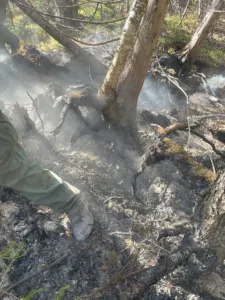
Mopping up, as firefighters call it, is the process of identifying locations where pockets of smoldering material exist, then managing those areas accordingly. Commonly referred to as hot spots, duffers or smokes, these locations of remaining fire activity are tracked down by crews, an activity often called "cold trailing."
Firefighters then open up the concerning spots to surface weather conditions, then douse the embers with water.
Water is delivered to crews many ways, including engines or utility terrain vehicles - when access is available - or by a network of pumps and hoses for firefighters on foot. On the Black River Fire alone, nearly 2 miles of hose spread like tree branches to provide water access, the DNR said.
To maximize the effectiveness of on-the-ground firefighters, DNR pilots have used drone-mounted infrared cameras to determine the precise locations of strong heat signatures, where temperatures are significantly higher than ambient air temperatures. Less than three hours from drone liftoff, firefighters receive specific GPS coordinates and the size and density of lingering fire behavior.
On the Rugged Terrain Complex, addressing residual heat locations adjacent to containment lines is the priority, with work then progressing toward the interior of the burned area. This increases the effective width of areas which block fire from spreading. The increased effectiveness leads to reduced risk of a restart. These final cleanup steps will be ongoing for weeks to come.
"There is still quite a bit of work to do, but the volatility of these fires is under control," said Keith Murphy, DNR fire specialist. "Realistically, portions of these fires will not be truly extinguished until there is sufficient snow cover. Until then, we will keep many watchful eyes on each of them."
The DNR provided these fire statistics and closure details:
-- Ridge Fire in Marquette County: 466 acres, 50% contained. The Noquemanon Trail system west of the trailhead on County Road 510 remains closed.
-- Craig Lake Fire in Baraga and Marquette counties: 606 acres, 90% contained. Craig Lake State Park north of Craig Lake, the Teddy Lake Yurt and the North Country Trail within the park all are currently closed.
-- Black River Fire in Gogebic County: 326 acres, 70% contained.
-- Rugged Terrain Complex fire response: 27 firefighters active Tuesday.