
Wisconsin launches grant programs to address PFAS contamination
Trending
Gov. Tony Evers and state environmental regulators announced the launch of new grant programs Tuesday to help communities and private well owners address PFAS contamination.
The Wisconsin Department of Natural Resources is now accepting applications for about $80 million that's available for local and tribal governments to sample for the so-called forever chemicals in private wells and public water supplies. The agency is also offering $10 million in grants to private well owners for PFAS sampling.
The programs are part of bills passed and signed into law earlier this year that set the framework for spending $125 million set aside in a PFAS trust fund. With interest, the fund had accrued about $134 million by the end of June, most of which is devoted to PFAS grant programs and operations.
"This is an exciting day that has been a long time coming, and these programs will have lasting impact on communities and private well owners across the state," Evers said in a news release.
PFAS, short for per-and polyfluoroalkyl substances, are a group of thousands of synthetic chemicals that have been found in everyday products. The chemicals have been linked to serious health risks that include fertility issues, thyroid disease, kidney and testicular cancers. They don't break down easily in the environment.
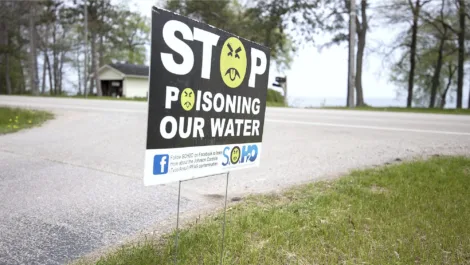
Among the communities dealing with PFAS contamination are the city of Marinette and town of Peshtigo in Marinette County, from a fire training facility.
Local and tribal governments, sewerage and lake protection districts are among those eligible for funds under the PFAS Community Grants Sampling Program. Steve Elmore, director of the DNR's Drinking Water and Groundwater Program, said they can test for the chemicals in private water supplies at homes.
"This will allow private well owners to have a better understanding of the PFAS levels in their well and what they're drinking," Elmore said.
Funds will also support sampling water systems at schools and childcare centers that are not already required to conduct testing. In the first round, the DNR estimates funding will support sampling of wells at more than 1,200 homes, child care facilities and schools.
Lee Donahue, a trustee for the village of French Island, said the grants are great resources for communities. The village, formerly the town of Campbell, has been dealing with PFAS contamination that stems from the La Crosse Regional Airport. Sampling has already been conducted on more than 500 private wells, nearly a third of which have levels concerning to state health officials.
"The goal is to equip municipalities with this additional financial resource to look at how safe their water may be, and what they may need to do in the future," Donahue said.
The DNR is offering grants of $1 million for drinking water sampling and $500,000 for actions to reduce PFAS exposure that may include providing bottled water. The agency is also offering $500,000 to sample wastewater, sewage sludge and liquid waste at treatment plants. Recipients are required to provide 20 percent in matching funds.
Vanessa Wishart is a partner at Stafford Rosenbaum in Madison who represents the Municipal Environmental Group's Wastewater Division. Wishart said sampling is often costly for wastewater operations that want to ensure utility spending doesn't lead to higher costs for ratepayers.
Some want to do more system-wide sampling to identify whether PFAS coming into their facilities is tied to industrial users, legacy contamination or soil and groundwater that's infiltrating their systems.
"That's one area where I see utilities really being able to put these funds to good use to engage in source reduction efforts upstream, which enables them to lower PFAS in both effluent and biosolids," Wishart said.
The DNR will also provide assistance to private well owners who are unable to sample wells through community grants under the Wisconsin PFAS Private Well Testing Program.
Those eligible can get a home sampling kit at no cost, and the private well owners will collect samples from their faucet for analysis. Sen. Eric Wimberger, R-Gillett, authored bills to address PFAS contamination that were passed this year.
"The people of Wisconsin deserve access to clean drinking water, and these programs will help communities test for and identify toxic pollutants in their wells and public water systems for remediation and removal," Wimberger said in a statement.
Those who find contamination in private wells can also apply for $35 million that was included in the legislation for replacing, rebuilding and treating wells under an expanded Well Compensation Grant Program.
"We wanted these programs to efficiently support municipalities pursuing funding," DNR Secretary Karen Hyun said in a statement.
Applications for community grants will be accepted now through April 30.
The DNR is also working to launch additional grant programs for sampling public airports, irrigation wells, farm fields and landfill leachate or liquids for PFAS. The agency anticipates rolling out those programs next year.