
Giving ‘children a voice’
Center advocates for victims of neglect, abuse
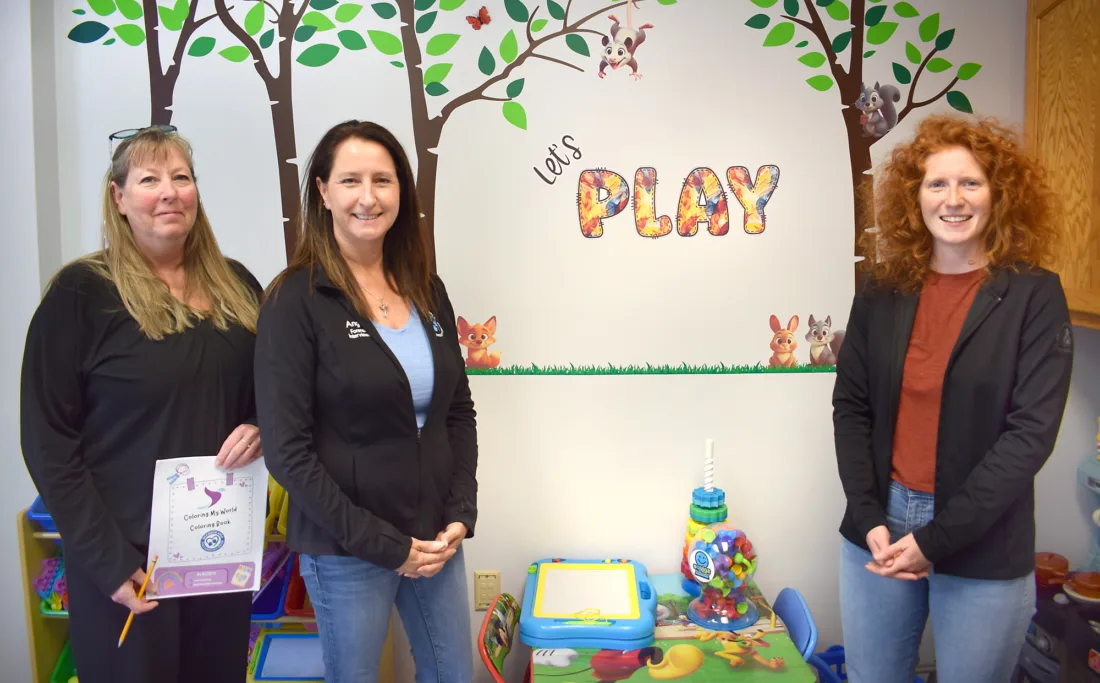
The Dickinson Area Child Advocacy Center, or DACAC, provides a safe, neutral and child-friendly environment where children and their non-offending caregivers receive coordinated support after allegations of sexual abuse, physical abuse and neglect. DADAC team members in the children’s room, from left, are Earlene Rex, child and family advocate; Angela Moreau, coordinator and forensic interviewer; and Molly Wahoviak, multidisciplinary team coordinator, forensic interviewer and advocate. (Terri Castelaz/Daily News photo)
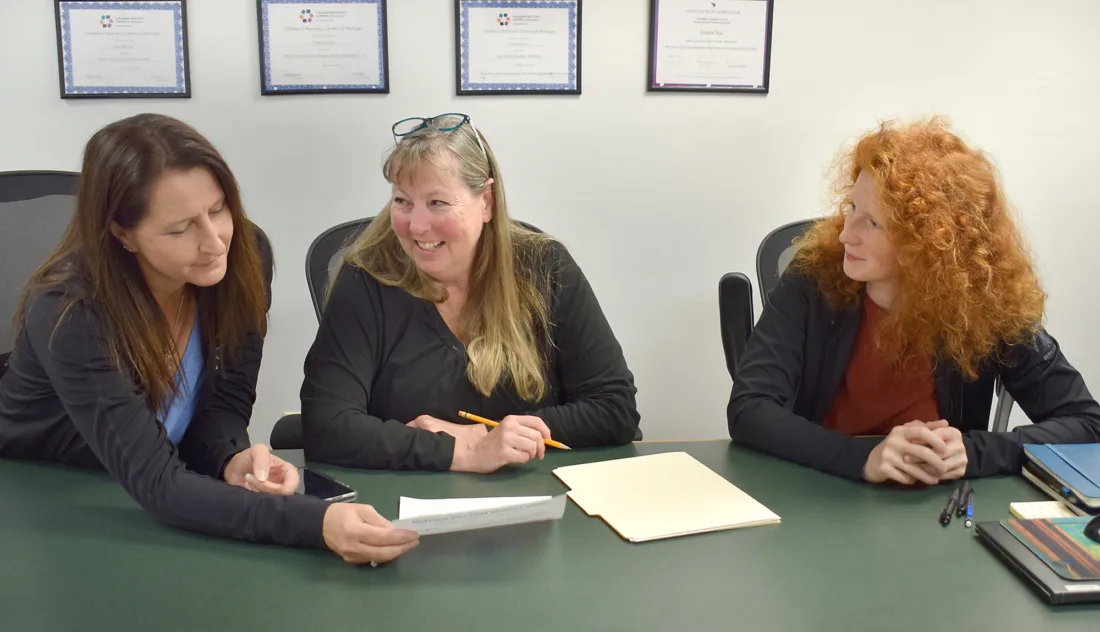
Dickinson Area Child Advocacy Center team members — from left are Angela Moreau, coordinator and forensic interviewer; Earlene Rex, child and family advocate; and Molly Wahoviak, multidisciplinary team coordinator, forensic interviewer, and advocate — discuss upcoming future training. With future financial cuts, the CAC welcomes all donations to ensure the center is able to continue with all its services in 2027. (Terri Castelaz/Daily News photo)
The Dickinson Area Child Advocacy Center, or DACAC, provides a safe, neutral and child-friendly environment where children and their non-offending caregivers receive coordinated support after allegations of sexual abuse, physical abuse and neglect. DADAC team members in the children’s room, from left, are Earlene Rex, child and family advocate; Angela Moreau, coordinator and forensic interviewer; and Molly Wahoviak, multidisciplinary team coordinator, forensic interviewer and advocate. (Terri Castelaz/Daily News photo)
Dickinson Area Child Advocacy Center team members — from left are Angela Moreau, coordinator and forensic interviewer; Earlene Rex, child and family advocate; and Molly Wahoviak, multidisciplinary team coordinator, forensic interviewer, and advocate — discuss upcoming future training. With future financial cuts, the CAC welcomes all donations to ensure the center is able to continue with all its services in 2027. (Terri Castelaz/Daily News photo)
Trending
IRON MOUNTAIN -- For a child who has experienced abuse, telling someone what happened can be frightening. Having to repeat that experience to several different people can make an already difficult situation even more traumatic.
At the Dickinson Area Child Advocacy Center, the goal is to make sure children don't have to navigate that experience alone. The DACAC provides a safe, neutral and child-friendly environment where children and their non-offending caregivers receive coordinated support after allegations of sexual abuse, physical abuse or neglect. But its work goes beyond the initial interview or investigation.
The mission is to reduce additional trauma, help families find stability and connect children and caregivers with the services and resources they need to begin moving forward.
Through a coordinated community response, the center brings together specially trained professionals who work in the child's best interest, providing compassionate, developmentally appropriate and trauma-informed support throughout the process.
"We are that safe space that gives children a voice," said DACAC Coordinator and Forensic Interviewer Angela Moreau.
Working together to carry out that mission are Moreau, coordinator and forensic interviewer; Molly Wahoviak, multidisciplinary team coordinator, forensic interviewer and advocate; and Earlene Rex, child and family advocate.
Each brings a different background and area of expertise. Moreau joined the DACAC in June 2024 after retiring as chief of police for the City of Niagara after 30 years of service. Wahoviak joined the center in July 2024, transitioning from her previous position at Caring House, while Rex also came from Caring House in July.
The three-person team works together through every stage of the process, from coordinating referrals and conducting forensic interviews to supporting caregivers and connecting families with additional resources.
Located in the Marshfield Medical Center-Dickinson Medical Building since June 2025, the center serves children and their non-offending caregivers in Dickinson and Iron counties in Michigan, as well as Florence County and the city of Niagara in Wisconsin.
For a child arriving at the center, the experience begins with a private entrance. Inside, the surroundings are intentionally designed to be welcoming and less intimidating than a traditional law enforcement setting.
A child will meet one-on-one with a specially trained forensic interviewer, while members of the multidisciplinary team observe from another room, allowing everyone involved to hear the information without requiring the child to tell the story repeatedly.
"The forensic interview is child-led, giving children the opportunity to share their experiences in their own words, at their own pace, through a neutral, developmentally appropriate, non-leading process that promotes safety, trust, and the accurate collection of information," Moreau said.
The setting is only one part of the center's approach. Equally important is the coordinated response that takes place behind the scenes. The Multidisciplinary Team brings together law enforcement, prosecutor's office, Child Protective Services, medical providers, mental health professionals and victim advocates.
"We have such great support from our MDT," Moreau said.
"The Dickinson Area Child Advocacy Center is one of the most important tools we have when a child may have been abused," Dickinson County Sheriff Aaron Rochon said. "How we respond in those first hours and days matters, both for the child's healing and for the integrity of the investigation."
Rochon also noted having these services available locally makes a real difference.
"Families don't have to travel long distances during one of the hardest times of their lives, and our investigators can coordinate quickly with our partners," he added. "Our job is to find the truth and hold offenders accountable."
The referral process begins with an allegation of abuse reported through one of three sources: Child Protective Services, law enforcement or a prosecutor's office.
The timing of an interview depends on the circumstances of each case.
Moreau explained that some situations require an interview as soon as possible because of safety concerns, while others require coordination with medical examinations or the collection and processing of evidence.
She said the center has averaged about 150 cases a year.
Most of the children interviewed are between the ages of 3 and 17. However, the center has also worked with adults with special needs and an individual who had recently turned 18 and needed a follow-up interview regarding abuse experienced as a child.
The multidisciplinary team meets monthly for case reviews and leadership discussions. These meetings allow the professionals involved to share information, coordinate services and follow the progress of cases.
"By bringing all of our partner agencies to the table we ensure that every child receives the support, protection and resources they need," Moreau said. "Our case review process ensures that all of our partners are working together so that no child or family falls through the cracks."
Michigan State Police Victim Advocate Karla Lehmann said the multidisciplinary partnership is essential to ensuring the center operates effectively and follows established standards.
"When best practices are followed and families are supported, we have better court outcomes," she said.
Lehmann said following those practices and providing support to families can also help ensure offenders are held accountable through the criminal justice system.
The center also works closely with pediatrician Dr. Alexis Whaley, whose office is upstairs in the same medical building.
Whaley said the process of navigating child protective services and legal evaluations can place considerable stress on children and their families. She added the DACAC and Delta Regional CAC work to ease that burden.
The cooperation among the center, medical providers and other community partners has made a difference in protecting children, she adds
"Without a doubt, children in our community are safer as a result of the diligent work of the Child Advocacy Center," Whaley said. "Having a local CAC has been an invaluable asset to child safety, health, and healing in our community."
The support doesn't end when the interview is completed. Family advocates help non-offending caregivers understand the process, provide crisis intervention, make referrals and connect families with services that may include mental health care.
Some cases close within a month, while others remain open for much longer depending on the investigation and court proceedings.
"Once that case closes at the CAC, we do a soft handoff to community-based advocates if they want to continue with advocacy and services after that point," Moreau said.
"We make sure they connect with all the resources they need," Rex added.
At the request of a family or prosecutor's office, advocacy can extend into the courtroom as well. Advocates may meet with victims and help them understand and prepare for the trial process.
"Our wraparound services ensure children and families receive support, advocacy and resources every step of the way," Moreau said.
Dickinson County Prosecuting Attorney Abbey Anderson said working with the CAC, they coordinate investigations to help ensure better evidence collection, to provide support to victims and their families and to prevent re-traumatization of child victims.
Anderson said the prosecutor's office and the MDT team appreciate the invaluable work of the center's staff and their commitment to children and families throughout the region.
Providing these services requires specialized knowledge and continued professional training. The center's forensic interviewers receive training through Michigan's Governor's Task Force on Child Abuse and Neglect, in partnership with the Michigan Department of Health and Human Services. They also follow Wisconsin's forensic interviewing protocol, known as Wisconsin Forensic Interviewing Guidelines, or WIFIG.
Wahoviak explained that forensic interviewers participate in peer reviews at least twice a year with other interviewers from the Upper Peninsula and Wisconsin.
The center's family advocates also receive ongoing training that meets National Children's Alliance standards for victim advocacy. This helps ensure children and their non-offending caregivers receive consistent support, guidance, referrals and assistance throughout the investigative process.
The specialized training and coordinated approach have become an important part of the center's development since it was established in 2019 through a Michigan Victims of Crime Act -- VOCA -- grant under the umbrella of the Caring House.
Initially known as the Caring House Child Advocacy Center, the program began with one advocate and one forensic interviewer. Lehmann, who served as coordinator, advocate and forensic interviewer, was instrumental in developing the program and building its multidisciplinary team.
Wahoviak said Lehmann continued to play an important role as the center rebuilt and established itself as the Dickinson Area Child Advocacy Center.
In 2024, the center rebranded and expanded staffing to include two forensic interviewers and a child and family advocate. The decision to have three team members with cross-training was intentional, Moreau explained. It allows the center to maintain coverage and provide a consistent response even when one staff member is unavailable.
The expanded team has also allowed the center to look beyond its daily caseload and increase its involvement in the community.
Staff members provide training to law enforcement, the Department of Health and Human Services and prosecutors' offices. They also speak to community organizations and groups about the center's services and the importance of protecting children.
Looking ahead, they hope to expand outreach into schools, reaching students and parent groups with information about prevention and ways families can recognize and address potential dangers.
Moreau said the DACAC is currently in the process of applying for accreditation through the National Children's Alliance, a certification process that verifies a CAC is meeting established best-practice standards for serving children who have experienced abuse, neglect or witnessed violence.
For Moreau, awareness and prevention are important parts of protecting children. She encourages schools, organizations and community groups interested in having the DACAC present a program to contact the center.
While the DACAC has developed its services and partnerships since opening, maintaining those services has become a growing concern. All services are provided free to children and families through VOCA grant funding. However, Moreau said the center anticipates an 18.5% reduction in federal funding in 2027.
The center operates under the umbrella of the Caring House and benefits from the organization's longstanding community presence and infrastructure, but it maintains separate program funding, grant awards, budgets, reporting requirements and service objectives. Donations or grants given to Caring House do not automatically support DACAC services unless they are specifically designated.
Continued community investment is important to maintaining the personnel, facilities, technology and secure case management systems needed to provide services in a safe, child-friendly environment. All contributions ensure the center can continue its work.
Moreau acknowledged the support from CSA Air and anonymous donors that allowed staff to attend a training session downstate.
"Through that training we were able to network with several different organizations, as well as different technology experts to learn about advancements and get what's new," she said. "We are very appreciative."
Those interested in learning more about the DACAC or making a donation can go to dickinsonareacac.org and select the donate button. The center also accepts toys for children of different ages, as well as gift cards for teenagers.
The importance of the community's continued involvement is something the center's partners emphasized as well.
Lehmann said she is proud of the work the center and its partners have accomplished, noting a successful child advocacy center depends on the commitment of everyone involved.
"In order for a child advocacy center to succeed and have legitimacy, you must have buy-in from the multidisciplinary team partners," she said. "All of our MDT partners work very hard and are committed to everything that goes into making it successful. The entire multidisciplinary team should be very proud of what they have built for this community."
Iron Mountain Director of Police and Fire Services Jeffery Solka also recognized the center's importance to local law enforcement, saying the department has relied on its expertise and assistance in investigations involving children.
"The Dickinson Area Child Advocacy Center provides a safe and supportive environment for children and families involved in investigations of suspected abuse," Solka said. "This allows their stories to be heard, which plays a critical role in supporting law enforcement investigations while keeping the safety and well-being of children a priority."
He said the IMPD remains committed to working with the DACAC and supporting its continued growth so the services remain available to children and families in the area.
"We are grateful to Angela, the CAC staff, our MDT partners, and the community members who support the center," Sheriff Rochon said.
For the three team members and its multidisciplinary partners, the mission is about more than conducting interviews or helping with investigations. It is about making sure children have someone to listen, families have someone to guide them and the community has a coordinated response when a child needs help.
———
Terri Castelaz can be reached at 906-774-2772, ext. 84241, or tcastelaz@ironmountaindailynews.com.