
Logging companies face growing costs, other challenges
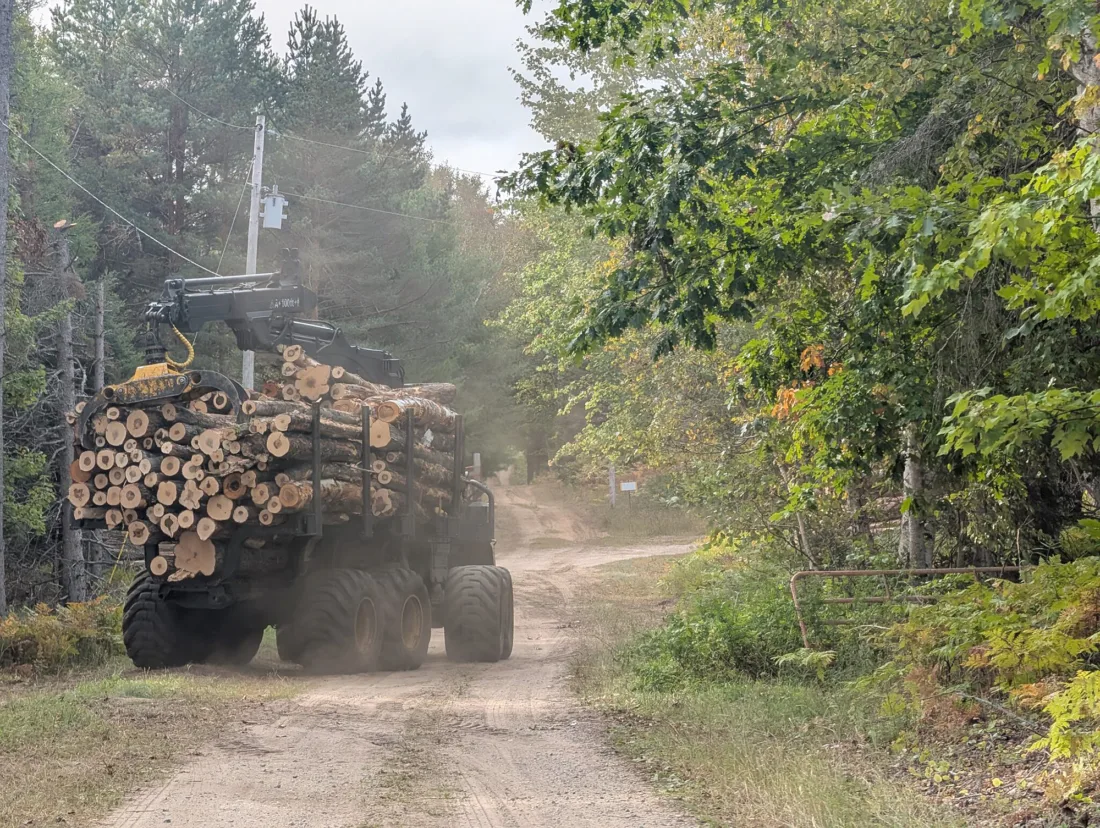
A forwarder carries harvested logs along a forest road near Pickford in the eastern Upper Peninsula. (Michigan Association of Timbermen photo)
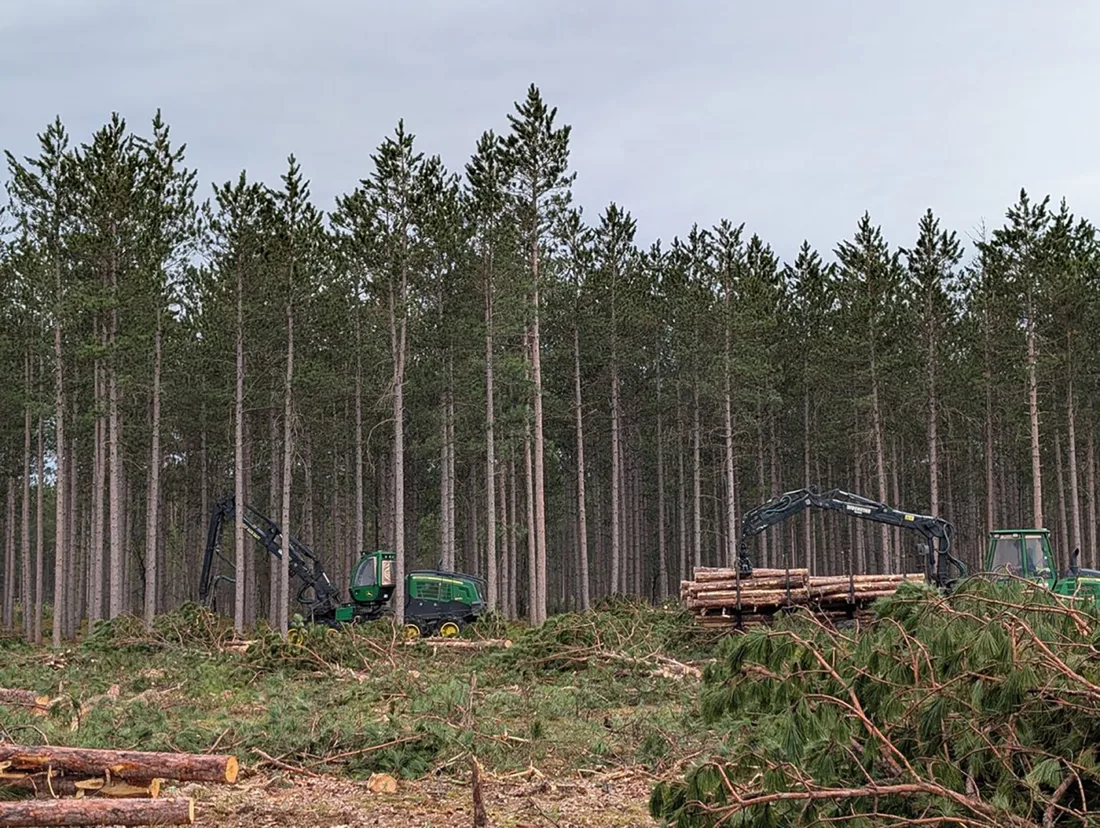
A harvester and forwarder work in a red pine forest north of Cadillac. (Michigan Association of Timbermen photo)
A forwarder carries harvested logs along a forest road near Pickford in the eastern Upper Peninsula. (Michigan Association of Timbermen photo)
A harvester and forwarder work in a red pine forest north of Cadillac. (Michigan Association of Timbermen photo)
Trending
LANSING -- Michigan's logging sector creates thousands of employment opportunities and generates hundreds of millions of dollars, but growing costs and shrinking markets have been stressing companies that supply timber for the state's forest products industries, according to the latest study from Michigan State University.
The study, published in the Forest Products Journal, found Michigan's logging industry directly supported 3,543 jobs in 2023, generating $144 million in labor income and $173 million in economic output.
According to Shivan Gc, an assistant professor of forest economics and environmental policy at MSU and a co-author of the study, the economic impacts of logging go well beyond those who work in the forest.
"One of the most important findings of our study as it relates to Michigan's logging industry is that it plays a much larger economic role than its direct employment numbers might suggest," Gc said.
The industry also supports businesses providing transportation, equipment maintenance and other services while supplying timber to sawmills, pulp and paper mills and other wood processors.
Researchers developed models demonstrating what would happen if there were a reduction of 20% of logging firms in Michigan. According to the models, there would be a job loss of 1,184 employees annually, reduced labor income of $51 million per year and lost economic output of $82 million per year.
Gc reiterated that the models were not predictions of closures, but just scenarios.
"If local logging capacity becomes insufficient, mills may have to obtain more wood from other states or Canada, potentially increasing transportation costs and reducing their competitiveness," Gc said.
For businesses already struggling to keep up with expenses, those pressures are not just theoretical.
According to Joe Doyle, the president of Doyle Forest Products in Osceola County, the outlook for the industry has become increasingly tough. Doyle, a second-generation logger who has been in the business for 40 years, said his family's business was founded in 1957.
"As for the current state of business, it is dismal at best," Doyle said.
Loggers face rising costs for fuel, equipment, insurance, supplies and labor, while the prices mills pay for timber have not kept pace, he said.
"Our income is controlled by what the mills will pay, not what we actually need to stay profitable," Doyle said.
Doyle estimated that the rising cost of fuel alone for his company has been adding up to $4,000 per week since April compared to the same time last year. He said that although mills provide fuel incentives, they still do not fully compensate for the higher expenditure.
Difficulties are not associated only with operational expenses. Doyle said the market for high-quality wood used in furniture, flooring and cabinets has weakened.
"Consumers today are not buying solid oak floors, oak or maple cabinets - they are buying laminated materials from overseas," Doyle said.
He said he believes there is opportunity with new wood products such as mass timber structures and other applications of low-grade wood. But market changes have made it hard for logging companies to be profitable.
Justin Knepper, the executive director of the Michigan Association of Timbermen based in Newberry, also noted that logging companies in the state are facing similar challenges due to market changes.
"Many businesses are working hard just to maintain their current operations, with increasingly tight margins and rising operating costs," Knepper said.
According to Knepper, equipment parts have grown particularly costly, with some far more expensive compared to a few years back.
In addition, he cited closure of businesses, logging firms idling their machines or even engaging in other businesses like gravel and dirt work as indicators of problems facing the industry.
The situation is particularly tough in some regions in the northern Lower Peninsula and the Upper Peninsula, where there are fewer mills and greater distances between markets, according to Knepper.
"The Upper Peninsula, especially the Eastern U.P. and then the rest of the U.P. as well, has been hit especially hard," Knepper said.
The MSU study found Michigan had a lower share of locally supplied timber than neighboring states. About 51.5% of Michigan's demand for logs and roundwood was supplied locally in 2023, compared with about 78.7% in Wisconsin and 87.6% in Minnesota.
Researchers also modeled a scenario in which Michigan relied less on locally harvested timber and more on imports. Even if wood-processing industries maintained production, the shift would reduce economic activity retained in the state, the study said
According to Knepper, tariffs on imported Canadian wood have had certain advantages for Michigan firms that use locally produced timber. However, transportation costs might make imported timber more economically viable for firms located near the border.
"We need to see domestic markets demand more lumber before there is a big difference," Knepper said.
Doyle said tariffs have not necessarily eased the pressure on logging businesses, which are also affected by the rising costs of imported supplies and equipment.
"Tariffs on Canadian wood are always welcome, but I think the tariffs in general have hurt us more than they have helped," Doyle said.
According to the study's authors, logging businesses play a role in forest management by providing workers and equipment needed to harvest timber, thin forests, support regeneration and remove dead or damaged trees.
According to Gc, the state's forest resource alone cannot sustain Michigan's forest products economy without the businesses and labor force required to harvest and process timber.
"If we lose too much logging capacity today, we may find it increasingly difficult to support forest management and forest-based economic development in the future, even when timber resources and market opportunities are available," Gc said.
The U.S. Forest Service has also faced staffing challenges in managing timber sales. A June report from the Government Accountability Office found workforce reductions and staffing limitations had strained the agency's capacity to prepare and manage timber sales.
Doyle and Knepper both described rising operating costs and weak markets as challenges facing Michigan's logging businesses, with some companies struggling to maintain their operations.
Knepper also pointed to changes in state timber-sale policies that could help logging companies, including adjustments to pricing, minimum bids and contract extensions, as well as easing certain seasonal hauling restrictions.
—
This story was provided by Capital News Service at Michigan State University.