
Report: Prized winter birds could be fewer in number
Northwoods notebook
Trending
The annual Winter Finch Forecast sounds like most of the region will see fewer of the favorite species in yard trees or feeders this coming season.
The Ontario, Canada-based Finch Research Network each fall releases its report on potential winter bird movement based on what food conditions are like in the north or east. Forecast author Tyler Hoar this year predicts while the birds might be on the move, they'll find ample to feed on naturally and so might not flock to feeders.
The 2026-27 forecast states, "The overall poor seed crops in a vast area of the central boreal will likely cause finches to move into Eastern Canada, the Great Lakes region and northeastern United States, but birds will likely be in the woods more than at feeders due to plentiful seed resources in the northeastern conifer forests. We do not expect any big irruptions of any of the finches in the southeastern states this year."
The forecast, as always, stresses it applies mainly to Ontario and adjacent Canadian provinces and U.S. states. Much of the Upper Peninsula and northern Wisconsin are farther west than the normal region covered in the report.
But it still can be a good indicator of which birds might wander through here during the course of the winter.
The annual report covers not just finches -- such as purple finches, pine and evening grosbeaks, red and white-winged crossbills, redpolls and pine siskins -- but also blue jays, red-breasted nuthatches and Bohemian waxwings that can be "irruptive" in the colder months.
The forecast's outlook for each noteworthy winter species:
-- Pine grosbeaks: These impressive large finches, the adult males colored like raspberry sherbet, were an early treat last year in this area, showing up in numbers and feeding on crabapples. This year, Hoar states in the report, "We do not expect much of a Pine Grosbeak flight … There appears to be a pretty robust American mountain-ash fruit crop across much of the boreal regions that will hold birds to the north."
Individuals that might reach the region will look for mountain ash berries and small ornamental crabapples, even in urban areas, the report notes. In Iron Mountain, in winters when present they seem particularly drawn to the crabapple trees on the south side of the causeway over the Chapin Pit. At feeders, they prefer black oil sunflower seeds.
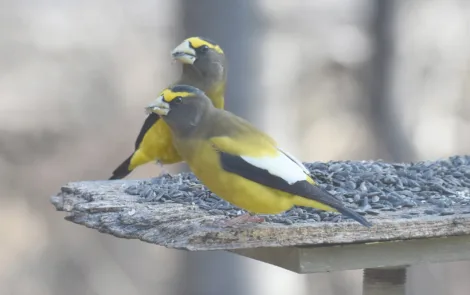
-- Evening grosbeaks: Hoar notes this species -- the males perhaps the most showy of the winter birds, with deep yellow and black -- has been tough to forecast, writing, "We predicted a moderate irruption in 2024-25, and a small one materialized. Last year we predicted a small irruption, and a moderately-sized one occurred." But a decade-long spruce budworm outbreak in the eastern boreal forest has boosted nesting success, so numbers appear to be up, he said. He predicts small to medium flocks for the Great Lakes region.
At platform feeders, evening grosbeaks prefer black oil sunflower seeds.
-- Purple finches: The prediction for this colorful bird for now is a movement into eastern Canada, the Great Lakes and northeastern United States, which have abundant spruce, white pine and mountain ash crops. The prospects for elsewhere are perhaps a small flight later in the season when other areas food sources have been depleted. At feeders, purple finches prefer black oil sunflower seeds.
-- Redpolls: Like the evening grosbeaks, these sparrow-like birds with touches of red on forehead and breast have become difficult to predict, according to the report. Birch seed crops to the north have been good, so most redpolls will remain in Canada. But there was this hopeful note: "Maybe the western Great Lakes and perhaps northeastern border areas will get a small to modest irruption." Watch for redpolls on birches, in weedy fields and at bird feeders offering nyjer and black oil sunflower seeds, the forecast states.
-- Pine siskin: "Again, this will be a year where several finches like Pine Siskins, the two crossbill species, and even Purple Finches will be found in the forests more than at feeders. So to find them one will have to venture out into the forested areas where the food is to find them."
Pine siskins' main difference from winter goldfinches is they have a streaked breast. But this species, like goldfinches, prefers nyjer seeds in silo or sock feeders.
-- Crossbills: While included here, it's worth noting that crossbills don't normally visit feeders, though several residents in the region have noticed them in their yards in the past. They prefer to feed on conifer cones, which their unique bill is designed to open to get at the seeds inside. The forecast notes that Whitefish Point in the Upper Peninsula's Chippewa County already has reported larger than normal numbers of highly nomadic red crossbills since August, a movement from the west. These likely will be the Type 2 variety, though the various crossbill types are almost impossible to identify without recording their flight calls.
White-winged crossbills likely will be in the far west and the far east, with scattered flocks in the Great Lakes, according to the forecast.
-- Other species: Though not finches, several other birds make similar irruptive movements in some winters, so the forecast regularly includes them as well. Two of them, however, tend to be year-round U.P. residents so don't seem so special when they show up at the feeders.
Perhaps the most prized of the non-finch winter visitors are the Bohemian waxwings. Larger than cedar waxwings and having a rusty rather than yellow patch on the underside of their tail, Bohemian waxwings are fruit eaters so will travel to where they can find decent amounts of berries or ornamental crabapples. But a "robust" mountain ash fruit crop in the boreal forest should hold most of them there, the forecast states.
Red-breasted nuthatches -- the tiny, woodpecker-like birds with the delightful nasal horn "toot" calls -- are not uncommon here no matter what the season. They reached the southeastern United States last year but are not expected to have a flight like that this year with good cone crops in the northeast.
On blue jays, Hoar wrote, "With the poorer crops west of Lake Superior, there should be an above-average flight of Blue Jays southward along the western edge of this forecast." Again, blue jays have never been in short supply each winter at our feeder, especially when I break out the peanuts in the shell.
To read the Winter Finch Forecast 2026-2027 in full, go online to https://finchnetwork.org/winter-finch-forecast-2026-2027.
Betsy Bloom can be reached at 906-774-2772, ext. 85240, or bbloom@ironmountaindailynews.com.