
Harold William Johnson
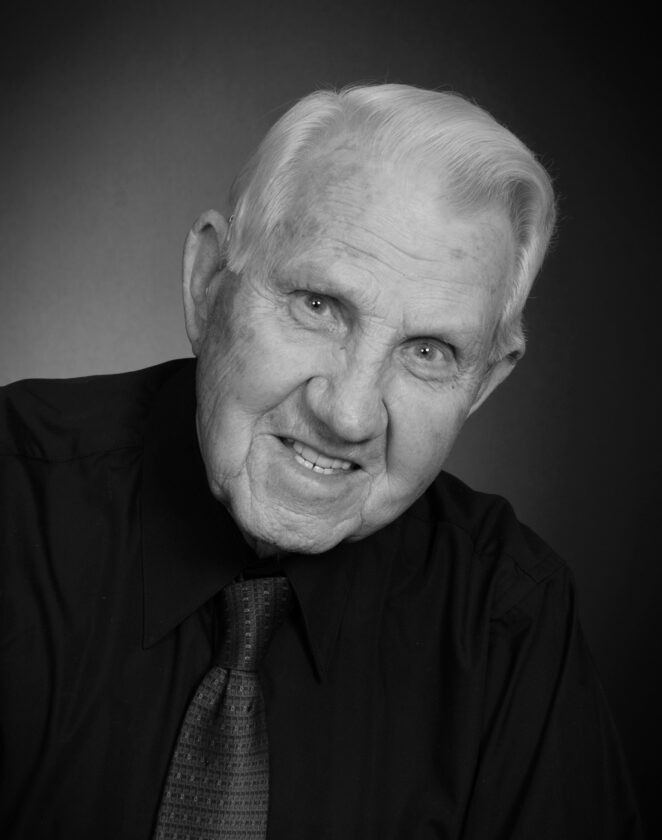
Harold William Johnson
ESCANABA — After an extraordinarily long and full life, former Escanaba coach, athletic director, and assistant principal Harold William Johnson passed away in Escanaba on Sept. 1 at the age of 99.
Harold was born in Felch, the eighth and final child of Swedish immigrants. At the age of 3 years he lost his mother to tuberculosis, so the task of raising him fell to his eldest sister, Evangeline, who was forced to drop out of school. With four older sisters doting on him and three older brothers teaching him to fight and play sports, he grew up strong and self-confident in the hills and forests and fields surrounding the Johnson family home, skiing and ski-jumping on home-made skis, hunting when food was needed, running traplines to make a few bucks from furs, and most of all, playing baseball and basketball every chance he could. And when he wasn’t outside he was, for as long as he could remember, sketching with pencil and paper, drawing ballplayers and soldiers and scenes from Felch, for he hoped someday to become a professional artist. In eighth grade his design was chosen for the Felch High School logo. When he was 14 his father died and sports became his escape and obsession. He joined the Felch town baseball team and starred on a high school basketball team that was the best Felch had ever seen. After graduating at age 16 he moved to Chicago where two of his sisters lived, found employment at a factory, and enrolled in a professional artist program at the Chicago Art Institute. But the year was 1941 and world events would soon interrupt his plans.
When the war came along Harold enlisted in the U.S. Army, his exceptionally keen vision and years of hunting experience leading to assignment as a machine gunner and chief of a 4-man anti-aircraft crew. He sat in a rotating turret with four 50 caliber machine guns, mounted on the back of a flatbed truck, and fought his way across France, Belgium, and Germany, all the way to Berlin. Years later his hearing would be diagnosed as a total loss.
After the war, Harold returned to Felch, worked cutting pulp, and re-joined the Felch town baseball team (where he played until his mid-40s). When opportunity knocked in the form of the G.I. Bill he enrolled at Michigan State University, though not as an art major, for the war had changed him. Now he wanted something more vigorous that allowed him to compete and take advantage of his other God-given talent: athletics. He wanted to become a coach.
That same year another life-changing event occurred. At his cousin’s home in Iron Mountain, he met Nina Peterson, destined to become his bride and true love for 75 wonderful years. They were married the following year, Sept. 13, 1947, at First Lutheran Church in Iron Mountain, then together caught a train around Lake Michigan to begin Harold’s second year at MSU. While Harold attended classes and played on the State baseball team, hard-working Nina earned their living expenses as a bookkeeper. Harold turned down an offer to play baseball professionally, opting instead for a stable family life with Nina.
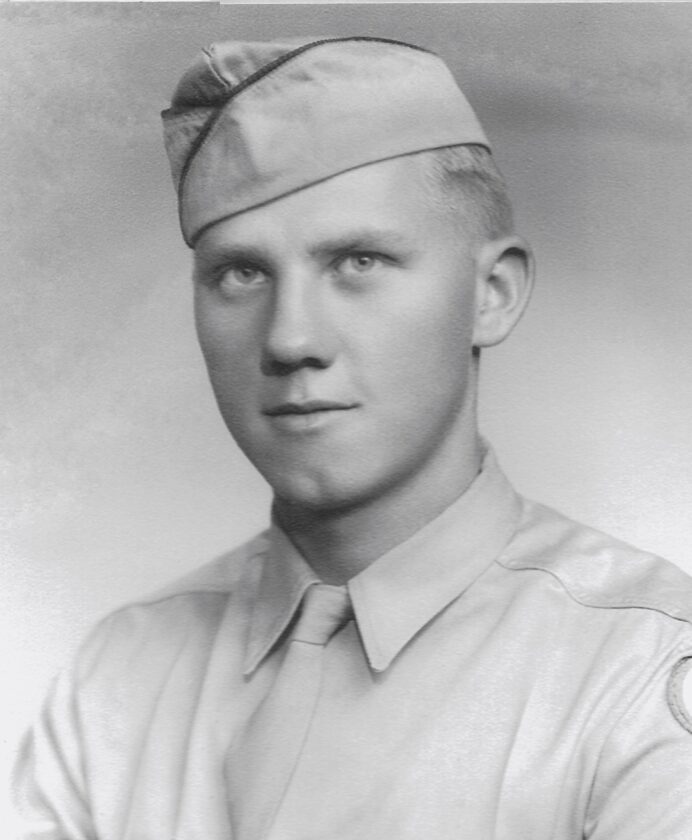
Harold William Johnson
Following Harold’s graduation, the young couple moved back to Felch where Harold had been hired as a teacher and basketball and baseball coach. From scrap lumber they built a small, one-room home. Nina worked in the office at the Felch school and prepared meals for teachers until their first child, Jay, was born in 1951. The basketball team Harold coached won the district championship, the only Felch team to do so besides the one he’d played on. To broaden his coaching experience, Harold and family took a year and a half sojourn to the downstate town of Lake Odessa, where their second child, Terri, was born in 1955. This added experience was just what John Lemmer, superintendent of Escanaba Area Public Schools, was looking for. He hired Harold and the young family moved to the “big city” of Escanaba.
At Escanaba High School, Harold taught gym classes and coached baseball, basketball, football, and track. In the summers, he worked on a Master’s Degree in school administration at Michigan State and Northern Michigan. Eventually, he became athletic director and assistant principal and narrowed his coaching duties to just basketball. Following his final season of coaching, 1966-67, he was named U.P. Coach of the Year and in 1991 he was inducted into the U.P. Sports Hall of Fame. In 1986, after 38 years in education, Harold retired and began traveling around the country with Nina in their camper van. With Nina’s urging he took oil painting classes at Bay and found his artistic talent still intact, his teacher claiming he was the best student she’d ever had. In 1996 Harold and Nina were blessed with the birth of a grandson, Chase Parker. Harold loved children and often played with Chase, just as he had with his own kids. During their long years of retirement, they spent many winter months in Arizona and Florida, often socializing with other snowbirds from Escanaba. Summers found them at their Round Lake cottage named “Liten Skog Hem” (“Little Forest Home”) by Harold. He loved being in the woods and he especially loved being at this place that he’d built with his own hands. He also loved gardening and caring for his lawn, shrubs, and trees in Escanaba.
Harold was very active in the Escanaba community, serving as president of Kiwanis and the Bethany Lutheran Church Council and singing in the Bethany Choir. He was a member of the Swedish Club and American Legion and played in the men’s golf league at the Escanaba Country Club until age 95. Until his last days he was an avid follower of all sports, especially Esky High School teams.
Harold is survived by his two children, Jay Johnson and Terri Parker (Landon); and his grandson, Chase Parker; as well as many nieces, nephews, and their children.
Harold’s funeral will be held at Bethany Lutheran Church in Escanaba at 11 a.m. on Saturday, Oct. 7, with visitation at 10 a.m., and a luncheon to follow in the Fellowship Room below.
Donations may be made to the Harold and Nina Johnson Special Music Fund at Bethany Lutheran.
-
- Harold William Johnson
-
- Harold William Johnson