
The highest obligation and privilege
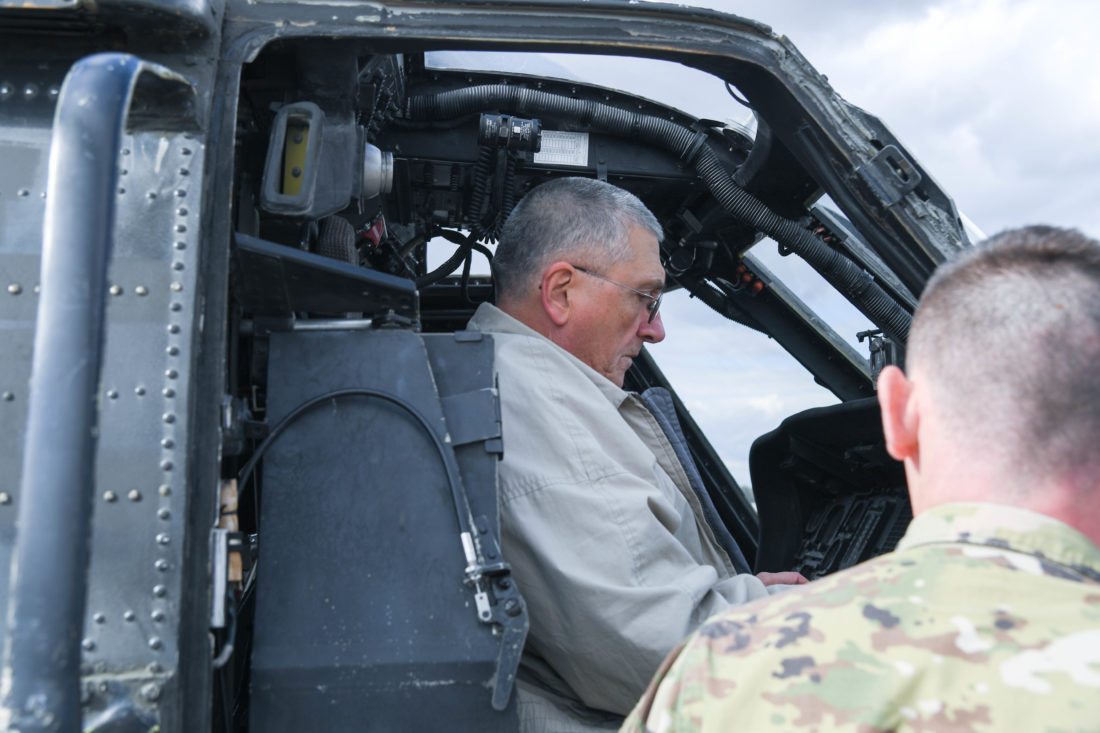
DANIEL PAUL, ACCOMPANIED by Spc. Catlin Cone at Fort Campbell, Kentucky, examines the controls of a Blackhawk helicopter.
“The soldier is the Army. No army is better than its soldiers. The soldier is also a citizen. In fact, the highest obligation and privilege of citizenship is that of bearing arms for one’s country.”
–George S. Patton, Jr.
The American soldier is quiet, resolute and extremely dedicated. When joining the Army, each one has voluntarily raised their right hand and taken the oath to protect and defend the United States of America.
They come from all walks of life, making the Army an incredibly diverse and open organization. They serve at numerous installations — sometimes very remote — throughout the world, working to fulfill their mission of constant readiness at a moment’s notice to respond to our country’s call. These soldiers are your neighbors, friends, relatives and acquaintances. These courageous men and women are the few.
Still, to this day, their years of service resonates far beyond their active duty service. For example, retired 1st Sgt. James Phillips was drafted right out of high school and was in Vietnam and then in Desert Storm during his 25 years of service. Today, he works at the gun range tower, still continuing to make a difference in the lives of soldiers. When asked about his service, he stated, “If I had a chance to do it all over again, I’d do it.”
The 101st Airborne Division Combat Aviation Brigade at Fort Campbell, Kentucky, rolled back their curtains and included me into a day in the life of our American soldier. The unique daily activities that I observed, coupled with the soldiers’ personal perspectives, afforded me the opportunity to have a small glimpse into what our soldiers do throughout the course of a day when not deployed.
The standard goal that ties everything together is “readiness at all times” for whenever our nation calls. As stated by Sgt. 1st Class Andrew McClure, “Readiness means ready for everything, whether it is physical training, the motor pool, the gun range, et cetera. Readiness means always prepared.” Staff Sgt. Clodfelter stated it was rewarding to see that everything the soldiers did in the state of readiness resulted in accomplishing their mission.
To be in a constant state of readiness, all of the soldiers have physical training, or PT, beginning at 6:30 a.m. outside, with the soldiers saluting the flag as the cannon sounds and reveille is played. Afterwards, the 1st Sergeant reviews with a number of assembled platoons of soldiers what their training will entail and to share additional information for the day.
The exercises begin with a selected individual from each platoon leading PT. This involves stretching, warm-ups, sit-ups, running, pull-ups, and weightlifting. Safety is explained to the soldiers and is paramount in everything they do.
The rationale for the strong emphasis on PT is readiness. The soldier’s body is strengthened and flexibility is increased, thus enabling them to successfully complete assigned tasks, along with reducing the chances of injury.
While attending PT, I participated in some of their exercises — on a small scale — such as weighted push-ups, medicine ball activities, along with the weighted bell. Along with that, I had the unique experience of donning the military gear that all soldiers are expected to carry. The gear was a 30- to 40-pound, fully loaded rucksack and a flak vest with protective plates that added another 15 pounds. For me, this was extremely heavy and difficult. Our soldiers must be in shape to be able to carry this gear — along with their rifle, pistol, ammunition and water — for miles through any terrain.
“Many of the exercises that our soldiers do coincide with the tasks that they are assigned,” Capt. Kristoffer Sibbaluca explained. “For example, mortar operators are expected to twist and turn as they fire their mortars. This activity parallels with some of the stretching exercises in the PT program.”
After PT, typically on Monday, or as it is called, “Motor Pool Monday”, the soldiers must meet for formation at the Motor Pool Staging Area. At that point, they receive instructions from the battalion commander, command sergeant major and/or the company commander, or 1st sergeant. After receiving instructions, the platoons then disband and go to their assigned tasks on vehicle maintenance, known as Prevention, Maintenance, Check and Services, or PMCS.
This vehicle screening and servicing ensures that all are in a state of readiness. Some of the maintenance checks are as follows: Fluid levels, brakes, belts, starters, batteries, lights and communication equipment. If extensive service is required, the vehicle is either transported into the garage or the mechanics will make the necessary repairs outside.
While this was occurring, I had the opportunity to speak to a few soldiers on their own unique perspective on the Army. Sgt. Maj. Eric Arnt, when asked about the greatest challenge, said it was “transforming civilians arriving at boot camp with different sets of values to shape into one set of values: The Seven Army Values.” The sergeant major and I discussed some of these values: integrity, loyalty and self-service; the rest are duty, honor, personal courage and respect. I might add, I witnessed these values on display throughout the day with every soldier I encountered.
First Sgt. John Nelson shared the same sentiment about Army values as Arnt, but he also said that when working with and teaching soldiers, he tries to incorporate their individual learning styles into his methods of teaching.
I had also spoken with 1st Lt. Julie Dillon, a Blackhawk helicopter pilot who has been assigned additional duties at the motor pool. She said that relying on others, as a team, to teach her about vehicles has increased her understanding and appreciation on how tirelessly soldiers work to keep all equipment in readiness condition.
Our soldiers have specific job titles, but they are soldiers first, which means that they are required to meet certain expectations such as PT and vehicle maintenance as well as weapons and marksmanship. As part of their readiness, soldiers are expected to disassemble, assemble, and clean weapons such as handguns and rifles, thus ensuring that they function properly at all times.
The practice of proficiency at discharging their weapons occurs at the gun range. The gun range that I attended was specifically designed for handguns, including the M-9. During this time, three soldiers were positioned on the firing line in full gear, including helmets, discharging their M-9s at designated targets located in their firing lane. The multiple targets were at various distances throughout the firing lane. All were hidden prone, behind berms.
The person in the control tower overseeing the range was in charge of the number of targets that would rise up at a moment’s notice. As the targets rose, the soldiers would discharge their weapons at them. The information on the accuracy of each soldier’s performance was conveyed to the control tower. The information then was compiled on how well each soldier did, thus providing the opportunity to the soldiers to assess how to improve their accuracy.
I met Sgt. Garver at this range. When asked about his personal success in the Army, he said that when he was a drill sergeant, he taught many of these skills to the new soldiers and that to see these skills come together upon deployment was extremely rewarding. This feeling was not only conveyed in his voice, but was very visible on his face as well.
Another portion of our soldiers’ day is spent at the Dining Facilities Administration Center, where they receive nutritious, wholesome food. Food and its preparation are crucial in the readiness process. By that, I mean that the food is nutritious, meeting all health standards, including the Army’s standards, and is extremely tasty. It is also designed for maximum energy, so that the body can metabolize it successfully to accomplish various mission-driven goals. The food choices are: chicken and beef prepared in different fashions, various kinds of wraps, rice, a variety of fresh vegetables and a large salad bar, finished off with desserts. While having a meal at the DFAC, I witnessed a plethora of smiling faces and jovial comments as the soldiers were dining or selecting their food.
The food is not only prepared hot on the base but also in the field or when deployed. As DFAC service director Warrant Officer Andrew Welch told me, every meal is a mission and after a long day in the field, a good, nutritious, tasty, hot meal lifts the morale of the soldiers.
Again, improving morale by providing a great meal adds to the readiness. In fact, the 101st Combat Aviation Brigade’s DFAC food service competed all year against fellow Army DFACs and won. They now advance to the finals against other branches. I call this the “Super Bowl” of field food preparation and service.
Spc. Richardo Hunter, who works in the DFAC, when asked about his duties, said with a proud smile that “It is not a job, but a career.” He also said that he enjoys working as a team, gaining leadership responsibilities and helping others.
As an aviation brigade, the flight line is an integral part of the overall mission purpose. It is an area where the rotary helicopters reside: the Chinook (CH-47), Blackhawk (UH-60 and UH-60M-Medical) and Apache (AH-64A). There are two airfields on Fort Campbell, and I was able to observe both Saber and Fort Campbell proper airfields. It was during my observation that I noticed continual readiness maintenance taking place on the helicopters in various sized teams, ranging from one to over eight soldiers. This maintenance occurred in and outside of the hangars.
While he was working on a Blackhawk helicopter, I met Spc. Catlin Cone. He talked not only about continually maintaining the helicopters, but about the ongoing training and refresher courses he takes that enhance his skills and knowledge of helicopters. He stated that he enjoyed working as a team and helping other soldiers.
When asked about his job, he said, “Think about what you enjoy and have a passion for the future.” Cone’s passion for what he was doing was very evident. He also provided me the opportunity of sitting in the cockpit of a Blackhawk helicopter. I was amazed at the hundreds of dials and levers. All of these have to function properly; otherwise, there could be serious ramifications.
As civilians, we observe the Army’s actions through different multimedia and digital sources. We witness snapshots of the military, their missions, and occasionally results of particular missions. But that is just the tip of the iceberg.
Behind the scenes in constant readiness are so many soldiers working as a team, and alongside support personnel, expending countless hours planning, training, inspecting, maintaining, repairing, and working hard to ensure that the mission is accomplished successfully. As Lt. Col. Yastrzemski precisely stated, “We have ordinary people doing extraordinary things.”
To conclude, I would like to extend my appreciation and gratitude to the Brigade and 6th Battalion Command Teams, Alia, Yastrzemski, and Sibbaluca for providing me the opportunity to witness “A Day in the Life of an American Soldier.” I am so humbled by what I experienced. It seemed as though I had known the soldiers for a long time. Their candidness has given me newfound respect and appreciation for all they have sacrificed to keep their fellow Americans safe.
God bless all of you. I will keep you in my prayers. To all of my readers, please keep all that are serving, or have served, in your prayers.
Daniel J. Paul is a recently retired school administrator. His articles focus on education, old-fashioned family values, and relationships. Visit his website meaningfuldifferences.net.
Columns

With Bondi out, will a new AG make a difference?
Trump’s Iran war leaves GOP adrift ahead of midterms
NEW YORK (AP) — This is not the run-up to the midterm elections that Republicans wanted. A year and a half after ...
Almanac for April 4, 2026
Today is Saturday, April 4, the 94th day of 2026. There are 271 days left in the year. Today in history: In ...
News flash: Bernie Sanders is not a New Yorker
Placing values over voices
