What does Trump’s $12B farmers’ bailout say about his tariffs?
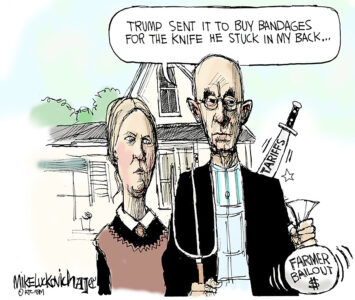
Suppose someone randomly walks up to you, cuts you with a knife — and then offers you a bandage. You might accept the bandage but would you be grateful about it?
Stretch the parable a little: Suppose the bandage wasn’t nearly big enough for the wound?
Serious economists left, right and center have long warned that weaponizing tariffs is almost always self-defeating economic policy. Reasonable, stable tariffs have their place in trade relations, but President Donald Trump sometimes seems to be the only person in the country who thinks his unpredictable, pugilistic deployment of excessive taxes on foreign imports is good for America.
Among the strongest counter-arguments is Trump’s own announcement last week that he’s extending $12 billion in federal aid to America’s struggling farmers.
Trump boasted that it’s being funded by revenue from his tariff increases. That’s false (the money is coming from the Department of Agriculture) but the claim is ironic. That such a bailout actually is needed — and that in fact this particular bandage isn’t even big enough to stanch the agricultural industry’s bleeding — can be added to the high pile of evidence that Trump’s aggressive, reckless misuse of tariffs is a disaster.
Trump’s spastic tariff attacks against America’s biggest trading partners, and the resulting retaliatory tariffs and overseas market losses to U.S. exports, isn’t the only reason America’s farmers are hurting this year. But it’s a big part of it.
Trump earlier this year imposed a 145% tariff on Chinese products. Not only did China impose retaliatory tariff hikes, but it shifted its agricultural buying to markets such as Brazil and Argentina.
American farmers are thus squeezed from two sides: Trump’s tariffs make it more expensive for them to buy the farm machinery and other items they need; and other nations’ retaliatory tariffs and market shifts make it harder for them to sell their corn, soybeans and other crops overseas at prices that will even cover their costs.
The result has been an estimated total loss of as much as $44 billion by U.S. crop producers on this fall’s harvest, as the Agricultural Risk Policy Center at North Dakota State University told multiple media outlets recently. This despite a record-high corn harvest this year and strong production numbers for other crops.
“We love our farmers,” Trump said in announcing the $12 billion aid package at a White House event Monday. He has odd ways of showing it. In addition to the havoc his tariff policies are playing with farm expenses and crop prices, his immigration crackdown has made farm labor more scarce. And his freezing of foreign food aid — in addition to being damaging to America’s global standing and unconscionably cruel to countless children — has deprived U.S. farmers of yet another major market for their crops.
Here in Missouri, farmers — who as a group have heavily supported Trump politically — aren’t throwing any parades in gratitude for the aid package. And it’s not just that the $12 billion represents, at best, a third of the industry’s recent losses.
“They didn’t get into this business and they don’t stay in the business to receive checks from the government,” Mike Steenhoek, executive director of the Soy Transportation Coalition, told the Post-Dispatch’s Hannah Wyman. “It’s a whole lot better just to be able to base your business on the fundamentals and actually sell to customers than be beneficiaries of the federal government.”
It remains astonishing that the leader of the world’s largest economy has never appeared to grasp a simple economic fact: American tariffs aren’t paid by the countries upon which they are levied. They are ultimately paid by American consumers, in the form of higher prices on imported goods and manufacturing materials. At the same time, the inevitable retaliatory tariffs from other countries hurt American manufacturers and farmers by making their exports more expensive overseas.
So the money Trump brags about collecting from other countries via tariffs is actually coming out of regular Americans’ pockets every time they shop. Then he’s using that money to (partly) offset the market losses that America’s farmers have suffered as another result of his tariffs.
Here’s an idea: Instead of this expensive Rube Goldberg contraption of a trade policy, how about keeping prices lower for American consumers by lowering our tariffs, which will simultaneously keep markets open for American farmers by eliminating the motive for other countries to impose retaliatory tariffs? Or does that make too much sense?
This arrangement is known as free trade. It’s something Republicans used to support — just as they used to support agriculture via good trade policies rather than government bailouts.
ONLINE: https://www.stltoday.com/opinion/editorial/article_4e95a3ae-b1b3-449e-83d4-923abf98e6f7.html
Editorials
Editorial cartoon for Dec. 17, 2025
What does Trump’s $12B farmers’ bailout say about his tariffs?
Suppose someone randomly walks up to you, cuts you with a knife — and then offers you a bandage. You might accept ...
Supreme Court is failing its most important job
In early November, a conservative Supreme Court justice showed a clear-eyed understanding of the threat that ...
Editorial cartoon for Dec. 16, 2025
Use caution when going out on early ice cover
Those eager to take advantage of winter’s snow need to keep safety at the forefront of their preparations, the ...