
Trending
Residents in the region need only look at what likely is a dead ash tree -- perhaps already a stump -- in their yard or neighborhood to know the devastation that can be done by an invasive species.
Since first being discovered in the U.S. in 2002 in Michigan, the emerald ash borer has all but wiped out ash trees across the Midwest and northeastern state, spreading as far west as Colorado and south as Texas.
Now, another invasive insect threatens to do the same to at least 12 varieties of hardwood trees, most notably our beloved maples.
So Michigan's Invasive Species Program and the U.S. Department of Agriculture's Animal and Plant Health Inspection Service has asked for the public to look for and report signs of the Asian longhorned beetle.
Each year, APHIS declares August as Tree Check Month because this is the most likely time to see the beetle and the damage it causes to trees, according to a news release. Though beetle sightings are less common, everyone can help look for signs of this destructive beetle by checking trees on their property and in their community for damage, APHIS said.
The Asian longhorned beetle, or ALB for short, is a non-native, wood-boring beetle considered invasive in North America because it attacks at least 12 types of hardwood trees, including maples, elms, horse chestnuts, birches and willows. There are no effective predators or diseases in North America to keep ALB populations in check, APHIS advises.
The adult female beetle will chew a small depression in the bark to deposit each of her up to 90 eggs. Upon hatching, the larvae eat their way into the tree's heartwood, leaving tunnels that damage the tree. The next summer, usually around August, they bore round exit holes and emerge as adults to mate and start the cycle again.
Infested trees do not recover and will die. They become safety hazards. Branches can drop, and trees can fall over, especially during storms. Because so many types of trees can be affected and infestation is fatal, managing the beetle means removing both infested and at-risk trees. It's much the same pattern as happened with the ash borers, and we know how that played out.
But there's hope for different results this time. The USDA APHIS ALB program has managed to successfully eradicate infestations in Illinois; Boston, Massachusetts; New Jersey; Brooklyn, Queens, Manhattan, Staten Island and Islip in New York; and a portion of East Fork State Park and Stonelick and Monroe townships in Ohio. Work continues in other infested areas of Massachusetts, New York, Ohio and South Carolina.
So remaining vigilant will provide a fighting chance against this invader.
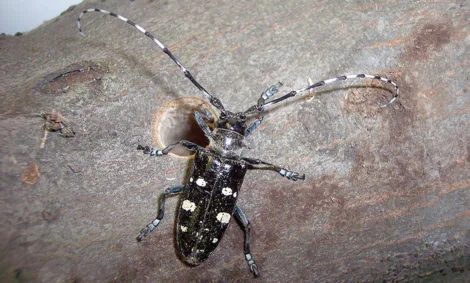
The adult beetle has markings that are easy to recognize:
-- A shiny, black body with white spots. Its body is about 1 to 1.5 inches long.
-- Boldly marked black and white antennae that are longer than its body.
-- Six legs with feet that can appear bluish.
Note that the white-spotted pine sawyer, a Michigan native, is similar in appearance; however, the pine sawyer is brown to black, not shiny, has a telltale white spot between its head and the top of its wing covers and lacks the vivid white markings on its antennae, APHIS advises. For a comparison and more information on look-alike insects, visit Michigan.gov/ALB.
Signs that a tree might be infested include:
-- Round exit holes about the diameter of a pencil found in tree trunks and branches.
-- Shallow, oval or round scars in the bark, where the adult beetle chewed an egg-laying site.
-- Material that looks like wood shavings lying on the ground around the tree or in the branches.
-- Dead branches or limbs falling from an otherwise healthy-looking tree.
If you think you found a beetle or tree damage, report it by calling the ALB hotline at 866-702-9938 or submitting an online report through the ALB webpage, APHIS says. Try to photograph the beetle or tree damage. If you can, capture the beetle in a durable container and freeze it, to preserve it for identification.
ALB doesn't move far on its own, but it can and has hitchhiked to new areas in untreated firewood. When traveling, leave firewood at home and purchase what you need locally or choose certified, heat-treated firewood to help prevent this destructive pest from showing up at your favorite places. This has been the recommendation since EAB surfaced and remains good practice.
For more information about ALB, call the USDA at 866-702-9938 or go online to APHIS.USDA.gov/Plant-Pests-Diseases/ALB.