Canadian players helping reshape college hockey
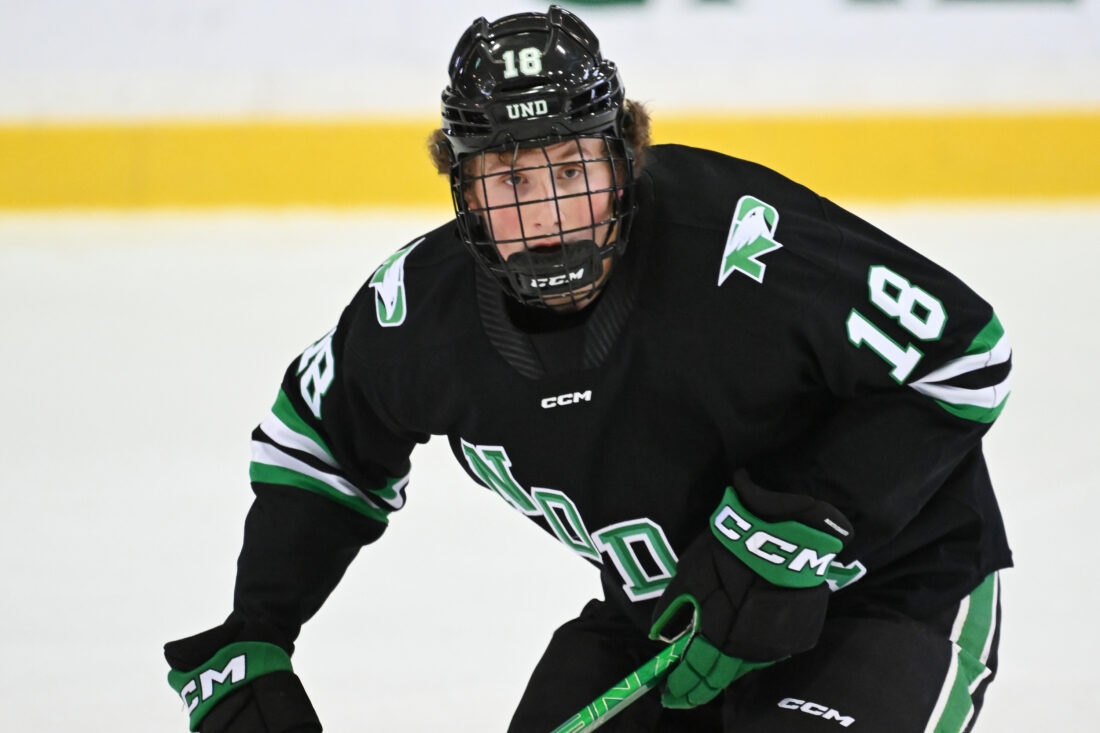
North Dakota defenseman Keaton Verhoeff skates to the puck against St. Cloud State during an NCAA hockey game on Dec. 5 in St. Cloud, Minn. (AP Photo/Craig Lassig, file)
Sidney Crosby never played for an NCAA title. Neither did Nathan MacKinnon, Connor McDavid or, going way back, Wayne Gretzky.
For decades, the stars of the Canadian Hockey League were deemed pros as juniors — they received stipends — and ruled ineligible for the NCAA as a result.
In the age of name, image and likeness deals and the transfer portal, the NCAA recently lifted its ban on CHL players. That means a new wave of CHL standouts has the opportunity to hoist an NCAA trophy before skating off to chase the Stanley Cup in the NHL.
This week, there are nearly 20 players with CHL connections on the rosters of the Frozen Four participants: Denver, Michigan, Wisconsin and North Dakota.
“This is going to make college hockey better,” said Denver coach David Carle, whose team faces Michigan in a semifinal game Thursday as the Pioneers seek their 11th national title and Michigan pursues No. 10. “Obviously, it’s probably happened quicker than we thought.”
The CHL and NCAA have long been two different avenues for players to take in hopes of reaching the top of the sport. The CHL has 61 teams spanning North America in the Western Hockey League (WHL), Ontario Hockey League (OHL) and the Quebec Maritimes Junior Hockey League (QMJHL). They have produced the likes of Gretzky, Crosby, MacKinnon, Connor Bedard and many of the NHL’s top names.
There was also a path through college hockey, which was typically forged by a stop in the United States Hockey League (USHL), which met NCAA amateurism rules. On Tuesday, the USHL unveiled a standard player development agreement that introduces benefits, including support for travel and secondary education along with reimbursements for training and career-ending injuries.
The lanes converged in November 2024 when college’s governing body lifted the long-standing ban on players who suited up in the CHL.
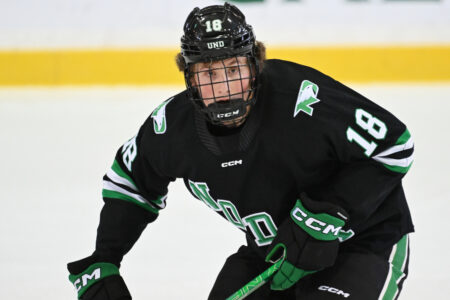
It led to an influx of immediate talent onto the NCAA ice. For instance, forward Gavin McKenna left Medicine Hat of the WHL to play for Penn State. He could be the top pick in the 2026 NHL draft, with North Dakota defenseman Keaton Verhoeff also in the running to go No. 1 overall.
All four freshmen goaltenders at the Frozen Four have roots with the CHL. Denver’s Johnny Hicks (WHL) is 14-0-1 since stepping into the net on Jan. 24. Michigan’s Jack Ivankovic (OHL) has 25 wins, while North Dakota goalie Jan Špunar (WHL) has more shutouts (six) than losses (four). Wisconsin’s Daniel Hauser (WHL) is 20-7-2 this season.
“Players coming through the CHL and its member leagues are accustomed to competing in big games, under pressure, and in demanding environments where every shift matters,” CHL president Dan MacKenzie said.
The CHL caters to players ages 16 to 20, with common aspirations: “Everybody came to our league with laser focus on the National Hockey League,” said Dan Near, the commissioner of the WHL. “Until now, nobody’s ever walked into our door and said, “‘My dream is to play in the NCAA.’ That was foreign to us.”
But they’re adjusting to the new landscape of hockey.
“There just needs to be more time and data for players to get a better understanding of what’s the best path for them,” Near said.
The NCAA Division I Council’s approval of a rule that allowed players with CHL experience to compete at U.S. colleges starting this season was a landmark decision. Before the ruling, CHL players who previously received a certain level of stipend for living expenses were considered pros and not permitted into the NCAA ranks.
Last summer, there were 21 CHL players selected in the first round of the NHL draft, including the New York Islanders picking defenseman Matthew Schaefer from the OHL’s Erie Otters with the first pick.
Things changed quick, too.
A year ago, Denver forward Kristian Epperson was scoring 27 goals for the OHL’s Saginaw Spirit. On Thursday, Epperson, a third-round pick of the Los Angeles Kings, is playing for a spot in the national title game.
“I definitely didn’t entirely think I’d be ending up in the Frozen Four,” Epperson said. “Now that it’s here, it’s like a pinch-me moment.”
For coaches, it’s been a major recruiting adjustment. In a hurry, too, with programs scrambling to sign players.
“We just continue to push the ceiling,” said Badgers coach Mike Hastings, whose team faces North Dakota in the semifinals. “The talent level that’s at the collegiate game right now is at an all-time high.”