Great horned owls form a duet
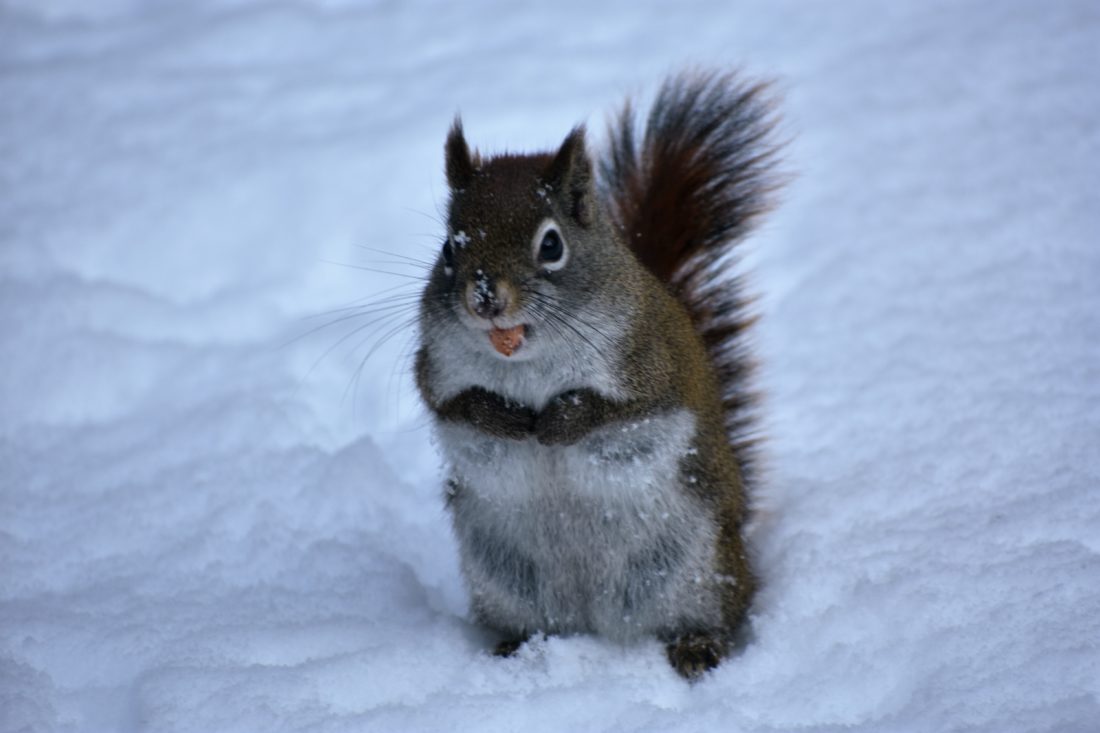
A squirrel stretches out in search of winter grub. Betsy Bloom Photo
The squirrels that visit our feeders and yard might have reason to be looking over their shoulders.
As I headed out pre-dawn Tuesday for work, an owl, unseen but quite close, began to hoot just to the northeast of the house at Six Mile Lake.
It was answered from the other side of the yard and within minutes a duet had begun, one higher-pitched, the other deeper-voiced, both now calling from the same woods that line the southwest edge of our property.
My mom says she’s never heard an owl in more than a decade living year-round in north Dickinson County. I heard my first this past summer but not so far this winter until Tuesday.
The pattern of the calls matches the great horned owl and the different pitches suggest a pair, which could mean a nest in the works. As mentioned in a previous column, it’s the right time of year.
Technically, Michigan can lay claim to a variety of owls to rival Harry Potter’s Hogwarts school, with seven species thought to spend at least some time regularly each year in the Upper Peninsula. But in reality, only three — great horned, barred and diminutive northern saw-whet — can be considered common here, local wildlife rehabilitator and birder Phyllis Carlson said.
The area is a little too far north for screech owls, although they have turned up in Menominee County, Carlson said, and a little too far south for the Canadian forest species: the impressive great gray owl, northern hawk owl and the boreal owl, the tiny far north counterpart to the saw-whet.
All three may venture into the region during “irruption” winters when rodent populations crash to the north, forcing them to seek food elsewhere. But the closest area to reliably see them would be Sax-Zim Bog northwest of Duluth, Minn.
Long-eared owls, which look like smaller, thinner and more surprised versions of the great horned with much longer feathered “ears,” are reported in the U.P. but not often seen, Carlson said.
Short-eared owls prefer more open grassland areas to hunt, as do any snowy owls that might venture down from the arctic for the winter, so they, too, usually are passing through rather than resident.
The barred owl is smaller than the great horned, with no ear tufting and large dark eyes — one of the winning shots in The Daily News’ recent photo contest was a barred owl in the snow. They also have different calls, with the great horned’s described by the Cornell Lab of Ornithology as a “hoo-h’HOO-hoo-hoo,” while the barred asks, “Who cooks for you? Who cooks for you-all?”
The great horned owls I heard Tuesday may have gravitated to our yard because of the traffic at the feeders, which draw in red, gray and flying squirrels, along with the occasional rabbit and likely many other rodents scurrying under the snow. Given the thick crust created by the recent warming and refreezing, the owls for now can’t dive in to reach prey, so must come to sites where something edible might venture out long enough to present an opportunity.
And the great horned owl isn’t picky about what it will eat.
Great horned owls are big enough, strong enough and fearless enough to take on animals as large as fox and raccoon; those who let their cats roam outside may lose them to this bird. Skunks seem to be a particular favorite, as being sprayed does not deter them. They’ll even pounce on other birds of prey and have been known to drive bald eagles from their nests, according to Cornell. They kill with a grip that snaps the spine.
Crows mob them with good reason, as they are one of the main predators of that species.
I don’t know whether the owls will stick around — I have not heard them since that morning, though once on nest and eggs they can be expected to go silent. Carlson said her captive male owl, Journey, has stopped calling.
But if they do decide to move in, more than the squirrels might be nervous about the new neighbors.
Betsy Bloom can be reached at 906-774-2772, ext. 40, or bbloom@ironmountaindailynews.com.
Outdoors

Sagola youth club competes at Marshfield
Migration hits the brakes in icy weather
Outdoors report: Changes made in sturgeon, trout seasons
Outdoors report: Turkey licenses available for spring season

Michigan’s Great Lakes fish populations assessed