
Bear season opens Wednesday; youth hunt next weekend
Outdoors report
Trending
IRON MOUNTAIN -- Michigan’s Liberty Hunt will take place next weekend.
The hunt is a statewide firearm deer season that takes place on public and private lands open to firearm deer hunting. Youth 16 years old or younger and individuals with qualifying disabilities can participate.
To qualify for the Liberty Hunt on Sept. 12 and 13, you must meet one of the following criteria:
-- Be licensed under the Mentored Hunting Program and accompanied by a qualified mentor.
-- Be 16 years old or younger.
-- Be a veteran who has been determined to have 100% disability or a resident of Michigan rated as individually unemployable by the U.S. Department of Veterans Affairs.
-- Have been issued a permit by the Michigan Department of Natural Resources to hunt from a standing vehicle.
-- Have been issued a permit by the DNR to hunt using a laser-sighting device.
-- Be a blind individual.
-- Be a deaf individual as defined by section 2 of 72 PA 1978, MCL 408.202.
Here are some more details:
-- Hunters 9 years old and younger must be licensed through the Mentored Hunting Program and accompanied by a qualified mentor.
-- Youth 10-16 years old can hunt with a bow, crossbow or firearm, regardless of license used.
-- For youth 10-16 years old, valid licenses include a single deer, deer combo or antlerless deer license.
-- A qualified individual may harvest an antlered or antlerless deer with an unused single deer license (including the license issued through the Mentored Hunting Program), a deer combo license regular kill tag or a deer combo license restricted kill tag. Antler point restrictions do not apply.
-- A universal antlerless license or deer management assistance permit may also be used to take antlerless deer only, if issued for the area/land where hunting.
-- During this season, you can harvest only one antlered deer and multiple antlerless deer (one per kill tag).
-- All hunters participating must wear hunter orange.
-- Baiting restrictions apply.
***
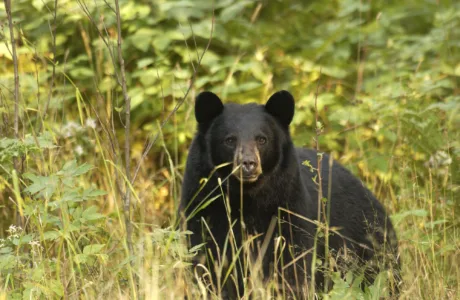
Bear hunting season opens Wednesday, both in Wisconsin and in the Upper Peninsula.
The Wisconsin DNR reminds hunters that all bears must be registered by 5 p.m. the day after recovery, and hunters must submit two upper premolar teeth to the department. These samples provide data used to monitor and ensure the health of the bear population.
This year, over 34,000 people applied for one of the 15,245 bear licenses available in Wisconsin, and 106,000 more people opted to purchase a preference point to improve their chances of drawing a license in a future lottery.
The Wisconsin DNR's Bear Hunting webpage at https://dnr.wisconsin.gov/topic/hunt/bear provides general information about hunting bears, regulations and hunting hours, and how to complete the mandatory registration and tooth submission processes.
The Michigan DNR issued 6,278 bear licenses for the 10 bear management units across the state this year. More than 72,500 people applied for a bear license or preference point.
Successful Michigan hunters must register their harvested bear at an official checkpoint or via designated reporting guidelines within 72 hours.
In the U.P., bait can be used to hunt bear Sept. 9 - Oct. 26. Dogs can be used Sept. 14 - Oct. 26. Michigan’s bear hunting regulations are found at https://www.michigan.gov/dnr/managing-resources/laws/regulations/bear.
***
Trichinellosis, also called trichinosis, is a disease that people can get by eating raw or undercooked meat from animals infected with the microscopic parasite trichinella. Cases have been detected in black bears. Animals infected with trichinella usually don't appear to be sick, and the parasite is microscopic so it cannot be seen in infected meat with the naked eye.
You can prevent trichinosis by properly handling and cooking meat. Health officials advise whole cuts and ground meat from wild game animals should be cooked to an internal temperature of 160 degrees Fahrenheit. A meat thermometer should be used because color is not a good indicator of doneness for game meat.
After handling meat, wash hands thoroughly with warm, soapy water and disinfect all equipment and work surfaces. Learn more about trichinosis from the Centers for Disease Control and Prevention at https://www.cdc.gov/trichinellosis/about/index.html.
***
Targeting walleye in the fall can offer some of the best fishing of the season. The Michigan DNR offers these tips:
-- In early fall, walleye can be found in a variety of locations within the water body, including deep, shallow or anywhere in between. Keep that in mind and don't stick to one depth range.
-- If you're out in the morning, check the areas where deep water meets the shallow spots.
-- As the day progresses start heading deeper, as walleye can be photosensitive.
-- Don't forget to try your luck during the nighttime hours. This can be a very productive time during the fall, especially along rock points and flat areas.
The DNR reported this U.P. fishing activity:
Little Bay de Noc: Anglers reported fair to good walleye fishing over the past week. Anglers used sonar to locate fish and cast minnow-profile baits. Presentations varied from erratic reaction-style lures to slow-moving live bait, including nightcrawlers on crawler harnesses or jigs. Anglers also caught coho salmon near the mouth of the Escanaba River while trolling or casting spoons and small crankbaits.
Marquette: Most anglers continued to troll north of White Rocks out toward Granite Rock and the Clay Banks in 80 to 160 feet of water for lake trout. Anglers reported catching fish throughout the water column. A few anglers reported catching salmon and brown trout near Little Presque Isle and the Clay Banks around Granite Point and the Little Garlic River in 60 to 100 feet of water. Few anglers ventured out to the Sand River and Shot Point, resulting in low numbers of lake trout, though fish were caught in deeper water near the sand hole in around 180 feet of water. Coho salmon were caught between the Lower Harbor Lighthouse and the Chocolay River in 60 feet of water, with lines set 25 to 30 feet down. The South Shore Fishing Tournament yielded few salmon.
Keweenaw Bay/Huron Bay: Anglers reported catching primarily lake trout, with the occasional coho salmon trolling spoons and flasher-fly combinations. Anglers jigging for lake trout reported a poor to fair bite, with success on both natural and artificial presentations. Fish were caught in 100 to 140 feet of water, with some anglers catching smaller fish in water deeper than 200 feet.
Manistique: Anglers fishing near the river mouth reported slow chinook salmon fishing. Despite marking fish on sonar, bites were rare. Anglers heading away from the mouth of the river and targeting staging salmon reported good fishing while trolling spoons. Few adult Chinook salmon were caught near the Garden Peninsula, though overall catch rates remained good.
Traverse Bay/Portage Entry: Anglers reported fair to good fishing for lake trout while trolling spoons and flasher-fly combinations near the bottom in 60 to 100 feet of water and around structure. Coho salmon and a few brown trout were also caught in low numbers while trolling. Anglers jigging for lake trout reported a fair bite when using natural presentations, with most fish caught between 100 and 140 feet of water with a few caught in water deeper than 200 feet.