
September delivers a shorebird visitor
Northwoods notebook
Trending
September is such a bittersweet time of the year.
So many of our beloved bird species only spend a few short months in the Upper Peninsula. They might show up in April or May and by September they've nested -- hopefully successfully -- and now have no reason to remain.
The male ruby-throated hummingbirds left more than a week ago. After bullying others away from the feeders for weeks, they suddenly disappeared Aug. 31, roughly at noon. How do I know? I had friends at Six Mile Lake that morning, and we noted the male hummingbird perched atop the feeder hooks. When the clouds later cleared, a female had taken up the post.
A few females or juveniles remain but probably not for long.
Northern flickers search like robins for food in the yard. Turkey vultures appear to be everywhere. Common nighthawks likely have already passed through and I only managed to see one.
Waves of warblers are on the move, with several varieties chasing insects through the trees in the yard. Common grackles and red-winged blackbirds are flocking up and the string of Canada geese goslings that paraded around the lake seem to have mastered flight.
Seeing them go brings some sadness. But this fall exodus does have some compensations -- species passing through that choose to make a fleeting, random visit from far away during spring or fall migration.
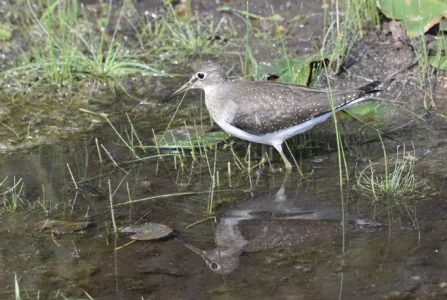
Like the solitary sandpipers that winged in last week to pick through the floating vegetation and shallows along our dock at Six Mile Lake.
The first assumption when seeing a shorebird on inland lakes is spotted sandpiper. It's the most widespread breeding sandpiper in North America, according to the Cornell Lab of Ornithology’s All About Birds website, https://www.allaboutbirds.org. They are a summer-long resident at Six Mile Lake.
And "spotties" are fascinating. They often reverse what's seen in most breeding birds. The females set up territories, are known to mate with several males and will leave eggs for the boys to tend and raise as chicks, according to All About Birds.
But solitary sandpipers are monogamous, perhaps because, as the name implies, they tend to be singular when seen rather than in a flock.
And unlike most shorebirds, they choose trees rather than ground to nest, laying eggs "in old nests of several different songbirds, particularly those of the American robin, rusty blackbird, eastern kingbird, Canada jay and cedar waxwing," All About Birds states, adding "of the world's 85 sandpiper species, only the solitary sandpiper and the green sandpiper of Eurasia routinely lay eggs in tree nests."
Solitary sandpipers nest by freshwater lakes, ponds and creeks in areas of bogs and spruce trees. Those nests, however, are far to the north, in the subarctic and boreal forests of Canada and Alaska.
But while migrating, they're open to trying other settings, All About Birds notes, "They will put down in almost any puddle in any setting, from inner city to forest interior. They often stop at lakes, ponds or streams similar to their nesting habitat, especially where there are extensive muddy margins. They also appear in ditches, stagnant pools, cow pastures, rain pools, freshwater swamps, flooded sod farms or sports fields, bogs, rice fields, and even in wooded wetlands at higher elevations."
Which certainly explains why they might have gravitated to Six Mile Lake, which seemed to offer good feeding -- I saw them come up with several small, dark, wormlike creatures and some sort of insect larva that had many legs. Apparently they can tackle small clams, crayfish, snails, small fish, tadpoles, salamanders and frogs as well. They several times demonstrated two distinctive traits of the species, bobbing the back half of its body or trembling its tail and feet while foraging, to stir prey to move.
These solitary sandpipers were either immature or in non-breeding plumage. They were surprisingly tolerant of my presence, unlike the usually skittish resident spotties, perhaps not having been around humans enough to be wary.
All About Birds states that solitary sandpipers leave their breeding areas in August, so no surprise they'd show up about now -- and not stick around.
But they were a good reminder to keep watch for other birds that might only be seen here each year during migration. I'm hoping other shorebirds and waterbirds might follow the solitaries in paying Six Mile Lake a visit.
Betsy Bloom can be reached at 906-774-2772, ext. 85240, or bbloom@ironmountaindailynews.com.