$9 billion cut to public broadcasting and foreign aid advances in Congress
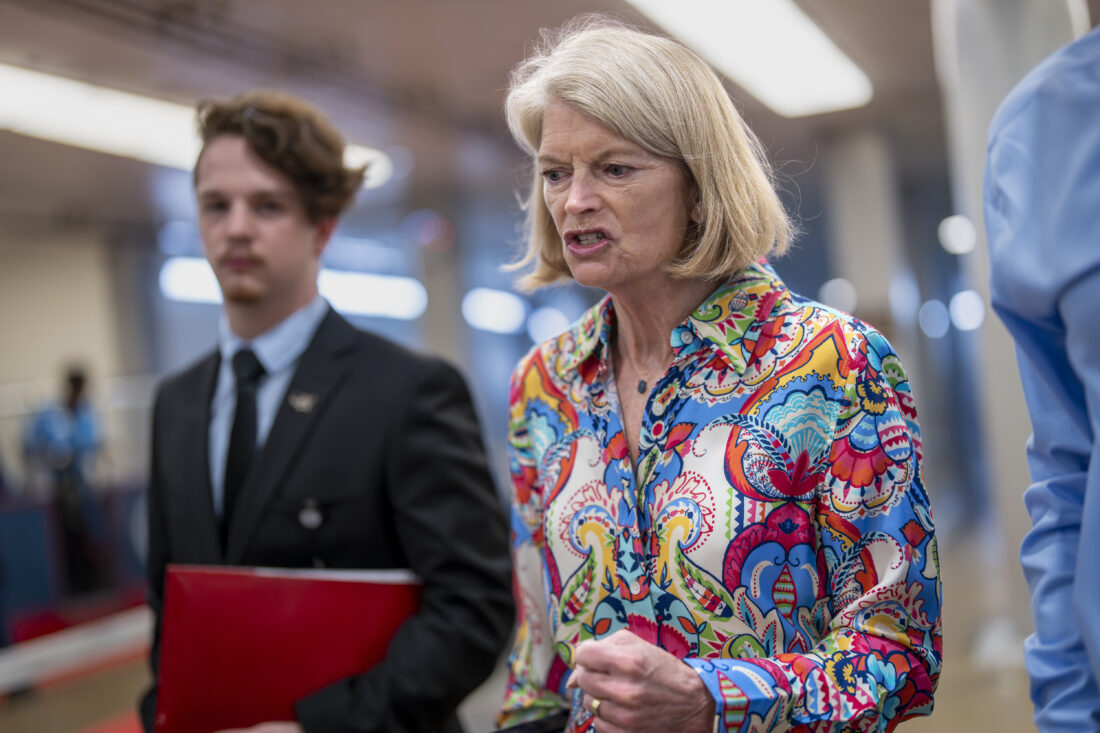
Sen. Lisa Murkowski, R-Alaska, a member of the Senate Appropriations Committee, heads to the chamber at the Capitol in Washington on Wednesday as Senate Republicans push President Donald Trump's request to cancel about $9 billion in foreign aid and public broadcasting spending. (AP Photo/J. Scott Applewhite)
WASHINGTON (AP) — The House was expected late Thursday to approve President Donald Trump’s request to claw back about $9 billion for public broadcasting and foreign aid as Republicans target institutions and programs they view as bloated or out of step with their agenda.
The White House had described the package as a test case and said that if Congress went along, more would come. The House’s approval would mark the first time in decades that a president has successfully submitted such a rescissions request to Congress, and even then the results were more mixed. Unlike other presidents, Trump is getting nearly all the cuts he requested.
Opponents voiced concerns not only about the programs targeted, but about Congress ceding its spending powers to the executive branch as investments approved on a bipartisan basis are being subsequently canceled on party-line votes. No Democrats supported the measure when it passed the Senate, 51-48, in the early morning hours Thursday. Two Republicans also voted no.
“We need to get back to fiscal sanity and this is an important step,” House Speaker Mike Johnson, R-La., told reporters.
The package cancels about $1.1 billion for the Corporation for Public Broadcasting and nearly $8 billion for a variety of foreign aid programs, many designed to help countries where drought, disease and political unrest endure.
The effort to claw back a sliver of federal spending comes just weeks after Republicans also muscled through Trump’s tax and spending cut bill without any Democratic support. The Congressional Budget Office has projected that measure will increase the U.S. debt by about $3.3 trillion over the coming decade.
The cancellation of $1.1 billion for the CPR represents the full amount it is due to receive during the next two budget years.
The White House says the public media system is politically biased and an unnecessary expense.
The corporation distributes more than two-thirds of the money to more than 1,500 locally operated public television and radio stations, with much of the remainder assigned to National Public Radio and the Public Broadcasting Service to support national programming.
Democrats were unsuccessful in restoring in the Senate.
Lawmakers with large rural constituencies have voiced particular concern about what the cuts to public broadcasting could mean for some local public stations in their state.
Sen. Lisa Murkowski, R-Alaska, said Tuesday that the stations are “not just your news — it is your tsunami alert, it is your landslide alert, it is your volcano alert.”
Less than a day later, as the Senate debated the bill, a 7.3 magnitude earthquake struck off the remote Alaska Peninsula, triggering tsunami warnings on local public broadcasting stations that advised people to get to higher ground.
Sen. Mike Rounds, R-S.D., said he secured a deal from the White House that some money administered by the Interior Department would be repurposed to subsidize Native American public radio stations in about a dozen states.
But Kate Riley, president and CEO of America’s Public Television Stations, a network of locally owned and operated stations, said that deal was “at best a short-term, half-measure that will still result in cuts and reduced service at the stations it purports to save.”
Among the foreign aid cuts are $800 million for a program that provides emergency shelter, water and family reunification for refugees and $496 million to provide food, water and health care for countries hit by natural disasters and conflicts. There also is a $4.15 billion cut for programs that aim to boost economies and democratic institutions in developing nations.
Democrats argued that the Republican administration’s animus toward foreign aid programs would hurt America’s standing in the world and create a vacuum for China to fill.
National News

TSA boss warns of airport shutdowns

Verdict puts pressure on social media firms

Iran rejects US ceasefire plan
News briefs
Truck lacked warning tool NEW YORK (AP) — Federal investigators say a runway warning system didn't sound an ...
Senators chase deal to end Homeland Security standoff