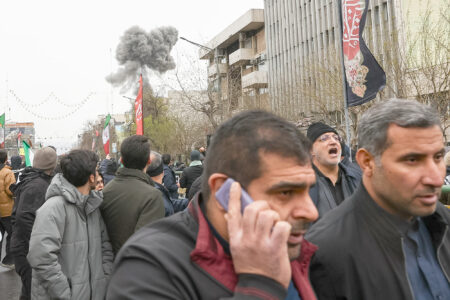
Iran escalates attacks on Gulf energy sites

People take shelter in an underground tunnel as air raid sirens signal a warning of incoming Iranian missiles in Jerusalem on Thursday. (AP Photo/Ohad Zwigenberg)
DUBAI, United Arab Emirates (AP) — Iran intensified its attacks on oil and natural gas facilities around the Gulf on Thursday, raising the stakes in a war that is sending shock waves through energy markets and the global economy.
The strikes, in retaliation for an Israeli attack on a key Iranian gas field, sent fuel prices soaring and risked drawing Iran’s Arab neighbors directly into the conflict. Global fuel supplies were already under pressure because of Iran’s stranglehold on the Strait of Hormuz, a strategic waterway through which a fifth of the world’s oil is transported.
Israeli Prime Minister Benjamin Netanyahu said late Thursday that, at the request of President Donald Trump, Israel will hold off on any further attacks on Iran’s South Pars gas field.
Since the U.S. and Israel launched the war on Feb. 28, Iran’s top leaders have been killed in airstrikes and the country’s military capabilities have been severely degraded. Netanyahu said in a televised address that Iran no longer has the ability to enrich uranium or make ballistic missiles, although he did not provide evidence.
Still, Iran — now led by the son of the supreme leader killed in the war’s opening salvo — remains capable of missile and drone attacks targeting its Gulf Arab neighbors and unnerving the global economy dependent on the energy they produce.
Underscoring the danger to ships in the region, a vessel was set ablaze off the United Arab Emirates’ coast and another was damaged off Qatar. Efforts to bypass the strait were also under pressure: An Iranian drone hit a Saudi refinery on the Red Sea, which the country had hoped to use as an alternative route.
Brent crude oil, the international standard, briefly surged above $119 a barrel, up more than 60% since the war started. The European benchmark for natural gas prices also rose sharply and has roughly doubled in the past month.
Qatar, Saudi Arabia and the UAE denounced the Iranian attacks. Arab League Secretary-General Ahmed Aboul Gheit called them a “dangerous escalation.”
But Iran showed no signs of backing down. Saudi Arabia said its SAMREF refinery in the Red Sea port city of Yanbu was hit. Saudi Arabia had begun pumping large volumes of oil west toward the Red Sea to avoid the Strait of Hormuz.
Qatar, a key source of natural gas for world markets, said Iranian missiles caused extensive damage to the Ras Laffan liquefied natural gas facility, where production had already been halted after earlier attacks. That could delay Qatar’s ability to get supplies to the market even after the war ends.
Two oil refineries in Kuwait and gas operations in Abu Dhabi also were targeted by Iran, authorities said.
Millions of people fled to shelters in Israel as sirens warning of Iranian missiles sounded in the central part of the country as well as Jerusalem and areas nearby, including the West Bank.
Trump and Netanyahu have cited various war objectives, including degrading Iran’s missile capabilities and its nuclear program, and killing its senior leaders.
At Thursday’s news conference, Netanyahu said: “Iran’s air defenses have been rendered useless, their navy is lying at the bottom of the sea. … Their air force is nearly destroyed.”
He said he hopes the Iranian people will rise up against the Islamic Republic that has ruled for nearly a half-century, but conceded “it’s too early” to say whether that will happen. There’s been no sign of any organized opposition since the war began, after Iranian authorities crushed mass protests in January.
The prime minister’s comments to foreign journalists came amid difficult days for Trump and Netanyahu, with a top U.S. intelligence official resigning and claiming Israel pushed Trump into the war, and Israel’s attacks on South Pars, which led to Iran’s retaliatory strikes on the region’s oil and gas fields.
“I misled no one,” Netanyahu said. “And I didn’t have to convince President Trump about the need to prevent Iran from developing its nuclear program.”
Meanwhile, Defense Secretary Pete Hegseth implied more Iranian leaders could be targeted, referring to the Islamic Revolutionary Guard Corps and Basij, a powerful internal security force whose leader was killed by Israel this week.
“The last job anyone in the world wants right now: Senior leader for the IRGC or Basij, temp jobs, all of them,” Hegseth said.
Gen. Dan Caine, chairman of the Joint Chiefs of Staff, said that U.S. forces were attacking deeper into Iranian territory, with warplanes hunting Iranian boats in the strait and helicopters striking Iranian drones. Caine said the U.S. military has also dropped 5,000-pound bombs on underground weapons-storage facilities.
Iran’s state TV, quoting a Revolutionary Guard statement, said the country’s air defense system hit an F-35 fighter jet. U.S. Central Command said an F-35 made an emergency landing after flying a combat mission over Iran. A command spokesman, Capt. Tim Hawkins, said the aircraft landed safely, the pilot was in “stable” condition and the incident was under investigation.
International News

Iran escalates attacks on Gulf energy sites
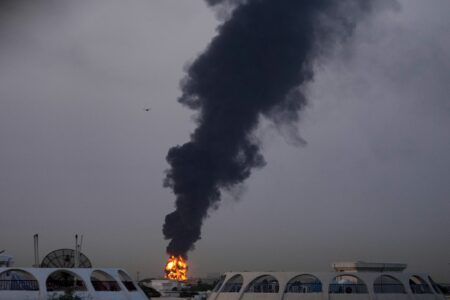
Iran keeps up attacks on neighbors
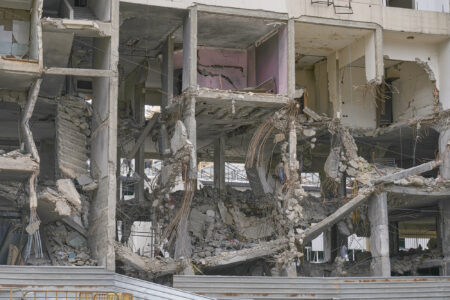
War rages on multiple fronts as Israeli attacks Lebanon
Kentucky mother among 6 killed in Iraq air crash
Trump calls for countries to send warships for Strait of Hormuz