Ford plant’s workforce grew by thousands
Menominee Range Memories
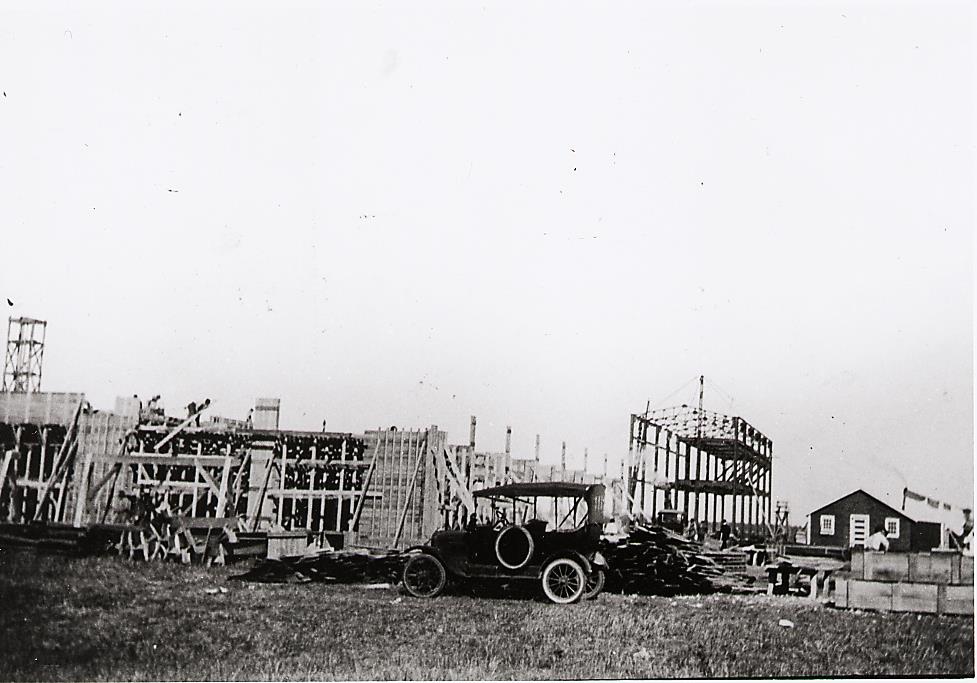
On July 16, 1920, the Ford Motor Company announced it would build its sawmill and body parts plant south of the Iron Mountain city limits on what was the Joseph Mongrain farm. Eight days later, a carload of machinery for mixing concrete for the construction arrived, followed by seven railroad carloads of cement and two carloads of portable houses to be used for temporary housing for the construction crew. Construction began on July 29. On Aug. 3, work began on the foundations of the sawmill, pictured here in late summer or early fall of 1920. By Aug. 19, the foundation of the sawmill, measuring 200 feet long and 125 feet wide, was almost finished and structural work was about to begin. The exterior of the $250,000 sawmill was completed about Dec. 4. The tall steel framework of the power house is visible at the right near one of the portable housing units. The first carload of logs for the sawmill arrived Nov. 30, with an anticipated 10 million feet of logs to be unloaded at the Ford property before the winter was over. The sawmill formally began operation on Tuesday, July 12, 1921, almost a year after construction began. (William J. Cummings)
IRON MOUNTAIN –The 24th installment of Menominee Range Memories, a series of articles by William J. Cummings, Menominee Range Historical Foundation historian, now available on the Dickinson County Library’s website, is titled “The Roaring Twenties — Ford Motor Company’s Arrival Impacts Dickinson County — Building the Plant.”
In his iconic book “Only Yesterday: An Informal History of the 1920s,” published in 1931, author Frederick Lewis Allen, editor of Harper’s Magazine and a notable American historian of the first half of the 20th century, wrote:
“The ten years between 1919 and 1929 took Europeans and Americans on a social and economic roller-coaster ride. With the end of World War I in 1918, people abandoned their cautious attitudes caused by the uncertainty of war and embraced the freedom and joyousness of peace. Soldiers returned home to open arms, and businesses shifted gears from supplying military needs to making commercial products.
“At the end of the war the United States was the strongest economy in the world. The country had supplied European and other nations with manufactured goods and agricultural products throughout the war, becoming a rich trader and source of investment dollars for the world.
“Britain, France, and especially Germany were devastated by the war. While Britain and France gradually recovered by mid-decade, Germany missed out on the prosperity enjoyed by other countries during the 1920s.
“After a brief recession following the war, the U.S. economy began to prosper as never before. This success created new opportunities for most people, a larger middle class, and a higher standard of living. The economic boom gave more people money and created a strong demand for consumer products such as automobiles, radios, and household items.
“Cities swelled with skyscrapers housing new businesses, high-rise apartment buildings filled cities with prosperous people, and suburbs, or residential areas outside of cities, popped up around urban areas. These changes marked the 1920s as a time of optimism for most people. The decade came to be referred to as the Roaring Twenties to describe the newfound freedoms and sense of rebellion that people, who were often dressing in flashy and extravagant fashions, were experiencing.”
A rather bleak economic picture had prevailed during the two decades prior to the arrival of the Ford Motor Company on the Menominee Iron Range. The gradual decline of mining in the early 20th century, with few new industries to take its place, stood at the heart of this economic decline, which is also reflected in population statistics.
In 1900, Iron Mountain’s population stood at 9,242. Although this was 1,600 more than in 1894, when the national economic downturn coupled with the flooding of key mines led to high unemployment and removals from the area, it was only a few hundred more than in 1890.
Though the population fluctuated over the following two decades, the 1904, 1910 and 1920 censuses all showed the population below the 1900 figure. The 1920 federal census listed Iron Mountain’s population at 8,251.
On March 14, 1918, General Manager Elwin Fayette Brown announced that the Pewabic Mine, Iron Mountain’s second-largest iron mine, would suspend all operations and by April 18 the mine was closed. By May 30, the work of removing the pumps and machinery was nearing completion.
During the 1920s, however, Iron Mountain experienced boom times. Contributing to the city’s growth and development was its central location in the Upper Peninsula, at the intersection of key highways in the region.
Central to Iron Mountain’s 1920s boom times was the “Ford Boom.” In early 1920, the news broke that the Ford Motor Company was planning to build a sawmill and factory to make wooden automobile components somewhere in the western Upper Peninsula.
Ford had recently purchased 430,000 acres of timberlands in the area of Lake Michigamme in Iron, Baraga and Marquette counties to provide the company with its own source of wood for manufacturing parts.
At the time lumber from the northern woodlands was shipped to the company’s plants in Detroit, made into parts and then re-shipped to branch assembly plants. Ford’s plan was to establish a sawmill and body parts factory near the sources of the raw materials and ship the parts directly to the assembly plants.
Henry Ford, together with son Edsel and company general manager C. W. Avery, visited Iron Mountain as a prospective site for a factory on July 7, 1920. Other prospective sites mentioned at the time included Menominee, Marquette and Republic.
By July 16 Ford had decided on Iron Mountain as the location for his sawmill and body parts factory, and the following day Ford engineers arrived in the city and began laying out the site. Work at the site began before the end of July and connection was made to the Chicago & North Western Railway. The company eventually purchased 3,000 acres.
In mid-August, the Michigan Iron, Land & Lumber Company was organized by the Ford Motor Company interests for the purpose of conducting the Iron Mountain sawmill and body plant, as well as the extensive Ford logging operations in the Upper Peninsula. Organized with a capital stock of $2 million, the officers were Henry Ford, president; Edward G. Kingsford, vice-president and assistant treasurer; Edsel Ford, treasurer; and C.B. Longley, secretary.
On March 9, 1923, Kingsford announced that the name of the company had been changed from the Michigan Iron, Land & Lumber Company to that of the Ford Motor Company, the subsidiary having been absorbed as a part of the parent plant at Detroit.
The local plant was always referred to as the Iron Mountain plant, even after the Village of Kingsford in which it was located was chartered on Dec. 29, 1923.
The first part of the plant to be built was the sawmill. Planned to be three times the size of the Iron Mountain’s Von Platen-Fox sawmill, it went into full operation during December 1921, and was doubled in capacity in 1924.
The first “body plant” was built in 1921 and went into operation in March 1922. Later in 1922, this first body plant building was enlarged and a second plant added. A third body plant was built in 1923. By March 1924, the three body plants were making 69 different body parts and producing an estimated 350,000 wooden parts per day.
A chemical or distillation plant that converted the waste wood into wood alcohol, wood tar, gas, oil and charcoal went into operation during September 1924. As the Ford operation expanded, the company built the Ford Dam and Hydroelectric Plant on the Menominee River nearby to provide an adequate power supply. The power plant was completed in June 1924.
The extensive Iron Mountain Ford Motor Company building plan included the following: 50 houses erected around Crystal Lake (1920); office building for the Michigan Iron, Land & Lumber Company on Brown Street (1920-1921); sawmill (1920-1921); power house (1920-1921); body plant 1 (1921-1922),; six dry kilns (1921); body plant 2 and addition to body plant 1 (1922); 14 additional dry kilns (1922); Ford Commissary or Ford Store (1922); filing room and motor repair building (1922); filtration plant (1922-1923); body plant 3 and extensions to body plants 1 and 2 (1923); 32 additional dry kilns (1923); house building program in Lower Ford Addition for 25 to 50 homes (1923); chemical plant (1923-1924); carbonization building (1923-1924); Ford Hydro-Electric Plant on the Menominee River (1923-1924); new sawmill (1924); new power house (1924); 26 additional dry kilns (1924); Upper Ford Addition house building program of 100 homes (1924); Ford Hospital on Woodward Avenue established (1925); seven charcoal briquette storage silos (1925); Ford Clubhouse (1925); Ford Airport (1928).
By early March 1924, there were a total of 52 dry kilns at Kingsford’s Ford Plant, making this the largest battery of dry kilns on Earth at the time.
By Feb. 16, 1924, the total number of local employees reached approximately 3,500 with a payroll of a half-million dollars a month.
By Sept. 30, 1924, the payroll contained the names of more than 5,200 persons. By Oct. 9, 1925, the Ford Plant employed more than 7,000 men with a payroll estimated at approximately $1 million a month. There was an increase of approximately 1,300 men in the previous six weeks, which the management felt reflected the public’s positive response to the newly-revamped Model T, sometimes called the “high hood” model.
By Nov. 12, 1925, the Iron Mountain plant was listed as employing 7,271 men — more than any other division of the Ford Company with the exception of the Detroit area.
This 16-page installment of Menominee Range Memories contains 13 period photographs with extensive captions which provide additional information regarding the development of the Iron Mountain Ford Motor Company Plant in Kingsford.
The 108-page book “Iron Mountain Ford Motor Company Plant, Kingsford, Michigan, 1920-1951” by William J. Cummings is available at the Cornish Pumping Engine & Mining Museum for those interested in a definitive history of this aspect of local history and includes information on the CG-4A glider production here during World War II.
Read the rest of this story on the Dickinson County Library’s website at www.dcl-lib.org. New installments will be added to the library’s website and on the library’s local history research computer.
Local News

Loons back on the nest at Six Mile Lake

Trump visit to Wisconsin highlights rural agenda

UW regents approve fourth tuition increase in four years

NWTC Aurora adds commercial driver’s license to training
Hancock man reportedly drowns in Lake Superior
HOUGHTON COUNTY — The body of a 57-year-old Hancock was recovered Wednesday morning after an apparent drowning in ...