
Bohnak questions Michigan’s priorities for rural health funds
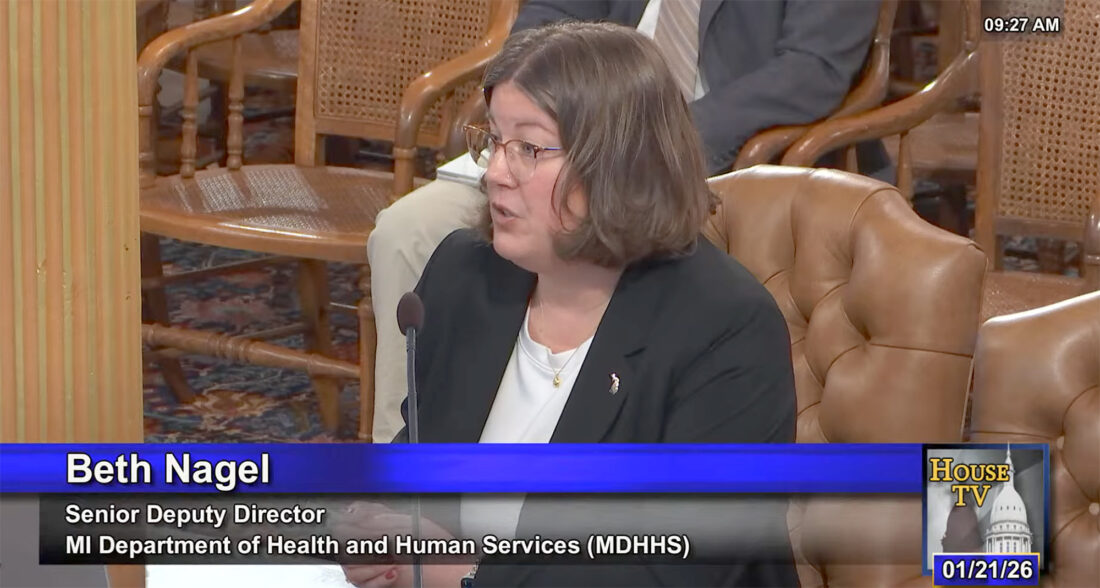
Beth Nagel, senior deputy director at the Michigan Department of Health and Human Services, testifies Jan. 21 before the Michigan House Appropriations Committee. (Screenshot via Michigan Advance)

KARL BOHNAK
Beth Nagel, senior deputy director at the Michigan Department of Health and Human Services, testifies Jan. 21 before the Michigan House Appropriations Committee. (Screenshot via Michigan Advance)
KARL BOHNAK
Trending
State Rep. Karl Bohnak, R-Deerton, on Wednesday joined Upper Peninsula health officials in raising concerns about a proposal from the Michigan Department of Health and Human Services that he says forces sparsely populated counties to compete with Michigan's biggest counties for federal rural health care funding.
"When our state health officials push bad ideas like this, they should have to come to the U.P. and explain how Detroit can possibly be considered rural," Bohnak said in a news release. "They should look a cancer patient in the eye who drives dozens of hours each month for lifesaving care -- or a pregnant mother who lives with the constant fear of whether she'll reach a hospital in time during an emergency. These are the people rural health care dollars are meant to help."
At stake is the distribution in Michigan of just over $173 million in federal rural health care funding. Created under the One Big Beautiful Bill Act of 2025, the Rural Health Transformation program provides $50 billion over five years to improve rural health care. The program was created by Congress in response to concerns by rural providers about Medicaid cuts included in the One Big Beautiful Bill Act.
Acting as the RHT passthrough, MDHHS classifies entire counties as "rural" or "partially rural," enabling entities across those counties to apply for funding. As a result, all of Wayne County, with 1.8 million residents, qualifies for aid despite the department identifying only about 100 rural residents, Bohnak said.
Matt Maskart, CEO of Pathways Community Mental Health in Marquette, and Tonya Darner, market CEO of U.P. Health System, recently testified before the House budget committee on the need to ensure funding reaches truly rural communities, Bohnak said.
Maskart told the panel that residents in downstate communities are often within an hour of comprehensive, world-class health care. In contrast, U.P. residents seeking the same level of care may face an eight-hour drive, unreliable transportation, limited time off work, and the added expense of overnight lodging.
"That availability might as well be on the moon," Maskart said. "My concern is that the counties currently designated as partial rural or fully rural that border urban areas may capture a disproportionate share of grant funding leaving truly remote communities without the resources needed to establish or strengthen care closer to home."
According to Michigan Advance, state health department officials say they’ll weigh multiple factors when awarding grants, including population and geographic isolation, to ensure funding reaches areas with the greatest need.
Beth Nagel, senior deputy director at MDHHS, said the agency is fully aware there are major differences between what's available in a fully rural county or a partially rural county.
She told the committee MDHHS “wants to reach who it needs to impact, but we also want it to be as inclusive as possible.”
In response to criticism, Lynn Sutfin, spokesperson for the state health department, told Michigan Advance in an email that the rural classifications in the state's proposal mirror the definitions of the Federal Office of Rural Health Policy within the U.S. Health Resources and Services Administration.
"This broad definition of the term rural is meant to provide as many opportunities as possible for Michigan's rural residents to benefit from the funds whether they reside in a county that is fully rural or partially rural," Sutfin said, adding that the department anticipated prioritizing counties with a high prevalence of chronic disease, limited access to health care facilities, high Medicaid dependence and significant rates of child poverty or aging populations.
The federal grants must be awarded and distributed by December.
———
Jim Anderson can be reached at 906-774-2772, ext. 85226, or janderson@ironmountaindailynews.com.