Area museums host college class touring three states
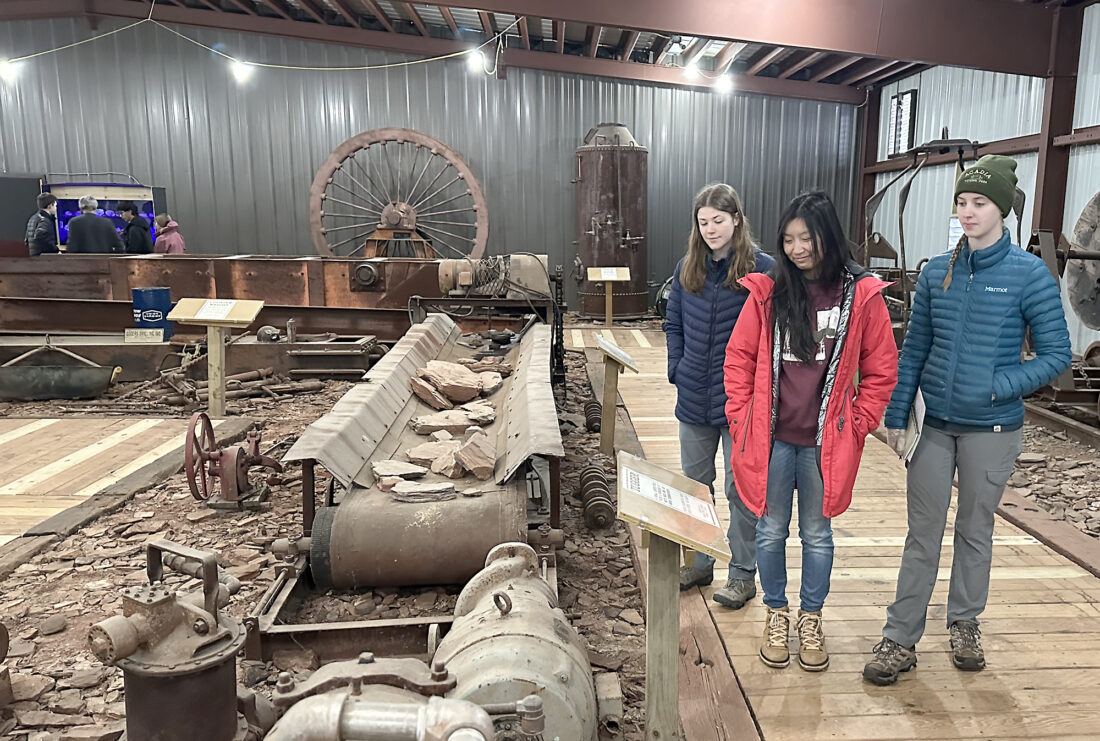
A group of Calvin University students and professors visited local sites of interest during an eight-day tour in the Lake Michigan region. From left Rebecca Evenhouse, Josslin Wright and Miriam Kort look at mining equipment in the Cornish Pumping Engine and Mining Museum in Iron Mountain. (Terri Castelaz/Daily News photos)
IRON MOUNTAIN — Students from Calvin University of Grand Rapids are gaining hands-on experience in sustainability through an eight-day tour around Lake Michigan that included stops in the local area.
The group spent time learning about the region’s mining history at the Cornish Pumping Engine and Mining Museum in Iron Mountain and explored the history of the paper mill industry at the Niagara Area Historical Museum just over the Wisconsin border.
“We will be trying to learn about the different communities on how they manage their environment, community and economic systems,” Calvin University Environmental Education Coordinator Tom Hartzell said. “All those different pieces fit together to make a sustainable society.”
Hartzell, who organized the tour, said each students was assigned a specific site where they are to “become an expert.”
All the participants are college sophomores representing a wide range of majors. “It’s a really diverse mix, so I wanted to provide them with a variety of different areas of interests,” Hartzel said.
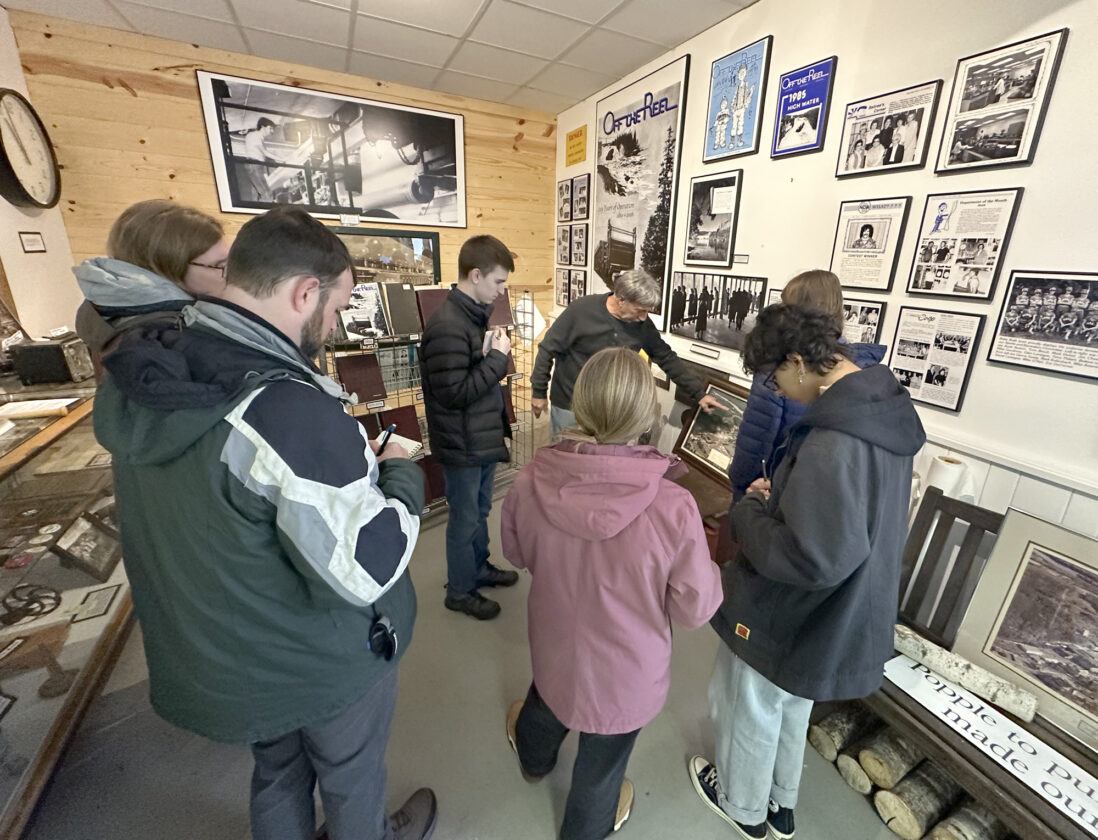
Niagara Area Historical Museum volunteer Rick Wagner shows photographs of the Niagara, Wis., paper mill to visitors from Calvin University. Wagner explained the process of paper making to the group.
After researching to map out the route, he found that mining played an important role in the history, culture and economy of Dickinson County, just as the paper mill industry shaped the community of Niagara, Wis.
The group explored both museums and attended a presentation on the Niagara Paper Mill by museum volunteer Rick Wagner.
Both professors and students said they were moved by Wagner’s passion and the stories he shared about the paper mill and the history of the town.
“It’s fascinating to see how both towns were built by their industries — the iron mine in Iron Mountain and the paper mill in Niagara,” he said. “When a town is so centered around that one industry, such a sense of pride and community cohesion comes through.”
“You can see that even in just one day,” Hartzel added.
Student Miriam Kort pointed out that although mining was dangerous, it was extremely important economically for Iron Mountain and surrounding area.
“It had the same importance as the paper mill did for building Niagara, and you can see how the shutdown affected the community,” she said.
Rebecca Evenhouse said she enjoyed seeing how the paintings at the Niagara museum told the town’s stories. “It was also so cool to hear the stories firsthand from the people that have experience with the mill and who lived in this town for many years,” Evenhouse said.
She added she enjoyed touring the mining museum. “It was amazing to look at all the old equipment and see how it was used during that time,” she said.
Hartzel emphazised how significant perserving history is for communities. “I really appreciate these types of museums and the storytellers who share their knowledge, because you don’t want to lose them,” he said.
After the historical museum visit, the group traveled to Serenity Woods, the Niagara museum’s second location. Students found the site not only visually beautiful but also a place where memories were preserved and where neighbors gather to connect and support each other.
Upon the group’s arrived in Iron Mountain, they were welcomed by local resident Virginia Feleppa, who prepared a hearty Upper Peninsula meal for the students.
Before reaching Iron Mountain, they stopped in Charlevoix to visit a lavender farm and spoke with representatives from the Mackinac Bridge Authority about the history and engineering of the large structure.
They also visited the Hiawatha National Forest, where they met with forest rangers and staff to learn about it means to manage a national forest and how the land is protected.
Future stops on the tour include Green Bay, where the group will meet with an organization working on the East River and the county land conservation district. They will also go to the School of Freshwater Sciences at University of Wisconsin-Milwaukee to talk with an organization that works to bring more nature elements into the schools, and the municipal wastewater district.
The tour will conclude in Chicago, where they will meet with the sustainability planner of the city of Evanston, Ill., and Faith in Place, an environmental advocacy group.
Hartzell expressed his appreciation to both area museums.
“We were blown away by the hospitality we received the whole time we were there,” Hartzell said. “Your community is so warm and welcoming.”
———
Terri Castelaz can be reached at 906-774-2772, ext. 85241, or tcastelaz@ironmountaindailynews.com.
-
- A group of Calvin University students and professors visited local sites of interest during an eight-day tour in the Lake Michigan region. From left Rebecca Evenhouse, Josslin Wright and Miriam Kort look at mining equipment in the Cornish Pumping Engine and Mining Museum in Iron Mountain. (Terri Castelaz/Daily News photos)
-
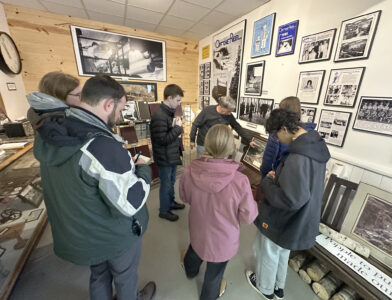
- Niagara Area Historical Museum volunteer Rick Wagner shows photographs of the Niagara, Wis., paper mill to visitors from Calvin University. Wagner explained the process of paper making to the group.
Local News

Danielson Insurance renews Bay IM scholarship
Outdoor education talk on Thursday in Florence
FLORENCE, Wis. — The monthly Florence County outdoor education talk will take place at 6 p.m. Thursday in the ...

Making March Madness: How a Michigan firm builds Final Four courts

US orders 2,500 Marines and amphibious ship to Mideast
Area museums host college class touring three states