
Lack of rehabbers leaves few choices for fawns in need of care
Northwoods Notebook
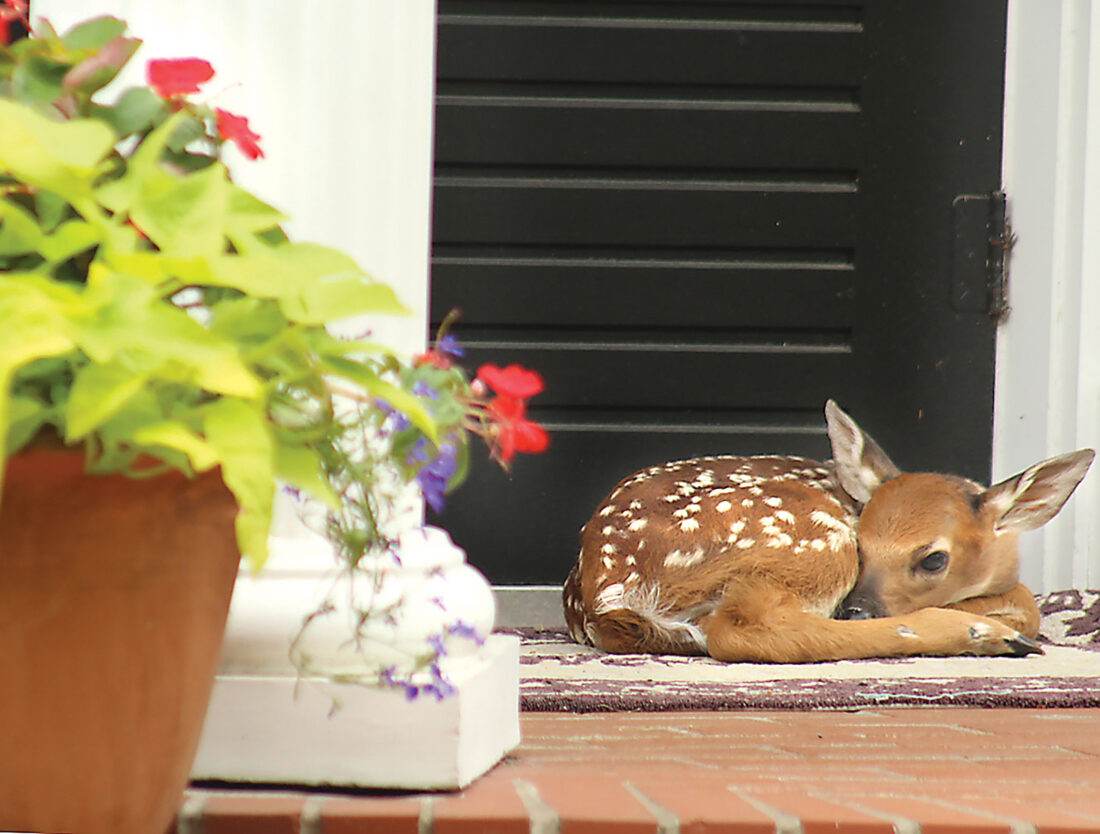
In June 2018, Dr. Donald and Sally Jacobs found this fawn on the welcome mat outside their front door at 1609 Parkview in Iron Mountain. It is normal for fawns in the first few weeks of life to bed down alone for hours where their mothers leave them, while she stays away to avoid potentially drawing predators. It does not mean the fawn has been abandoned. If judged to be in a risky location, the fawn can be gently moved to a nearby site — the doe will not "reject" it for having a human smell, wildlife experts advise. If the fawn flees, do not chase; the exertion could kill the fawn. (Theresa Proudfit/Daily News file photo)
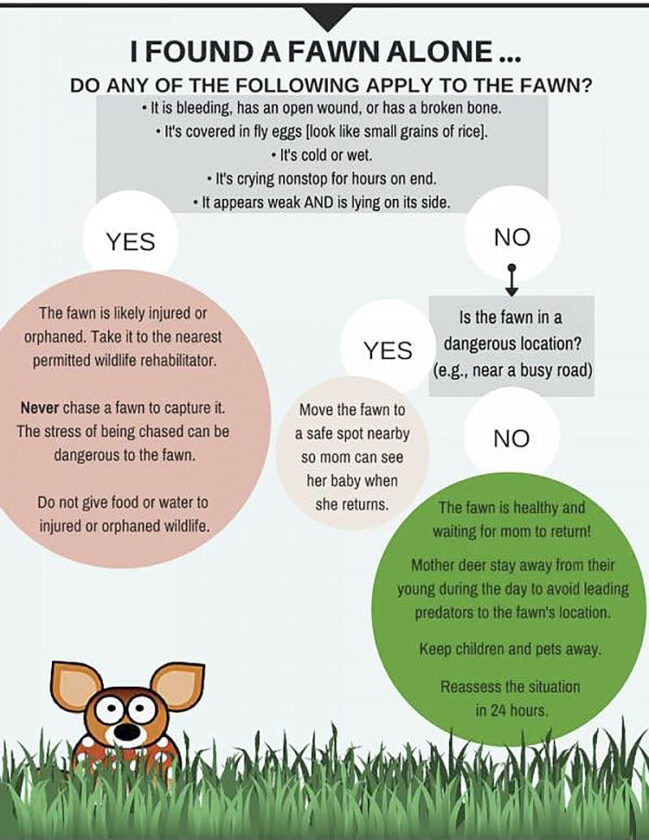
This chart, posted on the U.P. Wildlife Rehabilitation-Keweenaw Group's Facebook page, can help in judging what to do when coming across a fawn. (Courtesy photo)
In June 2018, Dr. Donald and Sally Jacobs found this fawn on the welcome mat outside their front door at 1609 Parkview in Iron Mountain. It is normal for fawns in the first few weeks of life to bed down alone for hours where their mothers leave them, while she stays away to avoid potentially drawing predators. It does not mean the fawn has been abandoned. If judged to be in a risky location, the fawn can be gently moved to a nearby site — the doe will not "reject" it for having a human smell, wildlife experts advise. If the fawn flees, do not chase; the exertion could kill the fawn. (Theresa Proudfit/Daily News file photo)
This chart, posted on the U.P. Wildlife Rehabilitation-Keweenaw Group's Facebook page, can help in judging what to do when coming across a fawn. (Courtesy photo)
Trending
As white-tailed deer begin to give birth in the region, a grim reality exists in the Upper Peninsula: Almost all fawns removed from the wild this summer, for whatever reason, will have no place where they can be taken.
This situation has wildlife rehabilitators and the Michigan Department of Natural Resources pleading with the public to leave fawns be if found alone.
Each spring brings reports of fawns supposedly "abandoned" by their mothers. The story tends to be the same: a fawn discovered motionless and pressed to the ground, no doe in sight despite a steady human vigil for mom.
It is common for does to leave fawns unattended for hours in the first few weeks of life, according to the DNR. This behavior minimizes drawing predators' attention to the fawn, which when born has almost no scent. A doe with twins will even leave the two at different locations so if it loses one, the other might evade detection.
But she usually is nearby and will regularly return to feed the baby, which otherwise is hardwired to remain bedded down where mom leaves it -- even if that's on a porch or deck, said Bill Scullon, a Michigan DNR wildlife supervisor.
"That's how they behave," Scullon said. He added that does regularly choose some seemingly unlikely spots to drop fawns, which when found usually are just fine.
"A vast majority of fawns do not need rescuing," said Lynn Hietala of the U.P. Wildlife Rehabilitation-Keweenaw Group, which covers Houghton, Keweenaw, Baraga and Ontonagon counties.
Yet with the current situation, rescuing a fawn is almost impossible, even if intervention appears warranted -- the doe obviously is deceased, the fawn has been continuously calling for hours or it has a visible and serious injury.
When called in, officials likely can't help short of putting the young animal down, they advised. "Usually, they have to euthanize it," Scullon said.
Why is that the only option for fawns? A lack of facilities and rehabilitators in the U.P., coupled with restrictions on how and where fawns can be housed.
Last year, only Hietala of the U.P. Wildlife Rehabilitation-Keweenaw Group and Kyann Clarke of Superior Wildlife Rehab & Education Center of Marquette accepted fawns. But this spring, Hietala had to bow out due to ongoing health problems from Lyme disease.
It leaves only Clarke still doing fawn rescue work in the Upper Peninsula -- and then only from Marquette County, as fawns can't be transported across county lines unless the facility has enough space and enclosures to keep them apart. This is to stem the potential spread of chronic wasting disease, or CWD.
Clarke, who operates out of her home, can only accommodate six fawns on her property. They will require months of care before they can be released in the fall, so she tends to fill up quickly.
But even if Clarke had more space, there's another obstacle to rescuing fawns from elsewhere: They must be returned to the county they came from no later than October. Transporting deer is dicey, Hietala said, as they can die from stress and often need to be sedated, which has risks to the animal as well.
"We need more (local) fawn rehabbers," Hietala said, adding at least one in each county would be ideal.
But that won't happen quickly enough for this season. Fawns can only legally be taken in by someone properly licensed and trained for their care. Those willing to seek that credentialing must take classes and have their facilities inspected, then start with small mammals, usually as a subpermittee with an experienced rehabilitator, said Clarke, who is founder and executive director of Superior Wildlife Rehab & Education Center.
It takes a full permit, however, to work with fawns, Clarke said.
The DNR has more information on wildlife rehabilitation and the permitting process in Michigan online at https://www.michigan.gov/dnr/managing-resources/wildlife/wildlife-permits/wildlife-rehabilitation-permit-information.
Those tempted to try raising a fawn, or any young animal, themselves should know that's illegal -- they could face a fine and the animal will be confiscated. These babies often have specific nutritional needs as well that the average household is not equipped to meet, they said.
And if that effort does manage to get the fawn to maturity, it will be habituated to humans, ill-prepared for the wild and might even be dangerous if a young buck that could turn aggressive as an adult, Clarke warned.
The two rehabilitators and the DNR encourage anyone who believes they have a fawn or other young animal at risk to contact them before stepping in:
-- Lynn Hietala, U.P. Wildlife Rehabilitation-Keweenaw Group, 906-370-1043.
-- Kyann Clarke, Superior Wildlife Rehab & Education Center of Marquette, 406-552-5680.
-- Michigan DNR Crystal Falls Field Office, 906-875-6622.
They also caution not to try providing food, water or other care for any wild animal unless under the direction of a rehabilitator, veterinarian or the DNR.
Finally, Clarke advised that anyone who removes an animal from the wild for any reason must contact a licensed rehabilitator, veterinarian or the DNR within 24 hours, or 48 hours on weekends.
They would prefer consulting people, if possible, before they take action.
"We can help the public decide," Clarke said, "whether that animal needs to be admitted."
———
Betsy Bloom can be reached at 906-774-2772, ext. 85240, or bbloom@ironmountaindailynews.com.