US wins 113 medals at Summer Games
Personal welfare of athletes draws heightened focus
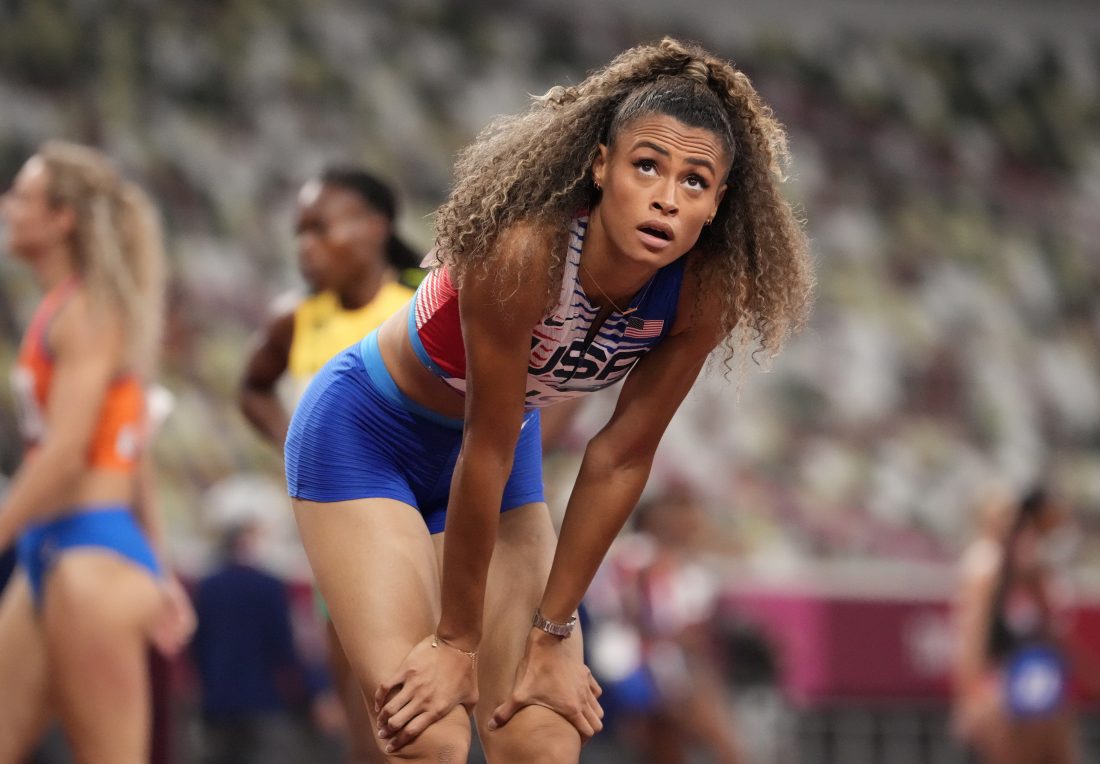
Sydney Mclaughlin of the United States after her team won the gold medal in the final of the women's 4 x 400-meter relay at the 2020 Summer Olympics, Saturday, Aug. 7, 2021, in Tokyo, Japan. (AP Photo/Charlie Riedel)
TOKYO (AP) — Kara Winger is the American record-holder in the javelin throw who just wrapped up her fourth Olympics. She has never finished higher than sixth place.
When she got the call over the weekend telling her she would be carrying the flag Sunday for the United States at the closing ceremony of the Tokyo Games, her first reaction was “shock.”
“I expected tweets with people saying ‘What has she done?'” Winger said.
Turns out, an awful lot over a career that has spanned two decades. That the American athletes chose her as flagbearer is a fitting lens through which to view the U.S. accomplishments at these Games.
The Americans won 113 medals, which, for the fifth straight Summer Games, was double-digits more than the nearest competition. It was, however, eight fewer than what they won five years ago in a Rio de Janeiro Olympics with fewer events.
When the athletes voted for Winger to represent them, they tapped into the core message resonating inside a fractured, fractious U.S. Olympic family over the last few years: The medals shouldn’t matter more than the athletes who win them. Or sometimes not matter at all.
“We spent a ton of energy on creating an environment where people could be heard, and feel safe to be heard,” said Sarah Hirshland, who came on as the CEO of the U.S. Olympic and Paralympic Committee in 2018.
She was tasked with repairing the damage from sexual-abuse cases that led athletes to wonder if they were valued for more than simply what they won.
If Winger as flagbearer is one sign that the USOPC has made some headway, then Simone Biles gets credit for making sure the message stayed front-and-center despite the hectic, pandemic-tainted run-up to an Olympics.
The willingness of the highest-profile athlete at the Games to step away because it didn’t feel right, and to place her personal welfare over victory for herself and country, was startling at first.
Much more than costing medals, what Biles did was re-center the focus. As the Olympics moved into their second week, all but the most cynical observers started celebrating athletes for winning bronze — or nothing — even if they were picked to win gold.
“These are not the USOPC’s medals, these are the athletes’ medals,” Hirshland explained as the Biles decision was still reverberating.
That was part of what Hirshland pitched as a new outlook for the USOPC.
Leading up to the Games, the USOPC introduced new mental-health offerings and created a new athlete-service division — first as a nod to the fallout from the sex-abuse cases, then as a resource to help athletes cope with a yearlong delay and the COVID pandemic.
Their offices stayed busy over the 17 days in Tokyo.
In the end, COVID-19 knocked out only four of the 600-plus athletes officially named to the team, a remarkable logistical challenge in a pandemic that came with its share of stumbles and critiques. Some athletes who worked all their lives to get to this point were bitter that they couldn’t share the trip with friends, family or fans.
The medal count did fall by 6%, even though there were more sports and more medals to be won.
And yet, there’s a reason Winger got the nod to carry the flag Sunday night.
Her fellow Olympians appreciated the story of an athlete who devoted her life to throwing the javelin — “A lot of us are in weird sports,” Winger acknowledged — knowing the rewards wouldn’t all be hanging from her neck in the end.
“An absolute joy,” Winger said. “I don’t know what the medals feel like, but I don’t think I’ll ever top this honor. And for me, that’s totally, totally fine.”
… Sue Bird capped off her unblemished 17-year Olympics run with a record fifth gold medal. All she and longtime U.S. teammate Diana Taurasi have done on the international stage is win and now stand alone with five gold medals — the first basketball players ever to accomplish that feat — after a 90-75 win over Japan on Sunday at the Tokyo Games. The U.S. has now won the last seven Olympic gold medals.
… Allyson Felix won her 11th Olympic medal, combining with her American teammates to finish the 4×400-meter relay in 3 minutes, 16.85 seconds for a runaway victory. The team of Felix, Sydney McLaughlin, Dalilah Muhammad and Athing Mu was never in jeopardy in this one. Poland finished second, 3.68 seconds behind, and Jamaica finished third.
… The U.S. men won their first gold medal in a track race at the Tokyo Games with a victory in the 4×400-meter relay. The team of Michael Cherry, Michael Norman, Bryce Deadmon and Rai Benjamin completed four laps of the Olympic oval in 2 minutes, 55.70 seconds. It was a fifth gold for the U.S. men in the 4×400 since 1996.
… The U.S. won its third consecutive gold medal in women’s water polo, pounding Spain 14-5 in the final. Maddie Musselman scored three times and Ashleigh Johnson made 11 saves as the U.S. improved to 134-4 since it won gold at the 2016 Rio de Janeiro Games.
… Nelly Korda gave the Americans a sweep of gold medals in golf, holding on for a one-shot victory in a thrill-a-minute finish to the Olympic women’s golf competition. Korda led by as many as three shots on the back nine. In the end, she needed two putts from just inside 30 feet on the 18th hole for par and a 2-under 69.
… The United States won its first Olympic gold medal ever in women’s volleyball by beating Brazil in straight sets. The U.S. had won silver three times and bronze twice previously for the most medals by any country that hadn’t won gold. But the Americans finally completed that quest by beating the country that denied them gold in the final match in both 2008 and 2012. The victory allowed U.S. coach Karch Kiraly to join China’s Lang Ping as the second person to win gold as a player in volleyball and then lead a country to gold as coach. Kiraly won gold indoor as a player in 1984 and ’88. He also won gold in beach volleyball in 1996.
… Jennifer Valente got up from a crash in the omnium-ending points race to hang on for the gold medal, capping what had been an otherwise frustrating and disappointing Olympics for American cycling. Valente won the opening scratch race, picked up three sprints in the points race and performed well in the elimination race to take an eight-point lead into the points race, where points are awarded for sprints every 10 laps.
… A Japanese team of All-Stars won the Olympic baseball gold medal for the first time, beating the United States 2-0 behind Munetaka Murakami’s third-inning home run. Masato Morishita and four relievers combined on a six-hitter, and the Japanese men (5-0) matched the accomplishment of the women’s softball team, which upended the Americans for their second straight gold medal. America, the nation that introduced baseball to Japan in 1872, finished 4-2.