MHSAA OKs expanded hoops schedules
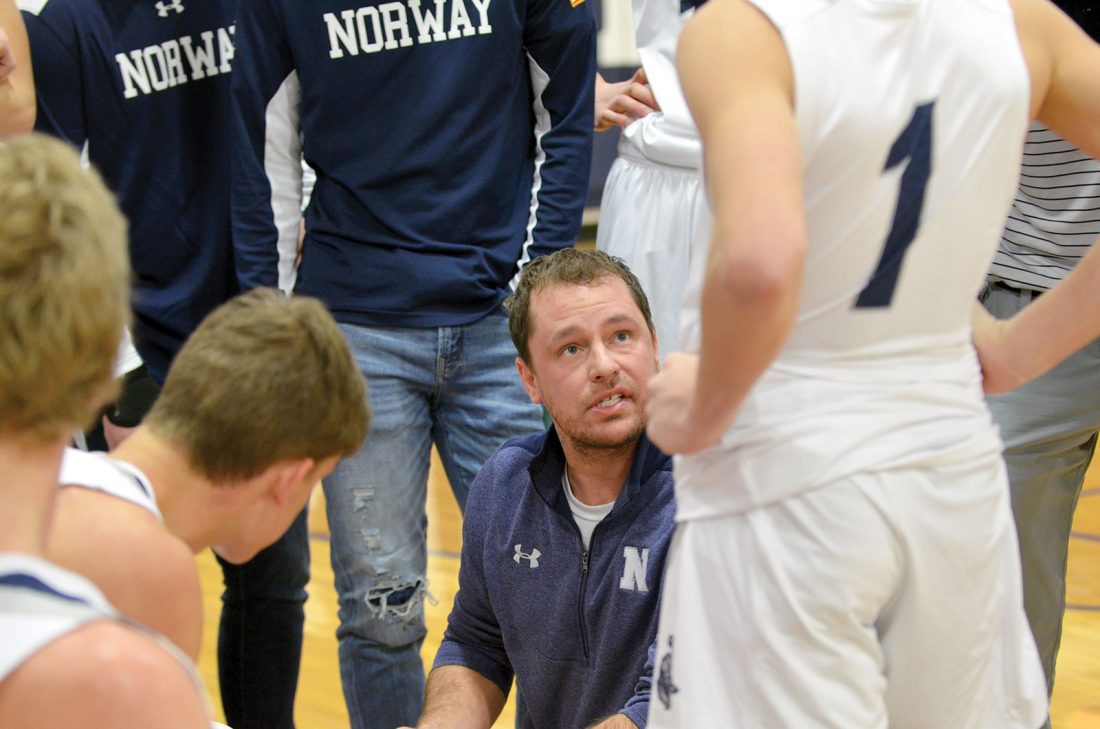
In response to the MHSAA’s decision to expanded the allowable regular-season basketball games to 22, Norway coach Jeff Gallino said he was all for the idea because it would allow teams to schedule more games outside their conferences. “One less week of practice in the preseason may cause a little bit of sloppy play earlier on, but I think it will be beneficial overall,” the coach said of the change. (Dennis Mansfield/Daily News photo)
EAST LANSING — High school sports fans will get even more of what they love, after a recent vote by the MHSAA’s Representative Council.
An increase in the number of regular-season games high school basketball teams are allowed to play might have been the most visible action taken by the council during its annual winter meeting March 25 in East Lansing.
The council approved a Basketball Committee proposal that will allow, beginning with the 2022-23 season, high school basketball teams to play up to 22 regular-season games at every level. Teams previously played a maximum of 20 games during the regular season, with the adjustment bringing MHSAA member school schedules more in line with what is allowed in most other Midwest states.
Additionally as part of the proposal, mandatory preseason practice was reduced by one week, allowing teams to begin playing games after 14 days instead of 21.
Norway boys varsity basketball coach Jeff Gallino said he liked the idea of playing additional games.
“We are excited about getting a couple extra games in and hopefully playing opponents that we usually don’t have on our schedule,” he said. “One less week of practice in the preseason may cause a little bit of sloppy play earlier on, but I think it will be beneficial overall.”
Forest Park girls varsity coach Kim Bjork said she didn’t hold a strong opinion either way.
“The past two seasons we haven’t played 20 games so that would be nice if we could get there,” Bjork said, referring to COVID-19 and weather-related cancellations. “Also with the shortages of officials, it may be difficult for ADs to get games covered.
“It will definitely open up some options to play more non-conference opponents,” she added. “I definitely don’t think it’s a bad concept but I think there are some hurdles to overcome first. I’m all for progression and this will definitely give some flexibility to teams wanting to play out of their conference to develop their programs.”
So much of the implementation of the change will fall on athletic directors in terms of scheduling and securing officials and other personnel to work the added games.
North Dickinson athletics director Mike Roell sees both sides of the issue.
“On the positive side, it opens up a couple more games for teams if they wish to get into a holiday tournament or fill a hole in their schedule,” Roell said. “Two more games gives more opportunity to kids and coaches to play more games and improve more during the season and better prepare you for the tournament.
“On the negative side, it takes away practice time for coaches where I think a lot of kids are lacking fundamentals,” he added. “There is already a referee shortage and this is only going to make it worse. The school records have been based on a 20-game schedule. Now kids have the opportunity to play 22 games per season which will make a difference over a career.”
Roell said from an AD’s point of view, he’s interested to see how schools are going to approach the 22-game schedule because of the difficulties getting in all 20 games — vis-a-vis referees, weather and transportation — with both boys and girls teams playing at the same time.”
Adding two basketball games was far from the only changes approved by the Representative Council.
Members also approved a proposal by the Classification Committee that will result in postseason divisions more reflective of the number of schools actively sponsoring teams for that season. Divisions are assigned by taking the number of teams playing a sport and dividing equally by the number of team championships awarded in that sport (for example, four in baseball and softball).
Previously, by the time seasons started, the smallest-school divisions in many sports ended up with fewer teams than larger-school divisions because small schools would declare they would be sponsoring a team during the classification process in March but then be unable to do so because of lack of participation or other reasons.
With the change, schools that have indicated they will sponsor a sport but haven’t participated in that sport as a team or with individual qualifiers over the previous two years will be removed from the classification process before divisions are determined. Those schools that have been removed must then notify the MHSAA they have an active team before being added back.
A number of other actions will affect competition as quickly as this spring and into the 2022-23 school year, including:
— The council approved a cross country/track and field proposal to allow for more MHSAA tournament opportunities for wheelchair athletes. Starting with the spring 2022 season, regional and final meets will include four events for wheelchair participants — 100, 200 and 400-meter races and shot put. The events will be open to wheelchair track and field athletes at MHSAA member schools.
— The council approved the expansion of postseason paralympic opportunities in swimming, adding a 100-yard freestyle heat to the 50-yard freestyle heat that has been offered at the finals since 2020.
— In baseball and softball, proposals were OK’d to allow district first-round games to be played during the week before Memorial Day. Baseball may play first-round games that previous Thursday, Friday or Saturday, and softball may play that previous Thursday and Friday, beginning this upcoming season. Previously, all first-round games were played the Tuesday after Memorial Day.
The change is expected to alleviate pitch count concerns in baseball and provide scheduling flexibility for later district rounds that could allow athletes, especially at small schools where baseball and softball players frequently participate in track and field.
— Another change proposed will raise the enrollment cap for cooperative hockey programs, potentially allowing for more opportunities for schools to contribute athletes who wish to play the sport.
— The council approved a Classification Committee proposal that will allow football teams to opt up in division after the annual release of classifications for the upcoming season in late March/early April. Football teams may opt up one division, with Executive Committee approval. All football opt ups will be for a minimum of two years, and the Executive Committee will consider those requests at only its April and May meetings each year.
— The council approved a number of increased benefits for MHSAA-registered game officials, including raises in postseason game fees paid to officials across all sports. Also moving forward, MHSAA officials will be provided membership in the National Association of Sports Officials (NASO), which will provide expanded liability insurance plus additional resources and professional services for all MHSAA registered officials. The council also approved a change to the registration process and fees that will automatically provide each official registration in two sports. All three changes were proposed by the Audit and Finance Committee.
— The council also approved a rule change allowing the use of school transportation during summer, but it must be funded from school-approved activities of booster clubs, school teams, student groups and community, civic or service groups.
Daily News sports writer Jerry DeRoche contributed to this report.
Local Sports
IM Juniors advance to state LL tourney

Tigers win 6th straight, beating Phillies 10-2
Brewers and Pirates rained out, setting up DH today
PITTSBURGH (AP) — The scheduled game between the Milwaukee Brewers and Pittsburgh Pirates was postponed because ...

Brewers add Bryse Wilson to pitching staff
U-M agrees to 2-year deal with Boynton