UP has six shrew species; white squirrel stocks up
Northwoods Notebook
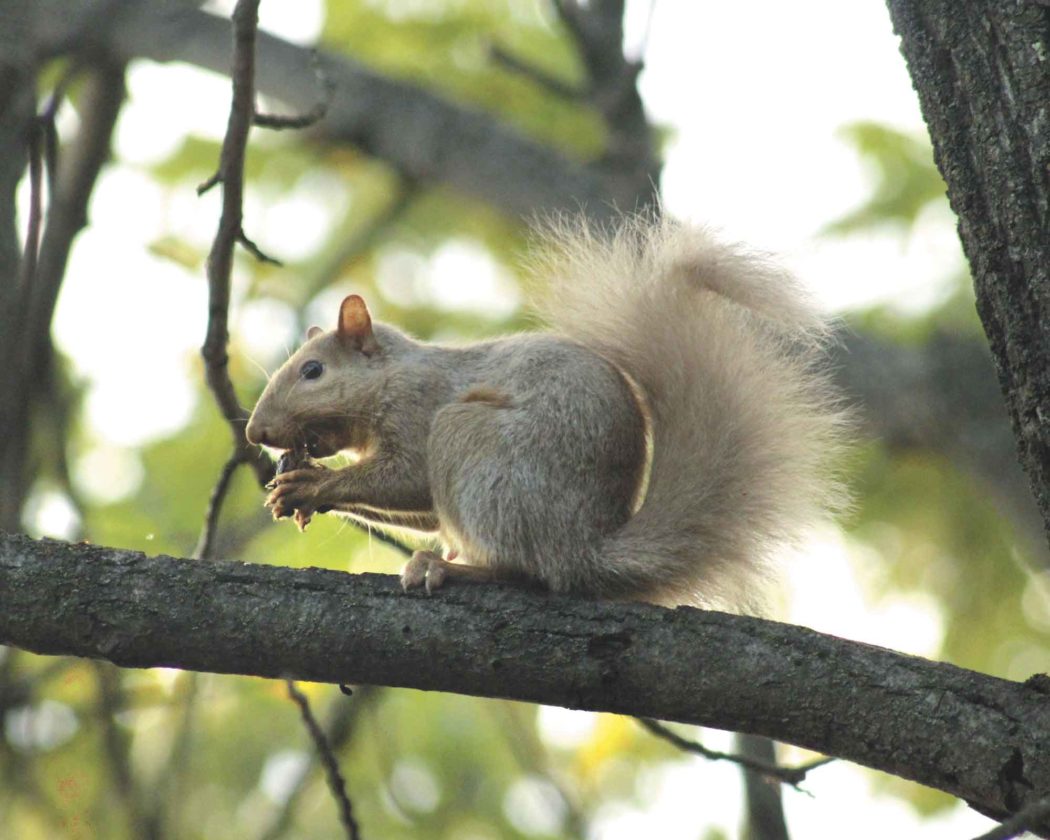
A squirrel eats a black walnut out of a tree on Iron Mountain’s east side. Several area residents have reported seeing the “blonde” squirrel in the area over the summer. It’s a gray squirrel with a white color morph. (Theresa Proudfit/Daily News Photo)
I’ve focused in the past on the larger mammal predators in the region — bears, wolves, even fox and weasels.
This week, I want to talk about the smallest of our carnivorous mammals: shrews.
At Six Mile Lake in northern Dickinson County, shrews account for most of what our cats pick off in the household, much more than rodents such as mice and voles. We’ve found them both newly killed and long dead and desicated, pushed underneath furniture with the other cat toys.
I wondered why. After all, a shrew at first glance would seem to have little reason to venture into a human household, as the insects that normally make up their diet would seem better found outside.
Yet a week ago I watched the cats drive a shrew into the line of shoes we have under a bench in the living room. I did try to capture the tiny creature as it scrambled among the shoes, but it escaped into the closet.
Bad move on the shrew’s part — the next morning, one of the cats was playing with a very recently deceased shrew.
Shrews look a lot like rodents but are quite different. Like moles, they are insectivores, primarily on a low-carb diet, rather than mice or voles that prefer grains and seeds, though they’ll certainly consume bugs if they can find them.
Six shrew species can occur in the Upper Peninsula: arctic, masked, smoky, pygmy, water and northern short-tailed shrew. The pygmy is the smallest mammal in North America, not surprising given the name — I mean, to be known as the pygmy among shrews, it’s got to be tiny.
But what I’ve seen so far looks to be northern short-tailed shrews. They have the distinction of having a venomous bite that helps it subdue prey that can be substantially larger, such as mice and frogs.
Like hummingbirds, their avian counterpart, shrews have super-high metabolisms that require it consume a lot of calories. So they’re constantly moving and foraging, which might explain why they end up indoors, said James Harding, an instructor and herpetology specialist with the Department of Integrative Biology at Michigan State University. He also knows a little bit about shrews.
Shrews also have poor vision and sense of smell — surprising, given the length of snout — but a keen sense of touch, with whiskers like cats to help feel out spaces. They may, like bats, use a form of echolocation as well to determine what’s ahead of them, according to University of Michigan researchers.
But it puts them at a disadvantage in knowing if a room has a cat. It does have one defense against predators — it can release a smelly musk that might make an attacker think twice.
“Not quite as palatable as mice,” Harding said.
That apparently doesn’t deter our cats, which are more than willing to play with them and then leave the body uneaten for us to find.
*****
Anna Bafile, who also works at The Daily News, has had a rare visitor in her yard on East A Street this summer: a gray squirrel that is all white in color. Theresa Proudfit got a chance to photograph it earlier this week.
This is a white color morph, as it lacks the pink eyes that are characteristic of an albino. Gray squirrels can show wide ranges of colors, including white, black, red, black with red tails or bellies, and spotted with white. The gray version can vary as well — some dark gray, some lighter, some with pale bellies, some all gray.
The black gray squirrel used to be a rarity but has grown more common — as the number of them rise, the recessive gene that can produce them becomes more likely to align.
I could not find many other types of squirrel that show this amount of variation, though pet rats and rabbits certainly do. Red foxes, too, have a “cross” version that can be fairly common in some areas.
*****
Wildlife rehabilitator Phyllis Carlson said reports from the state indicate five of seven birds she sent in this summer have tested positive for West Nile virus.
One was a young broad-winged hawk brought in after another fledgling, likely its nestmate, was discovered down in a yard with no parents in sight. Carlson fears they, too, succumbed to the virus. At least the first fledgling survived.
Another was a great horned owl and a kestrel falcon. She has yet to hear back on two of the birds, one of which was a robin.
Thankfully, the number of reports has dropped off dramatically now that autumn has arrived, said Monica Joseph, wildlife biologist at the Michigan Department of Natural Resources’ Crystal Falls office.
“It seems like the bulk of the cases have run their course,” Joseph said.
Betsy Bloom can be reached at 906-774-2772, ext. 40, or bbloom@ironmountaindailynews.com.