
A case against grape jelly ‘For the Birds’
Northwoods notebook
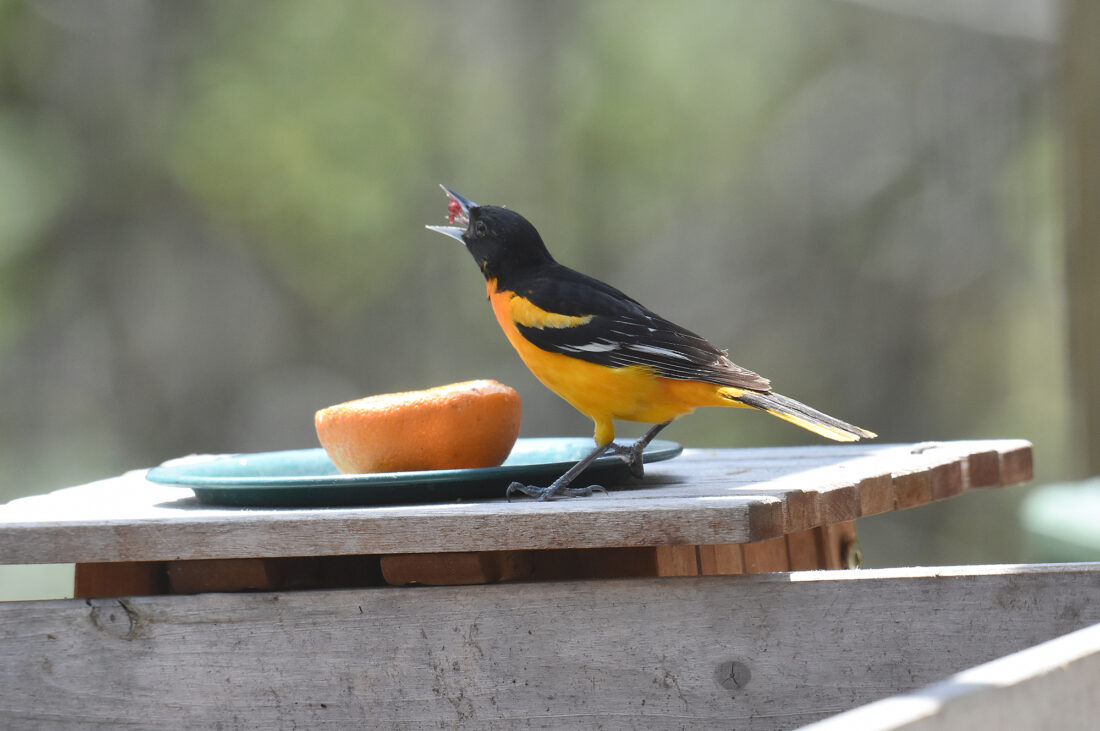
A male Baltimore oriole feeds on grape jelly placed in an orange peel at Six Mile Lake in Dickinson County. Experts are beginning to recommend against the practice of providing jelly for the birds, citing the danger it can pose if the sticky substance gets into feathers. (Betsy Bloom/Daily News photo)
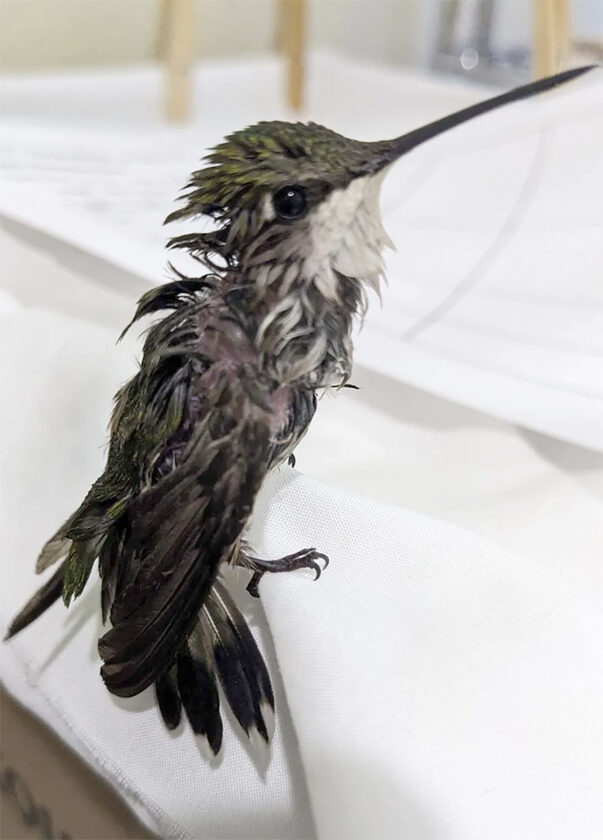
This hummingbird had to go to a wildlife rehabilitator after getting covered with grape jelly. (Photo by Audrey Gossett, Raptor Education Group Inc., via Laura Erickson’s For the Birds website)
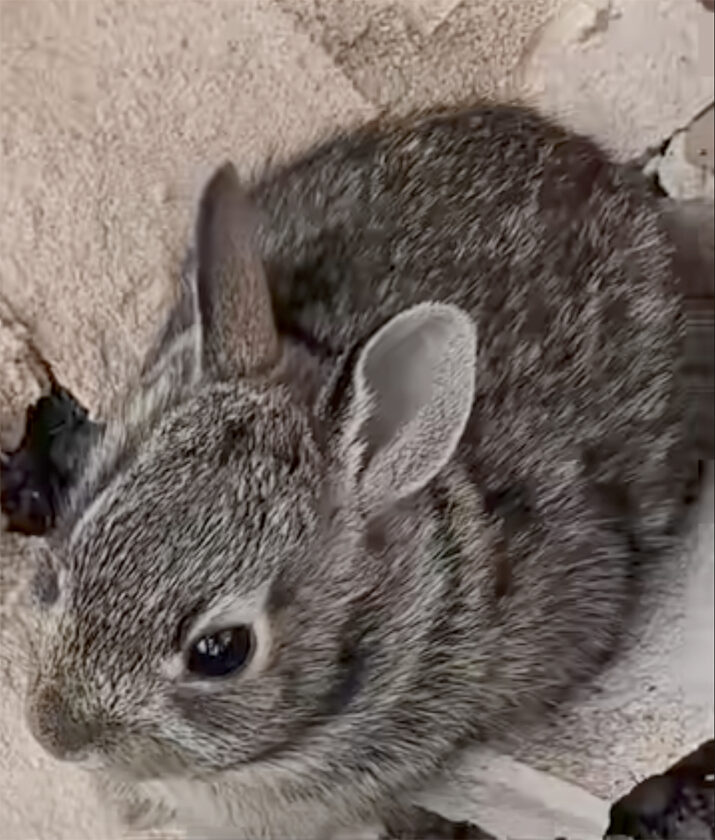
While this baby cottontail rabbit might look too young to be away from mom, it’s likely old enough to be on its own. (Screenshot from video taken by Denise Lind, The Daily News)
A male Baltimore oriole feeds on grape jelly placed in an orange peel at Six Mile Lake in Dickinson County. Experts are beginning to recommend against the practice of providing jelly for the birds, citing the danger it can pose if the sticky substance gets into feathers. (Betsy Bloom/Daily News photo)
This hummingbird had to go to a wildlife rehabilitator after getting covered with grape jelly. (Photo by Audrey Gossett, Raptor Education Group Inc., via Laura Erickson’s For the Birds website)
While this baby cottontail rabbit might look too young to be away from mom, it’s likely old enough to be on its own. (Screenshot from video taken by Denise Lind, The Daily News)
Trending
Another year has brought another online debate -- and warnings -- about providing grape jelly for the orioles.
But there's a new wrinkle I recently learned that I feel compelled to pass along.
In the past I've reprinted information about feeding jelly from an interview I had in 2019 with Laura Erickson of Duluth, Minn., an author who was science editor at the Cornell Lab of Ornithology, one of my favorite online reference sites for bird information.
Erickson also has a podcast, blog and long-running public radio program, "For the Birds"; more information on her impressive background can be found on her website, www.lauraerickson.com.
Back in 2019, she said grape jelly should pose no health hazard to orioles but did caution not to go overboard on the amount and use small containers.
The reason? In 2004, at the height of spring migration when the birds were numerous and she knew she was going to be gone much of the day, Erickson put out what she figures was about half a jar of jelly in a large bowl. When she returned, she found a tiny red-breasted nuthatch mired up to its eyeballs in the sticky mass. Luckily, it was a bird she'd been able to hand-feed through the winter, so it was tame enough to endure several baths and survived, Erickson said, though for some time it retained a purple stain on its belly. She fears it might have smothered or died from hypothermia had she not found it in time.
While it did recover, "I've still never forgiven myself," Erickson wrote on her blog in June 2023.
Still, she continued to provide grape jelly for the birds, being more careful about how it was offered. Back then, Erickson also counseled to check the label and avoid any that have artificial sweeteners or coloring, adding she preferred the jelly be made with sugar rather than high-fructose corn syrup. Generally, the simpler the ingredients, the better the jelly likely is to be for the birds, she said.
I've passed along that same information for several years, and I have to apologize to Erickson, because I did not realize that in June 2023 she had changed her opinion.
In a blog post titled "Jelly Is Killing Hummingbirds. It's time to just say no.", Erickson wrote:
"Today, June 3, 2023, I learned of a whole new hazard from feeding jelly from Marge Gibson, the director of REGI (Raptor Education Group Inc.), the state-of-the-art rehabilitation center in Antigo, Wisconsin, who alerted me to this post on REGI's Facebook page:
'Earlier this week REGI admitted three adult ruby-throated hummingbirds from different areas, within a two-hour period. They were covered in grape jelly. One patient was deceased on arrival; the others are alive but struggling. Other hummingbirds were admitted earlier in the month, and there is little doubt more will follow.
'During the past few years providing grape jelly to orioles has become a popular alternative to the traditional orange slices/halves. Grape jelly was a convenient energy food as it is a "semi solid" substance even in colder temperatures and easy to keep contained in a bowl. It provides a quick source of energy during migration. But then, for whatever reason, the use of jelly, the stuff we've always understood to be sticky, even as it covers the faces and clothing of our own children, bypassed logical use, and morphed into a multi-species, year-round jelly feeding frenzied fad.
'A problem in hot weather is jelly melts (liquifies) somewhat and therefore is more available to adhere to the bird's body, feet, and feathers. Some people added water to the jelly and began serving it in larger bowls. This fad occurred even within the birding community. Businesses became involved, developing new types of jelly feeders and bird specific jelly. A photo that became my own personal nightmare was on a birding site recently. It was of an adult Baltimore Oriole perched on a jelly feeder and feeding jelly to its own babies. That behavior is outside the natural history of this species and causes more questions about changes that may be happening due to a high sugar diet. Oranges are a healthier and more safe way to provide high energy food.
'REGI's current recommendation is to stop feeding jelly to birds year-round."
Erickson concluded:
"I've been writing about feeding jelly since the 1980s, and posting photos of warblers and tanagers at my feeders. Those photos were taken only during exceptionally harsh springs, but now I feel responsible for some of the popularizing of jelly in feeders. Since the horrifying experience with the red-breasted nuthatch, I've added a lot of caveats, and also posted my own and other people's concerns about the low nutritional value of jelly, but that hasn't been enough.
"I've justified my own feeding jelly because, in 2004 and some later springs, when insects were just not available in the sub-freezing temperatures, people found dead warblers and tanagers in the woods where they'd apparently succumbed to starvation. In extreme situations like that, jelly is better than nothing.
"But as that nuthatch proved, even in extreme situations, jelly is still dangerous. Nowadays, people want quick sound bytes, not nuanced information, and many people don't put the well-being of birds above their own pleasure in watching them. So I no longer have sweet advice about jelly. It's time to just say no."
I have to admit -- as you can see from the photo -- that I have been an enthusiastic jelly provider. And yes, while the oranges do attract orioles, the birds regularly seem to bypass them if jelly is out. The only time I've been lucky enough to have scarlet tanagers come to the deck, it's been for jelly.
I do set it up with Erickson's past words in mind, keeping the jelly shallow and spread among several small containers or orange peels that give the birds a clean rim on which to perch. And I quit with the jelly when the birds appear to start nesting. As she said in 2019, if the adults start bringing fledglings to the jelly, well, that's just bad parenting.
Quite honestly, I'm not sure how I'll proceed with this new knowledge; it’s tough to give up the colorful avian crowd that make this time of year so special.
But I respect Erickson's views. So I'm passing them along.
I'm not going to recommend one way or another -- she and REGI have made the case well enough. I'll leave it up to individuals to make their own choices.
*****
Almost all of the expected summer resident birds appear to have returned. While we have not been blessed with indigo buntings at Six Mile Lake, plenty of others have in the Upper Peninsula. I saw a scarlet tanager fly over M-69.
The one prominent birdsong not yet heard is the call of the eastern whip-poor-will. Its cousin, the common nighthawk, has yet to turn up as well but both are usually among the last to arrive and first to depart in late summer.
I wouldn't be surprised to see the first Canada goose goslings in the next week. The Birding Wisconsin Facebook page already had photographs posted of wood ducklings jumping out of nesting boxes.
*****
One final caution: the time of the year has come when young mammals begin to appear. Our publisher, Denise Lind, spied three tiny cottontail rabbits taking shelter underneath the steps to a back entrance at The Daily News. She posted a video of them on the newspaper's Facebook page, https://www.facebook.com/IronMountainDailyNews.
She was concerned about such young bunnies being without a mother. But likely the three are pretty much on their own. Despite being born blind and nearly naked, cottontail rabbits are ready to leave the nest at about three weeks. They can start breeding when only 3 months old.
The temptation to step in will be further tested as does begin dropping fawns over the next few weeks. That usually triggers a wave of reports of fawns supposedly "abandoned" by their mothers, when the doe has left them hidden to avoid tipping off predators.
In most cases, leaving wildlife babies alone is the best approach. If in doubt, the U.P. Wildlife Rehabilitation-Keweenaw Group has a host of information on its Facebook page, https://www.facebook.com/UPwildlifeRehab/, including contact numbers.
———
Betsy Bloom can be reached at 906-774-2772, ext. 85240, or bbloom@ironmountaindailynews.com.