Iron Mountain museums open for the summer on Monday
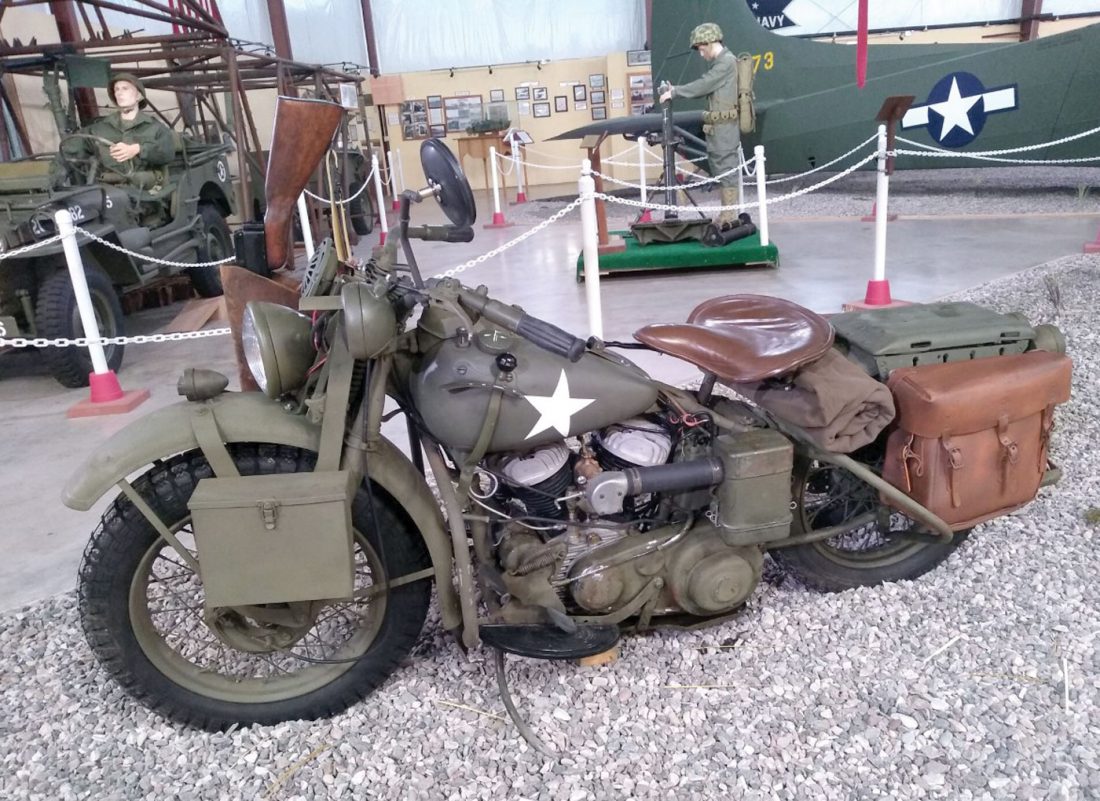
Guy Forstrom photo This WLA Harley-Davidson motorcycle, purchased in November 2021 by the Friends of the Museum and now on display in the World War II Glider and Military Museum, is among roughly 70,000 WLA motorcycles built by the famed Milwaukee-based company between 1942 and 1945. Thousands were sent to other countries under Lend-Lease Agreements. These bikes were nicknamed “Liberators” in Europe, since they were ridden by troops liberating towns and countries from German occupation. The WLA was used primarily for messenger and Military Police duties.
IRON MOUNTAIN — The Cornish Pumping Engine and Mining Museum and the World War II Glider and Military Museum, at 300 and 302 Kent St., will open for the season Monday.
The museums will be open from 9 a.m. to 5 p.m. Monday through Saturday and noon to 4 p.m. Sunday, until fall hours begin in September. Both museums are wheelchair accessible.
“Visitors to these two museums come from across the United States and around the world,” said Bill Cummings, president and historian of the Menominee Range Historical Foundation. “More than 4,455 people toured the museums last summer, making it the foundation’s best summer on record.”
Visitors often comment on the professionalism of the extensive displays and are amazed at the amount and quality of artifacts and information contained in these museums located in a smaller community.
“Surprisingly many local residents haven’t toured these museums, even though the Cornish Pump Museum opened in 1983 and the Glider Museum opened in 2011,” Cummings said. “It’s a wonderful place to learn more about our area and to bring visiting relatives and friends.”
The Cornish Pumping Engine and Mining Museum features the largest steam-driven pumping engine ever built in the United States. The 725-ton steeple compound condensing engine, designed in 1889 by Edwin Reynolds, chief engineer for the E.P. Allis Company — now the Allis-Chalmers Company — of Milwaukee stands 54-feet tall and has a 40-foot flywheel weighing 160 tons. The engine began operation in January 1893 at D Shaft of the Chapin Mine on South Stephenson Avenue just east of the Chapin Pit.
Dismantled in the summer of 1898 and placed in storage, the reassembled giant steam engine again went into operation in 1908 at the Chapin Mine’s new C Ludington Shaft, where it still stands. The pump could remove 3,190 gallons of water per minute from a depth of 1,522 feet. The Cornish Pumping Engine is a Michigan Historic Site (1958), a National Historic Site (1981), a Michigan Historic Civil Engineering Landmark (1984) and a National Historic Mechanical Engineering Landmark (1987).
A working model of the Cornish Pumping Engine and the pumping mechanism was fabricated by Clyde Unger on a scale of 1 inch to 24-inches. By pushing a button, visitors can activate the model, watching the steam engine’s flywheel turn and the high- and low-pressure cylinders rise and fall. The model’s pumping mechanism within the shaft, coordinated with the steam engine, also moves.
The museum also includes 16 cases chronologically documenting the history of the Menominee Iron Range with artifacts and period photographs, as well as an extensive collection of underground mining equipment, engines, ore cars, jack hammers, drilling equipment, smaller pumps, tuggers, scrapers, a skip used to transport miners to various mine levels, cars to transport miners to work areas and a dynamite car.
A photographic exhibit of the Iron Mountain Ford Motor Company Plant in Kingsford, which originally produced wooden parts for the Model T and later “woodie” station wagon bodies and 4,190 CG-4A gliders during World War II, is also featured.
An extensive display of tools, artifacts and historic photographs documenting logging and lumbering on the eastern Menominee Iron Range opened in the summer of 2021 and includes information on several sawmills as well as Iron Mountain’s Von Platen-Fox Lumber Company,
The World War II Glider and Military Museum features a WACO CG-4A World War II Combat Glider, one of seven restored combat gliders worldwide. Standing 12-feet high and 48-feet long, the glider has an 83-foot wingspan. The Iron Mountain Ford Motor Company Plant in Kingsford produced 4,190 of these gliders between December 1942 and August 1945, more by far than any other company in the nation at a lower cost than all other manufacturers.
A rare fully-restored World War II vintage Clark CA1 Airborne Bulldozer manufactured in Buchanan, Michigan, in 1944 and weighing 4,195 pounds is also on display. Approximately 1,500 airborne dozers, small enough to be transported in a CG-4A Glider, were built during World War II for the U.S. Army Corps of Engineers.
A fully-restored 1942 World War II Ford U.S. Army Jeep loaded into a CG-4A Glider framework and a World War II U.S. Army trailer also form a part of this exhibit.
New to the collection this season is a 1942 World War II WLA Harley-Davidson U.S. Army motorcycle acquired in mid-November 2021 with funds provided by the Friends of the Museum.
A comprehensive display of military uniforms from the Civil War to Desert Storm with information about the local men and women who wore them forms another important part of these exhibits. Historic photographs and vintage film footage also help tell the story. A 12-by-7-foot wall display on World War I history, commemorating the “Great War” and a collection of Spanish-American War photographs of Dickinson County’s Company E and more provide authentic views of these early conflicts.
Surrounding an early Sinclair gas station are the following fully restored Ford vehicles: a 1924 Model T Coupe, a 1928 Ford AA Fire Engine used at the local Ford Plant, a 1930 Ford Model A Tudor Sedan, a 1930 Ford Model AA Dump Truck, a 1939 V-8 De Luxe “Woodie” Station Wagon and a rare 1946 Sportsman “Woodie” Convertible Sedan, donated in April 2021 by the late Marcia McGregor.
Two airplanes hang from the museum ceiling. The carefully restored “Heiserman” is a small aircraft constructed by local pilot Charlie Heiserman, and the 3/4-sized Piper Cub replica represents the model used extensively during World War II to train glider pilots.
Another exhibit shows the evolution of local production of charcoal briquets utilizing wood waste products from the Ford Motor Company’s local plant in Kingsford. The sale of Ford Charcoal Briquets began in 1924, primarily marketed in Ford dealerships across the country. When the company ceased operations here in December 1951, the Kingsford Chemical Company was formed and the product name changed to Kingsford Charcoal Briquettes. Local production ended in September 1961, when the company moved to Kentucky.
The Menominee Range Historical Foundation is funded only through admission fees, gift shop sales, memberships, donations, bequests and occasionally grants. No tax dollars from city, county, state or national sources are received.
Volunteers and substitutes are always needed to welcome visitors at the museums. Those interested in assisting can contact Dianne Castelaz-Chiapusio at the museum archives building at 906-828-1822 or the Cornish Pump at 906-774-1086.
For more information about the Menominee Range Historical Museums, go to menomineemuseum.com.
Life
Foxy Loxy ladies to gather
NIAGARA, Wis. — The Foxy Loxy Red Hat ladies will meet at 12:30 p.m. Wednesday at The Brick in ...

Today’s birthdays

Skip the overpriced hair treatment
KHS Class of 1971 reunion

Strawberry Social and Quilt Show in Florence