
Trump says blockade will stay in force
Iran reopens Strait of Hormuz
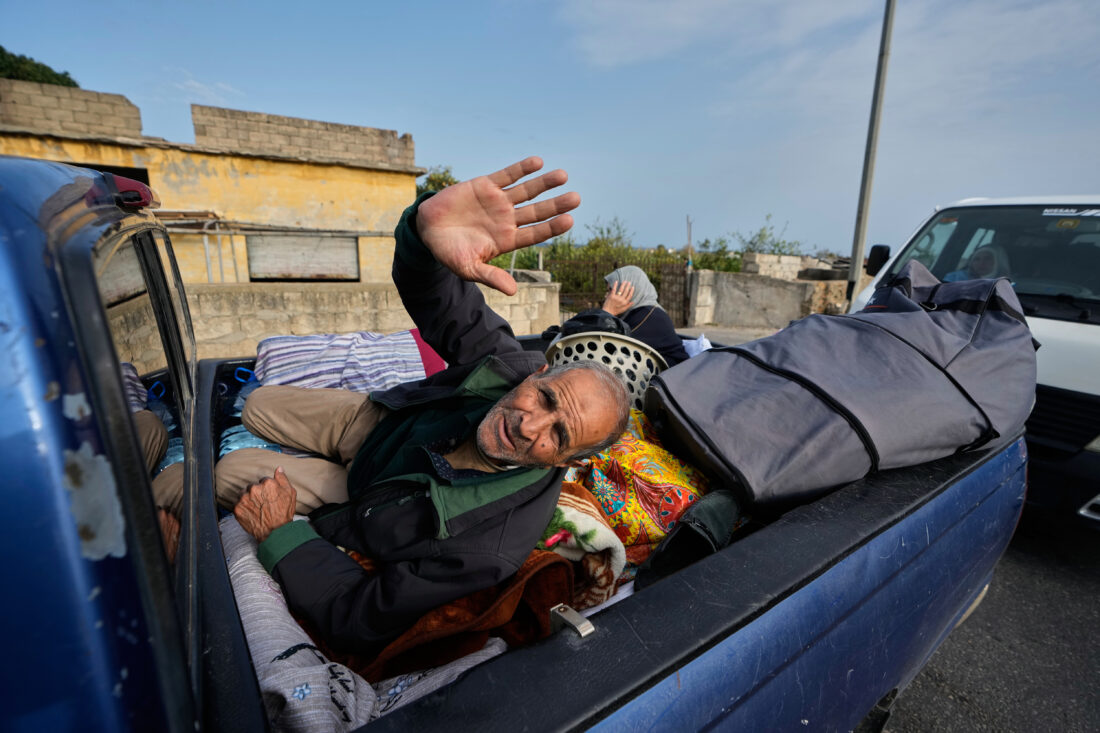
A displaced man gestures lying over belongings on a mini pickup, in Qasmiyeh near Tyre city, south Lebanon, as he returns with his family to their village following a ceasefire between Hezbollah and Israel, Friday. (AP Photo/Mohammed Zaatari)
BEIRUT (AP) — Iran said Friday it fully reopened the Strait of Hormuz to commercial vessels, but U.S. President Donald Trump said the American blockade on Iranian ships and ports “will remain in full force” until Tehran reaches a deal with the U.S., including on its nuclear program.
Iranian Foreign Minister Abbas Araghchi posted on X that the crucial waterway, through which about 20% of the world’s oil is shipped, was now fully open to commercial vessels, as a 10-day truce between Israel and the Iranian-backed Hezbollah militant group in Lebanon appeared to hold.
Araghchi said ships will use routes designated by the Islamic Republic in coordination with Iranian authorities, suggesting Iran planned to retain some level of control over the channel. It was not clear if vessels would have to pay tolls.
A data firm, Kpler, said movement through the strait remained confined to corridors requiring Iran’s approval.
Trump initially celebrated the Iranian announcement, posting on social media that the strait was “fully open and ready for full passage.” But minutes later, he issued another post saying the U.S. Navy’s blockade would continue “UNTIL SUCH TIME AS OUR TRANSACTION WITH IRAN IS 100% COMPLETE.”
A spokesperson for the Iranian Foreign Ministry said the blockade was a violation of last week’s ceasefire agreement between Iran and the U.S.
In comments published by Iranian state media, Esmail Baghaei said the strait is still under the supervision of Iran, which is serious about its commitments. But if the U.S. violates its own commitments, then Iran “will take the necessary reciprocal measures.”
“No leniency will be shown in this regard,” Baghaei said.
Trump also said Iran, with help from the U.S., is working to remove all mines from the strait.
Trump imposed the blockade earlier this week after Iran restricted traffic through the strait due to fighting in Lebanon, which Iran claimed was a breach of the Pakistan-brokered ceasefire.
The president’s decision to continue the blockade despite Iran’s announcement appeared aimed at sustaining pressure on Tehran as the fate of the two-week ceasefire reached last week remained uncertain. The ceasefire paused almost seven weeks of war between Israel, the U.S. and Iran.
Direct talks between the U.S. and Iran last weekend were inconclusive, as the two nations could not agree about Iran’s nuclear program and other points.
New talks
Trump suggested a second round of talks could happen this weekend.
“The Iranians want to meet,” he said in a brief telephone interview with the news outlet Axios. “They want to make a deal. I think a meeting will probably take place over the weekend.”
Oil prices fell Friday on hopes the U.S. and Iran were drawing closer to an agreement . The head of the International Energy Agency had warned that the energy crisis could get worse if the strait did not reopen.
Two Iranian semiofficial news agencies seemed to challenge Araghchi’s announcement about the strait.
Considered close with Iran’s powerful Revolutionary Guard, the Fars news agency issued a series of posts on X criticizing what it said was a lack of clarity over the decision to reopen the waterway and a “strange silence from the Supreme National Security Council and the negotiating team.”
Iran’s Supreme National Security Council has recently acted as the country’s de facto top decision-making body, amid doubts over the status of the new supreme leader, Mojtaba Khamenei, who was reportedly wounded early in the war.
The Mehr news agency also said the decision to reopen the strait needed “clarification” and required the supreme leader’s approval.
Truce in Lebanon
The ceasefire in Lebanon could clear one major obstacle to an agreement between Iran, the United States and Israel to end the war. But it was unclear to what extent Hezbollah would abide by a deal it did not play a role in negotiating and which will leave Israeli troops occupying a stretch of southern Lebanon.
Trump said in another post that Israel is “prohibited” by the U.S. from further strikes on Lebanon and that “enough is enough” in the Israel-Hezbollah war.
The State Department said the prohibition applies only to offensive attacks and not to actions taken in self-defense.
Shortly before Trump’s post, Israeli Prime Minister Benjamin Netanyahu said Israel agreed to the ceasefire in Lebanon “at the request of my friend President Trump,” but that the campaign against Hezbollah is not complete.
He claimed Israel had destroyed about 90% of Hezbollah’s missile and rocket stockpiles and added that Israeli forces “have not finished yet” with the dismantling of the group.
In Beirut, celebratory gunshots rang out at the start of the truce. Displaced families began moving toward southern Lebanon and Beirut’s southern suburbs despite warnings by officials not to return to their homes until it became clear whether the ceasefire would hold.
An end to Israel’s war with Hezbollah was a key demand of Iranian negotiators, who previously accused Israel of breaking last week’s ceasefire with strikes on Lebanon. Israel had said that deal did not cover Lebanon.
The fighting has killed at least 3,000 people in Iran, more than 2,290 in Lebanon, 23 in Israel and more than a dozen in Gulf Arab states. Thirteen U.S. service members have also been killed.
National News
An age of innovation in the US
News briefs
Court allows abuse verdict WASHINGTON (AP) — The Supreme Court is rejecting a push by President Donald Trump ...
Justices protect Fed, but uphold other Trump firings
Firefighters killed were trying to shield themselves from flames
US and Iran pause strikes, disagree over next steps
News briefs
Three die fighting fires BEAVER, Utah (AP) — Three firefighters have died and two were injured while battling ...