Menominee Range Memories: Nightingale a local hallmark of Roaring Twenties
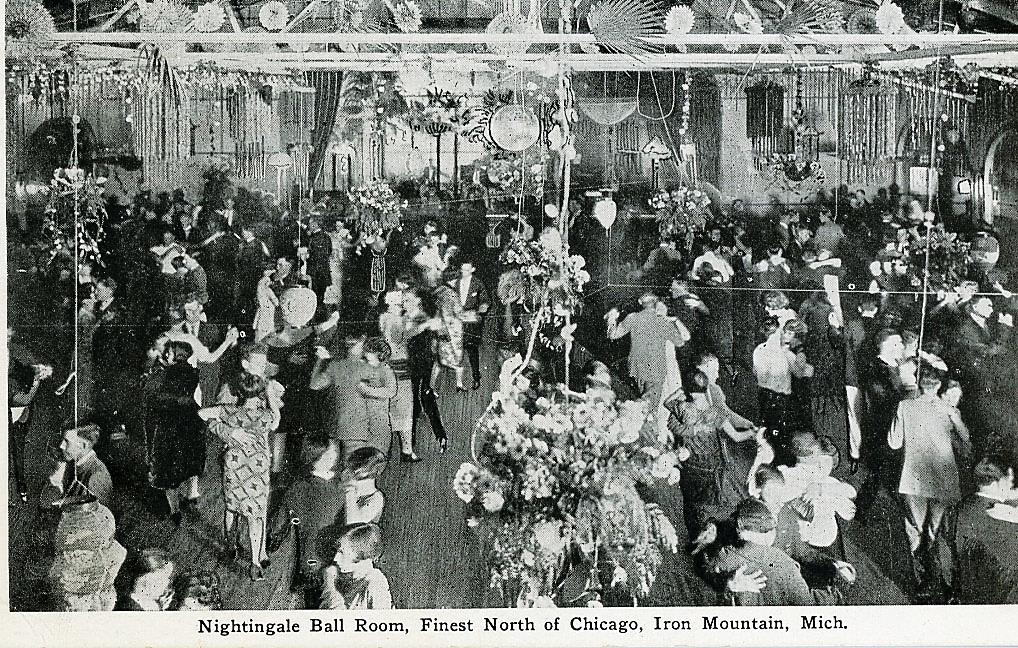
William J. Cummings Postmarked July 30, 1927, this rare interior view of the Nightingale Ballroom provides a glimpse of the décor and the dance floor.
IRON MOUNTAIN — The 35th installment of Menominee Range Memories, a series of articles by William J. Cummings, Menominee Range Historical Foundation historian, now available on the Dickinson County Library’s website, is titled “The Roaring Twenties — The Nightingale, Badwater.”
An article in The Iron Mountain News on Feb. 17, 1925, announced that excavation for the foundation for a club house and dance pavilion had begun on a site overlooking Badwater Lake, part of the Menominee River.
Claude and Gale Parmelee were the enterprising owners, and the site was just north of the Badwater picnic grounds, near The Pine Gardens.
The building was constructed of steel and concrete with a cream-colored stucco surface and a red tile roof, following Spanish architectural lines.
Gale Parmelee drew the plans, which originally called for a roof garden large enough to accommodate private and special parties and dinners, affording ample dancing space. This roof garden would be “about 175 feet above the level of Badwater Lake and afford an excellent view of the surrounding country for miles.”
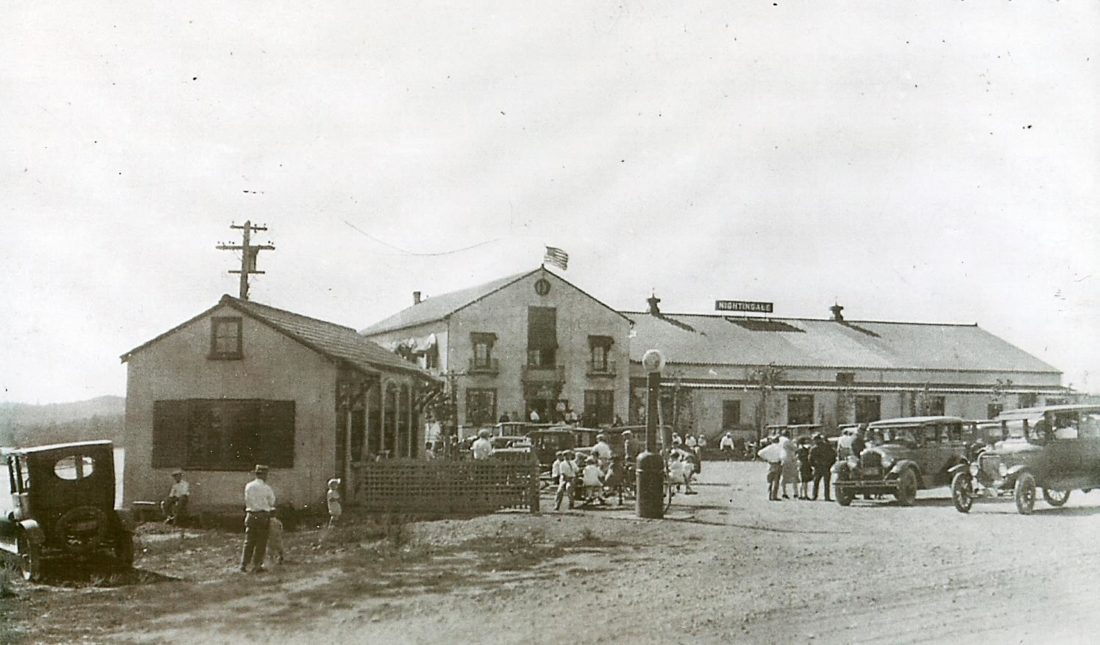
Hazel (De Gayner) Dault The Nightingale, a dance pavilion with a floor measuring 96 feet by 80 feet, opened May 15, 1925, just across from The Pine Gardens dance pavilion with an estimated 2,200 people in attendance. Designed by Gale Parmelee, architect of the firm of F.E. and G.F. Parmelee, the steel and concrete structure covered with a cream-colored stucco surface had a red tile roof, following Spanish architectural lines. Located about 175 feet above Badwater Lake, the site afforded an excellent view of the surrounding country for miles. The building was dedicated to the late Indian chief Jerome Dakota, who held council with his braves here. Brothers Claude and Gale Parmelee were the owners. This photograph was taken in about 1928. The Nightingale burned to the ground in the early morning hours of May 4, 1940.
Equipment for a complete dining room and grill were to be included, and “every convenience” would be available “to bring the clubhouse up to the requirements of resorters and tourists.”
Plans included “a large fleet of specially designed boats and canoes” that would be operated by Claude Parmelee “for sportsmen and persons desiring to make the Menominee River trip.” The specialized craft would be equipped with motors.
The building, dedicated to the late Indian chief Jerome Dakota, who held council with his braves on the site, was to be called the Nightingale. Construction of the building was under the supervision of E.D. Parmelee.
The opening of The Nightingale on May 15, 1925, was announced in the May 5 edition of The Iron Mountain News.
According to the article, the opening of The Nightingale dance hall would be “the realization of a dream come true” for Claude Parmelee, who was a well-known Michigan sportsman whose “fame as a crack shot for the Winchester (rifle) people” had spread across the entire United States.
Parmelee recognized the “development of Upper Michigan as the real playground of the tourist.” He had planned to use a large tract of land he owned at Badwater Lake near Twin Falls for a resort, and The Nightingale was “the first step” as he planned to develop additional features for sportsmen before the summer season began.
The article continued with a detailed description of the property, as follows:
“The new Nightingale has one of the most beautiful dance floors in the northwest and is not excelled north of Chicago. Of Spanish architecture, finished in a white stucco cement with a tile roof, the dance hall is imposing and looks more like a sumptuous summer house than a dance hall. The building is 148×80 with a dance floor 96×80. A mezzanine floor which is to be used for private parties and serving lunches is 36×80.
“All modern conveniences are to be found in the hall, a men’s smoking room and ladies’ rest room being located at each end. A large stage has been placed at one end and plenty of seats will be provided for patrons on the other two sides of the hall. There are four exits from the main dance floor and French windows run the length of the building on both the north and south sides, providing plenty of ventilation. A modern heating system, such as is used in the city schools, has also been installed.
“Entering the main door there is a large lobby with a ticket window on the right and check room on the left. The lobby leads directly to the soda fountain, tables and booths, accommodations being provided for a large number. To the right a stairway leads to the roof garden which is prettily furnished with wicker settees and chairs, and tables for serving of chicken and steak dinners as well as lunches. Private parties will also be catered to in the afternoon from 1:30 until 7 o’clock, a number already being arranged for the month of May. Floor lamps are used for the lighting arrangement.
“The dance hall itself is spacious enough to take care of the largest crowds, and will be attractively decorated for the opening night. The orchestra can be seen from all parts of the hall. Benson’s orchestra, of Chicago, has been engaged for the opening night and a number of high class attractions will also be presented.
“A novelty will be the projection of motion pictures during the dances. The pictures will be thrown on a screen in the hall, short topic reels being secured.
“Upon completion of the building this week work will be started on a modern tourist and sportsmen’s store and gasoline filling station. Mr. Parmelee has for years been connected with the Winchester people and is well equipped by experience for the sporting goods business. It is planned to handle a complete line of hunting equipment, fishing tackle and motor boats. A fleet of five motor boats equipped with Caille motors, especially adapted for use in a river such as the Menominee, has been ordered and will be rented out for excursion parties.
“A landscape gardener is also to start work on the grounds within the next two weeks. It is planned to plant a number of shrubs and trees, build a driveway leading to the dance hall and arrange a parking system. With the improvement of the grounds a complete amusement park is to be built.
“Mr. Parmelee will also put in a fully equipped shooting grounds, and his years of experience in shooting on the best grounds in the United States will also prove valuable in installing this project which is his pet hobby.
“The Nightingale was designed by Gale Parmelee, architect in the firm of F.E. and G.F. Parmelee, and will be managed by Claude Parmelee. It is planned to open two more places in Wisconsin of the same type as the Nightingale, one to be located in the central section of the state while the other will be built in the vicinity of Milwaukee.”
On May 11, 1925, the newspaper noted work on decorating the Nightingale for the grand opening was nearly completed, and all the wiring was finished. The roof garden was also ready, and Benson’s Orchestra from Chicago had been booked for the two-week opening celebration.
In the same edition, it was noted “six robed Klansmen, accompanied by about 18 other men, burned a fiery cross in the cleared land back of the new Nightingale dance hall on Saturday evening (May 9). While the flames attracted some attention, the Klansmen soon disappeared.”
The much-anticipated grand opening of the Nightingale was mentioned again in the May 15, 1925, edition of The Iron Mountain News.
The new dance hall cost $50,000. The large hall was “beautifully decorated and the roof gardens furnished with attractive wicker overstuffed furniture.”
The article noted that the “color effect and decorations” were “something entirely new.” Claude Parmelee, one of the owners and manager of the hall, “carried out a sportsman’s idea in decorating the hall, even to flower vases which represent some kind of wild game.”
The following additional details were:
“Benson’s orchestra, which has just completed an engagement at the College Inn, Sherman hotel, Chicago, will furnish the entertainment, being engaged for two weeks. A number of novelty features will also be presented.
“Chicken and steak dinners will be served on the roof garden and soda fountain service and light lunches will be afforded the dancers on the lower floor. Vellenette and Zanabas (sic – Sanabas) are in charge of this service and will cater to special dinner parties. A Sunday chicken dinner will also be served.”
(George Vellenette, a confectioner, was at 401 S. Stephenson Ave. in downtown Iron Mountain, according to the 1925 city directory. There was no listing for Sanabas or Zanabas.)
The headline in the Saturday, May 16, 1925, edition of The Iron Mountain News read: “NEW DANCE HALL IS WELL LIKED.” The opening was attended by 2,200 people.
According to the account, “the hall was beautifully decorated and the varied array of lighting effects, including a large crystal ball, was a pleasing spectacle.
“Benson’s Ramblers, a Chicago orchestra, pleased the large gathering with its program of music. Little Miss Dorothy Waters also scored with the audience with her toe dances, answering a number of encores at both her appearances.
“The Nightingale, which was started in February, was designed by Gale F. Parmelee and represents an investment of $50,000. Claude Parmelee, a brother, is manager. The new hall is complete in every detail, having a large dance floor, beautiful lighting arrangements and a roof garden. Concessions were opened last evening and work on the amusement park is going rapidly forward. A large sporting goods store and tourist camp site are also under construction. As soon as warmer weather arrives boat excursions will be started, a fleet of five motor boats, one of which was on display in the dance hall last evening, have been purchased.
“Soda fountain and grill service is in charge of Vellenette and Sanabas, who have a large space on the main floor and also on the roof gardens.”
Improvements were rapidly undertaken following the opening. On May 23, 1925, the management announced there would be dining room service for guests, and a fully-equipped restaurant would be ready for business within 10 days.
Dinner party and banquet service would be available, and special menus for tourists and commercial travelers could arranged.
The restaurant was to be managed by George Vellenette, manager of the Liberty Candy Kitchen in Iron Mountain, who was already in charge of the Nightingale grill.
By June 2, 1925, work had begun on the new “promenade veranda” at the Nightingale dance hall with completion expected the following week. The promenade was on the east side of the dance hall, extending the full length of the 112-foot building. The 12-foot wide veranda was to be enclosed with screens and would afford ample room for a lounge for the dancers.
The roof gardens were to be converted into a Chinese tea room, serving American and Chinese dishes. Wah Sing, formerly of the Canton Cafe, was in charge.
Plans were also underway for a large sporting goods store, and the completion of the summer playgrounds were all that was needed to fulfill the original program planned by the Parmelees.
With the arrival of warm weather, fishing trips on Badwater Lake would begin, and a complete line of motorboats, canoes and rowboats would be available to the public.
Manager Claude Parmelee announced that a modern pistol and trap shooting range was under construction in the vacant lot north of the Nightingale dance hall in the June 6, 1925, edition of The Iron Mountain News. The shooting range was to be completed the following week, and the first “shoot” was to be held within two weeks.
Parmelee was organizing the Nightingale Gun Club which would be headquartered at the resort. Parmelee would provide instruction on the proper manner of shooting pistols and rifles.
There were many activities held at the newly-opened Nightingale in June 1925.
In the June 9, 1925 edition of The Iron Mountain News, the announcement of a carnival dance to be held Thursday evening, June 11, by the Knights of Columbus Building Association was announced.
Peterson’s nine-piece orchestra was to furnish the music. The Building Association planned to give at least one dance every month, using the proceeds to erect a clubhouse on a site purchased across from the Milliman Hotel.
A Chamber of Commerce forum dinner was held Monday evening, June 15, 1925, at the Nightingale pavilion.
In the June 13, 1925, edition of The Iron Mountain News, plans for the largest open air dance pavilion in northern Michigan, connected with the main dance floor of the Nightingale pavilion, were announced.
The open air floor was to be built on the east side of the Nightingale, and would overlook the Menominee River and Badwater Lake. The new dance floor was to measure 70-by-146-feet and with the main floor would provide a dancing surface of about 50,000 square feet. Dancers would be able to use both floors.
At the front or south end of the building a two-story screened in porch was to be erected for the convenience of those who did not care to dance but wished to enjoy the music and the view. The porch could be reached from the main floor and the roof garden.
In the June 27, 1925, edition of The Iron Mountain News, it was announced that William Brandt, of Manitowoc, Wis., formerly with The Iron Mountain News, had accepted a position as assistant manager of the Nightingale dancing pavilion.
Brandt had been busy booking orchestras for the Nightingale during the past several weeks.
The Parmelees were reported to be contemplating the erection of a similar pavilion at Madison, Wis., and Brandt would have charge of the new place.
Brandt had recently returned from a trip to the eastern United States where he obtained new ideas on dancing pavilions.
Under the headline “TO SHOW FANCY DANCING STEPS: Pair From Chicago Will Exhibit ‘Charleston’ At Nightingale” in the Aug. 13, 1925, edition of The Iron Mountain News, opened as follows:
“Carolyn Goss and Jimmie Hilton, White City Steppers, winners of scores of Chicago dance contests, favorites in the $5,000 Herald-Examiner contest now going on in Chicago, demonstrators of correct dancing at national exhibitions, and finally, exponents of the latest dance craze, the ‘Charleston’ will appear at the Nightingale Saturday and Sunday nights to introduce the new dance, which is sweeping over the country.
“These professional dancers, wearing the colors of the White City ballroom, will teach Iron Mountain how to dance the new steps which are being taught in almost every metropolitan ballroom
“Music for the exhibition, and for general dancing, will be provided by the Elks’ full convention band of 40 musicians, arriving here from the Elks’ convention in Superior for the occasion. Sunday night will be Elk’s night at the ballroom.
“In addition there will be two full orchestras, including Weidneir, the famous Carlisle Indian football star, as singing baritone.”
An article in the Aug. 27, 1925, edition of The Iron Mountain News noted that a heating plant was being installed at the Nightingale so the resort could remain open year around. The roof and walls were to be reinforced within the building to assist in protecting the dance place from winter winds.
Other planned improvements included the construction of toboggan slides, ski jumps and an ice rink so winter sports could be enjoyed by visitors.
The following article appeared in the Dec. 18, 1925, edition of The Iron Mountain News under the headline “RADIO PLAYERS TO BE FEATURED AT NIGHTINGALE: Langdon Brothers Scheduled For Engagement of Two Days”:
“Dancers will have an opportunity to hear and see the famous Langdon brothers orchestra, of radio broadcasting fame, which has been engaged by the management of the Nightingale for tomorrow and Sunday nights.
“The brothers are featured in the playing of Hawaiian guitars and are capably assisted by other musicians. They have been heard by thousands of radio fans.
“The Nightingale has been re-decorated into a winter garden and plans are being made to make it a center of winter activities. It is also planned to have an ice rink and ski jump on the grounds.”
Under the headline “Fire Destroys Nightingale Pavilion” in the May 4, 1940, edition of The Iron Mountain News, the following article appeared:
“Only the chimney rising from the center of the still smoking ruins remained today of the Nightingale dance pavilion, situated about four miles north of the city, and which was destroyed by a fire of unknown origin shortly after 3 o’clock this morning.
“The fire department received the call about 3:05 a.m. Chief Mike Scolatti was notified and called the Riverside club in Wisconsin to verity the report. He was told that flames and smoke were pouring from every section of the building.
“Because there were no facilities for fire fighting at the Nightingale and as no road is available to the edge of the nearby Menominee river, Scolatti did not order out his equipment. He drove to the scene, however, and when he arrived the west wall and roof had already collapsed.
“The entrance to the structure was the last to crash into the flames, less than half an hour after the blaze was reported.
“The Nightingale was constructed in 1925 by F.E. Parmelee and Sons and was a popular dance resort. The construction cost was variously reported at from $40,000 to $50,000, including equipment.
“It was the second dance pavilion fire in that area, Pine Gardens, almost directly across the road from the Nightingale, having been destroyed several years ago. Pine Gardens was owned by Joe Andrews, who still lives near the site.
“The fire is believed to have started in the kitchen and travelled along the west wall. The blaze was reported shortly after the building was closed, following a meeting of Standard Oil dealers and officials. It was the annual spring conference of the district and local oil salesmen, with officials of the Green Bay branch.
“Although Parmelee could not be located this morning, it was reliably reported that the loss is covered by insurance.
“The building was of frame and stucco construction. Paper trimmings on the ceiling provided ready fuel for the blaze, which traveled rapidly before a brisk wind.”
Read the rest of this 15-page story on the Dickinson County Library’s website at www.dcl-lib.org, which includes additional information, seven additional photographs of the Nightingale, an advertising postcard for the Nightingale and an advertisement from Sept. 3, 1927 that appeared in The Iron Mountain News.
New installments will be added to the Library’s website and on the Library’s local history research computer.
-
- William J. Cummings Postmarked July 30, 1927, this rare interior view of the Nightingale Ballroom provides a glimpse of the décor and the dance floor.
-
- Hazel (De Gayner) Dault The Nightingale, a dance pavilion with a floor measuring 96 feet by 80 feet, opened May 15, 1925, just across from The Pine Gardens dance pavilion with an estimated 2,200 people in attendance. Designed by Gale Parmelee, architect of the firm of F.E. and G.F. Parmelee, the steel and concrete structure covered with a cream-colored stucco surface had a red tile roof, following Spanish architectural lines. Located about 175 feet above Badwater Lake, the site afforded an excellent view of the surrounding country for miles. The building was dedicated to the late Indian chief Jerome Dakota, who held council with his braves here. Brothers Claude and Gale Parmelee were the owners. This photograph was taken in about 1928. The Nightingale burned to the ground in the early morning hours of May 4, 1940.
Local News

Bay College establishes David Bahrman Memorial Scholarship
Keweenaw Heartlands final draft published

Responding in times of crisis
Iron Mountain names top seniors in Class of 2026
IRON MOUNTAIN — Iron Mountain High School has announced five seniors as the academic top 10% of the graduating ...

Millie Hill trail rebuild to include new ‘carpet’