Responding in times of crisis
Local nurse part of team for global disaster relief
-
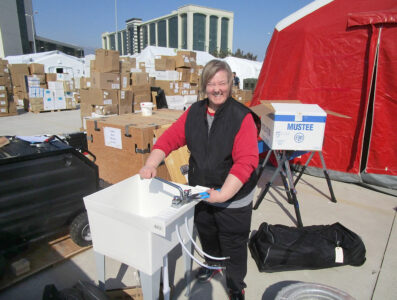
- Nurse Rhonda Lindstrom of Aurora, Wis., joined Samaritan’s Purse in 2016. She is shown working on a sink on day one of hospital construction at an emergency response site. The entire contents of the hospital are flown in boxes to the location. (Contributed photo)
-
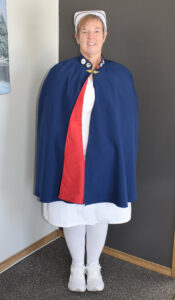
- Continuing to serve locally while being part of Samaritan’s Purse disaster response medical team, Rhonda Lindstrom of Aurora, Wis., is shown in her Nurses Honor Guard of Dickinson-Iron Counties uniform. (Terri Castelaz/Daily News photo)
-
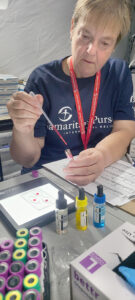
- Nurse Rhonda Lindstrom of Aurora, Wis., tests blood for emergency blood transfusions while on a mission with the Samaritan’s Purse disaster response medical team. (Contributed photo)
-
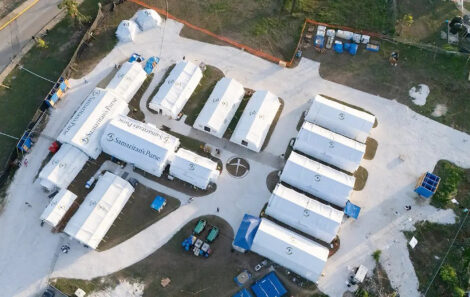
- An aerial view of the COVID-19 emergency field hospital in Central Park in New York City that local nurse Rhonda Lindstrom worked at during the pandemic. (Contributed photo)
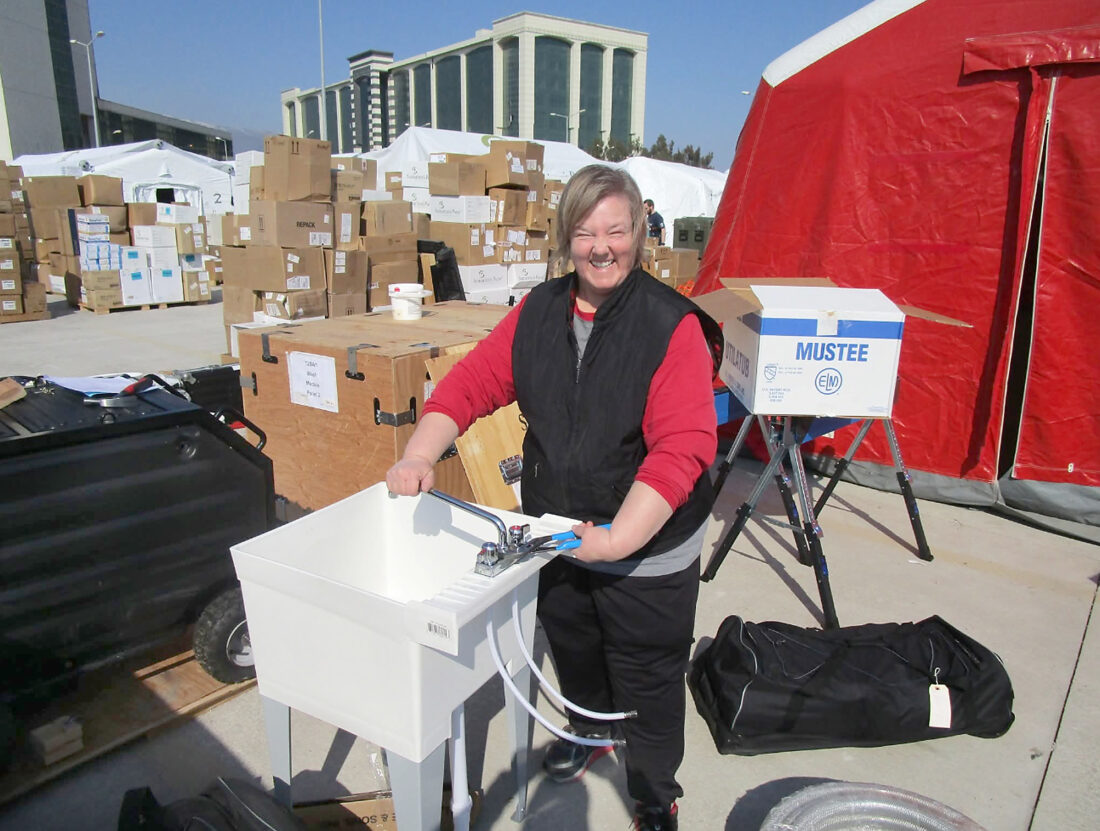
Nurse Rhonda Lindstrom of Aurora, Wis., joined Samaritan’s Purse in 2016. She is shown working on a sink on day one of hospital construction at an emergency response site. The entire contents of the hospital are flown in boxes to the location. (Contributed photo)
Today is National Nurse Appreciation Day recognizing their dedication and contributions that nurses play in society. This is the first part of a feature story on local nurse Rhonda Lindstrom.
———
AURORA, Wis. — While many nurses have a set routine, Rhonda Lindstrom of Aurora follows the call of need — bringing hope to communities devastated by disaster through her work with Samaritan’s Purse.
For Lindstrom, the leap from the predictable U.S. health field to the high-stakes realm of international crisis response is the natural culmination of a life devoted to service.
Her path to disaster relief nursing was unconventional: with early degrees in Spanish and business administration, nursing was never a part of the plan.
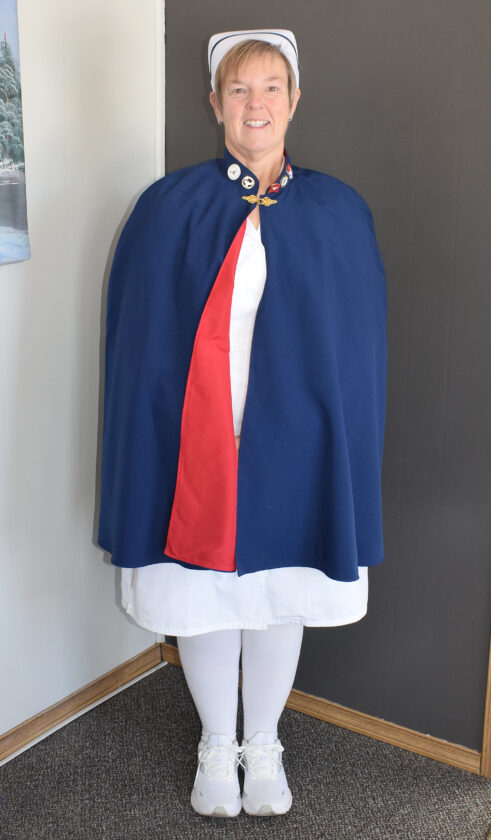
Continuing to serve locally while being part of Samaritan’s Purse disaster response medical team, Rhonda Lindstrom of Aurora, Wis., is shown in her Nurses Honor Guard of Dickinson-Iron Counties uniform. (Terri Castelaz/Daily News photo)
It was on international missions that Lindstrom recognized a critical gap in medical care.
“It was during my six and a half years in Turkey and working at an orphanage for children with special needs I realized now was the time to do something about it,” she said. “So at age 40 I went to nursing school.”
After graduating in 2015, Lindstrom began her nursing career on the floors of several Wisconsin hospitals, learning the hands-on skills that would later prove essential in unpredictable environments.
During school, she searched for ways to combine nursing with international service, eventually connecting with Samaritan’s Purse through a contact in Appleton, Wis.
“When I left Turkey, I knew that God was leading me to go back out in the world and do this work, but I knew it wasn’t going to be long term,” she said.
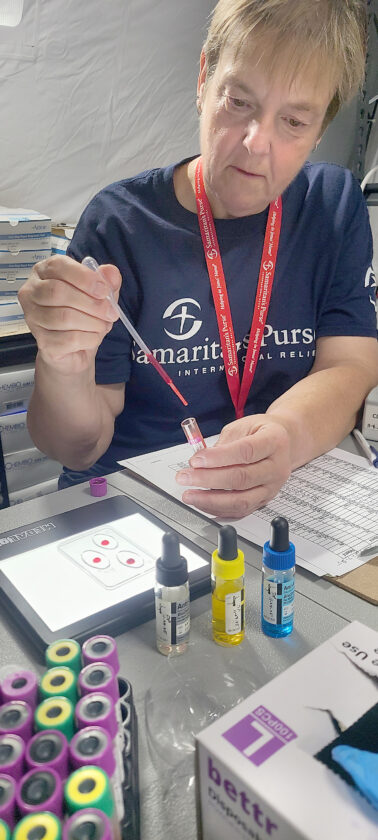
Nurse Rhonda Lindstrom of Aurora, Wis., tests blood for emergency blood transfusions while on a mission with the Samaritan’s Purse disaster response medical team. (Contributed photo)
Answering the call in crisis
Since joining Samaritan’s Purse in 2016, Lindstrom has traveled across the globe, providing critical medical care in some of the world’s most challenging environments.
Her first deployment came in 2020, during the COVID-19 pandemic in New York City — a setting few international response teams had ever faced on U.S. ground.
“We built a hospital right in Central Park, working alongside Mount Sinai,” she said. “We ran a facility that people actively asked to come to because we allowed families to share last moments with their loved ones. It was a really difficult but really important time.”
Over the course of the pandemic, she also served in North Carolina, Arizona and Los Angeles.
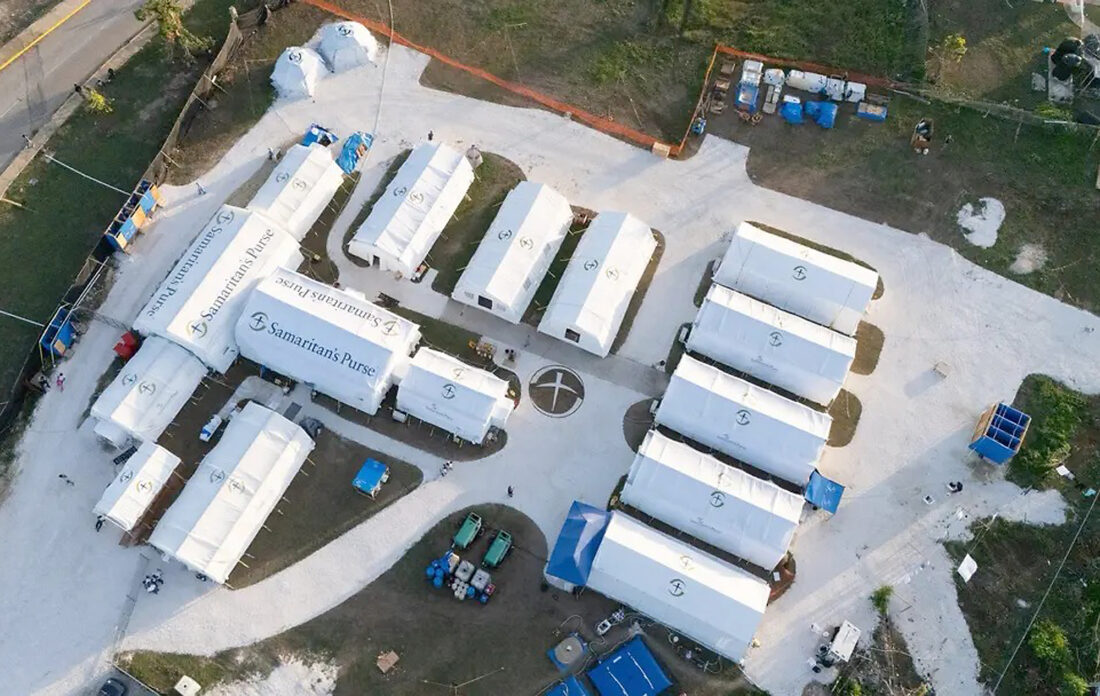
An aerial view of the COVID-19 emergency field hospital in Central Park in New York City that local nurse Rhonda Lindstrom worked at during the pandemic. (Contributed photo)
Her work has taken her far beyond domestic borders. In Ukraine, Lindstrom and her team arrived in a newly freed city, where residents had hidden in basements for months to escape Russian occupation.
“Many had war-related injuries, but most were suffering the consequences of untreated chronic conditions. Even something that seems ‘just chronic’ is often tied to trauma and disaster,” Lindstrom said.
She explained the Samaritan’s Purse team is provided with the best security at all times, noting Ukraine was in the middle of a war during their deployment.
“In addition to the feet on the ground with us, our home office is always in direct contact at all times — they know what’s going on all over the world,” she said. “I didn’t sign up to just go where it’s safe. It takes a little bigger measure of faith, but my safety is with the Lord.”
Every deployment demands trauma-informed care, because every patient’s story is shaped by extraordinary circumstances, she said.
Her calling took her back to Turkey, where she treated crushing injuries after a magnitude 7.8 earthquake and endured a subsequent 6.7 tremor while still on duty.
“It was so bad we were working long hours because of the large amount of people coming in,” she said. “Disaster nursing isn’t predictable.”
Beyond her medical roles, Lindstrom said her work with Samaritan’s Purse has often required her to step outside traditional nursing duties. After Hurricane Helene, which heavily affected North Carolina, she was deployed three times to assist the organization’s national team.
“That’s our backyard — our home office is in North Carolina,” she said. “They were overwhelmed. There was more work than there were people to do it.”
She described the experience of her support roles as just as meaningful.
“I’ve had to learn to do a lot of things that prepared me for this work,” she said. “Even as a nurse with Samaritan’s Purse, it’s not like working on a hospital floor in the U.S. It’s very different. I’m grateful for all the experiences I’ve had that made this possible.”
She added that the surgical team always prays with the patients prior to going into the operating room. “They are so appreciative — that is something very different than what is done in our U.S. hospitals,” she said.
Lindstrom’s last deployment was after Hurricane Melissa, which made catastrophic landfall in Jamaica in late October 2025.
With local hospitals severely damaged, she and her team built and operated a fully functioning field hospital alongside local providers. “We ran it for two months,” she said. “By the second month, local doctors and nurses were working alongside us, learning the equipment and systems.”
When the team departed, they left the hospital intact — fully staffed and operated by Jamaican medical professionals until permanent facilities could be restored.
“It was the worst hurricane they had ever experienced,” Lindstrom said. “There was no electricity anywhere nearby. But being able to leave something behind that they could continue using — that’s incredibly valuable.”
Lindstrom will leave today with the national team to areas of Wisconsin to assist with the clean up after the recent flooding. On this mission, she will put down her nurses cap and pull on her work boots to help dig out mud-filled homes and businesses.
She noted all of the challenges are part of a larger purpose. “I love what I do,” she said.
A life devoted to service
Her missionary work began years before joining Samaritan’s Purse and spanned continents.
In addition to the long-term work in Turkey, Lindstrom joined different organizations, churches or groups on shorter missions.
In 1999, she traveled to Jamaica to work with jailed young boys under dire conditions.
“The boys were eight to nine years old — it was horrible — we didn’t understand why they were even there,” she said. “I can remember the cells were very small and old, with metal bunk beds with only one mattress that they would fight over.”
During that two-week trip, the group built an outdoor playground for the boys.
While living in Mesa, Ariz., she was part of an active church group. Each month, she led mission trips to Mexico, bringing food and supplies to communities in need for several years.
“We also provided free medical services and help to build a dental clinic for a community,” she said. “That was awesome — we were building relationships as well.”
She has also traveled to India, providing medical assistance and aiding schools and an orphanage.
“People in third-world countries don’t get the opportunities that we do for medical help,” Lindstrom said. “So often this is their chance — they’re so grateful.”
Lindstrom recalled her time working in a Turkish orphanage with children with physical disabilities, where creativity became essential to therapy. “We would use things like remote-control cars to help with hand-eye coordination,” she said.
She also recently traveled to Zambia to teach nursing students about culture.
Every location presented different challenges, Lindstrom said.
She described her time in Haiti in 2011 as extremely difficult due to the poverty conditions and the prevalence of gangs.
“The Haitians I met were wonderful people — I would gladly visit them again and work with them anytime,” she said. “Just getting through Port-au-Prince was very tough — I believe the city was originally built for around 100,000 people, yet millions live there now. It’s overwhelming, and the gangs are running rampant.”
They spent their time working with the U.N. to help build a new school in the northern mountain region; however, to attend students would be required to wear shoes to enroll. “Which many didn’t have them at that time — that was just a normal way of life for them,” Lindstrom said.
Though she has seen the hardships of many communities firsthand, Lindstrom said it’s the people — not the places — that stay with her. “I’ve been to amazing countries, but what I remember most is the people. I can tell you a story about everywhere I’ve been,” she said.
Hitting the ground running
Disaster relief with Samaritan’s Purse is very different from hospital work in the U.S., Lindstrom said.
“We are all trained medical professionals. When we hit the ground, we hit the ground running,” she said.
Often, the first step is constructing the tent hospital, like a modern-day MASH unit.
Regardless of role, every team member pitches in alongside specialized members of the build team that arrives ahead to evaluate needs. Most often, within 24 hours of a disaster the team has assessed whether a hospital, medical care, food or shelter is required.
In addition to natural disasters such as earthquakes, tsunamis and hurricanes, the organization responds to wars, disease outbreaks and famine.
“We work usually with the Ministry of Health of the host country to decide the best course of action,” she said. “We don’t go anywhere, we aren’t invited.”
Hospital operations generally last two to three months, through some missions can be longer, such as Iraq, which was nine months.
Once the team departs, in most cases they leave the hospital for the host country to run until it’s no longer needed.
In disaster zones, nurses work 12-hour shifts, seven days a week for 30 days, often caring for a dozen of patients in extreme conditions. Sleep, meals, social time and even a restroom or wash facilities are luxuries.
“Every patient has just experienced trauma, so for us we experience secondary trauma with every patient,” Lindstrom said. “It’s not easy work but incredibly rewarding to serve people in a desperate time of need.”
As a ward nurse, Lindstrom gets to spent a lot of time with patients. “I get to do lots of loving on people in their culture, in their love language. That’s fun,” she said. “That’s what I look forward to the most.”
———
Terri Castelaz can be reached at 906-774-2772, ext. 85241, or tcastelaz@ironmountaindailynews.com.
Local News
Record-breaking scholarship season for M&M Foundation
MENOMINEE — The M&M Area Community Foundation has completed its 2025–2026 scholarship season, awarding 79 ...

Food, Fun and Fitness
KHS scholarship checks available
KINGSFORD — Kingsford High School has set the schedule for scholarship recipients to pick up their checks at the ...
Hydraulic Falls Road reopened to traffic
IRON MOUNTAIN — Hydraulic Falls Road is now open to traffic, according to the Dickinson County Road ...
Hertel stepping down as state health director