Grants given to start vaping education program in schools
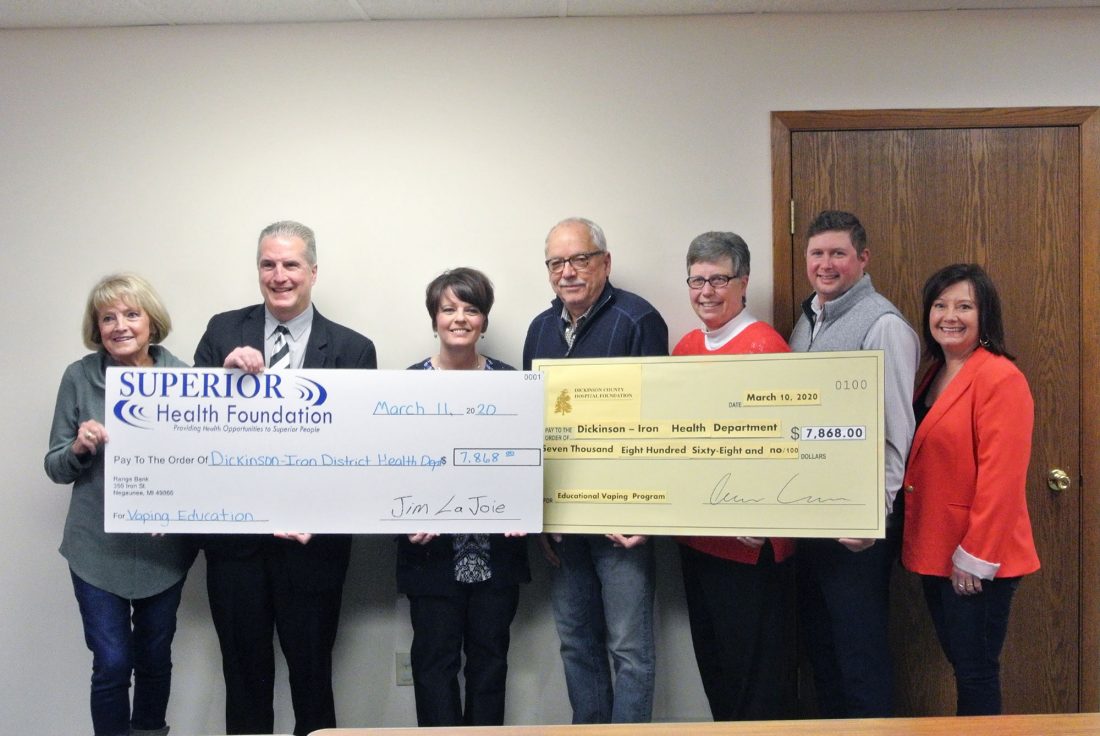
TWO AREA FOUNDATIONS have collaborated to fund a vaping education program in local schools through the Dickinson-Iron District Health Department. From left are: Kristine Leonard, member of both the Superior Health Foundation Board of Directors and the Dickinson County Hospital Foundation Board of Trustees; Jim LaJoie, executive director of the Superior Health Foundation; Kelly Rumpf, health educator at the Dickinson-Iron District Health Department; Dickinson County Hospital Foundation board trustees Steve Pontbriand, Peg Freeman and Ryan Pepin; and Tamara Juul, executive director of the DCH Foundation. (Brian Christensen/Daily News photo)
KINGSFORD — Two area foundations have collaborated to fund a vaping education program in local schools through the Dickinson-Iron District Health Department in Kingsford.
The Superior Health and Dickinson County Hospital foundations presented the health department Wednesday with two checks of equal amounts totalling $15,376.
The money will create a “tool kit” teachers can use to educate students about vaping, DIDHD Health Educator Kelly Rumpf said, adding they also want to inform parents about the effects of the popular practice.
Rumpf plans as well to suggest alternatives to disciplinary action against students caught using vaping devices, which has not proven successful in reducing use, she said.
“We want to take a different approach. We don’t want to punish,” Rumpf said. “These kids might be addicted to these products, so they need treatment. If they are continually getting caught, they need to be put in a treatment program versus being suspended or put into Saturday school.”
Rumpf still is researching what alternatives would yield results but has received letters of support from Kingsford, Norway, North Dickinson and Forest Park schools. Rumpf anticipates Iron Mountain and West Iron County schools will be soon be interested in the program.
A 2019 study by the Centers for Disease Control and Prevention on youth and tobacco use showed 1 in 10 middle school students reported using vaping devices in the 30 days before the study was conducted. More than 1 in 4 high school students reported using a vaping device, the CDC stated.
Though there are many different designs, the basic function of vaping devices remains the same: a battery-powered element heats a liquid solution, producing an aerosol taken into the lungs as the user draws breath.
The solution can contain nicotine, tetrahydrocannabinol and cannabinoid oils, flavorings and other additives.
According to the CDC, nicotine can harm adolescent brain development and affect attention, learning, mood and impulse control.
“This grant is all about community outreach and protecting our children, which starts with educating them on this fast-growing health concern,” Executive Director of the DCH Foundation Tamara Juul said. “Through collaboration with SHF, we can make a bigger impact on our community and hopefully save lives.”
Scientists are still learning about the long-term health effects of vaping, but some of the ingredients may be harmful to the lungs over time, the CDC stated.
In August, officials took notice of severe and sometimes fatal lung injuries across the country, which the CDC termed e-cigarette or vaping product use-associated lung injuries, or EVALI.
According to the CDC, about 2,800 EVALI cases have been reported, with 68 deaths confirmed in 29 states and the District of Columbia.
Laboratory data shows vitamin E acetate, a thickening agent most often used in solutions containing THC, is strongly linked to the rash of EVALI cases. While vitamin E acetate does not cause harm when ingested or applied to the skin, it may interfere with normal lung functionality when inhaled, the CDC stated.
Local News
Occhietti scholarships awarded

Michigan copper critical to Union victory in Civil War

National Road connected a young nation
Forest Park names top 10 in Class of 2026
CRYSTAL FALLS — Forest Park Schools has announced its top 10 seniors in the Class of 2026. — Maykayli ...

Michigan cities, counties have spent 18% of opioid settlement funds