Flanagan Block burned in 1896 and 1904; owner shunned insurance
Menominee Range Memories
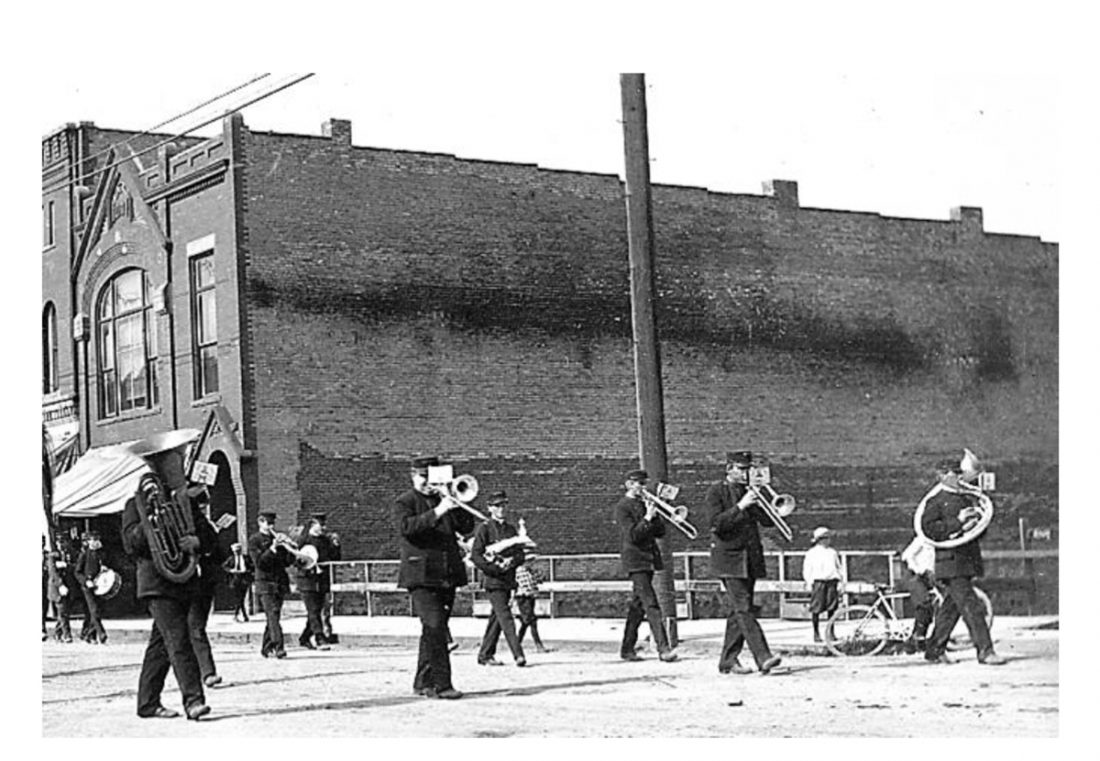
(William J. Cummings) The northeast corner of the intersection of South Stephenson Avenue and East A Street was vacant for many years following the fire which burned the Flanagan Block to the ground Feb. 25, 1904. There was an ice rink at this corner at times prior to the construction of the United States National Bank in 1921. The building with the triangular peak was the Odd Fellows Block, erected in about 1888. This detail of a postcard view was postmarked in Iron Mountain on July 23, 1909.
IRON MOUNTAIN — The 52nd installment of Menominee Range Memories, a series of articles by William J. Cummings, Menominee Range Historical Foundation historian, now available on the Dickinson County Library’s website, is titled “Downtown Iron Mountain — 425-431 South Stephenson Avenue.”
Simon Goldman sold “notions” at 423 South Stephenson Ave. by 1892. By 1902, H.E. Smith ran a clothing store here. There was no listing for this address in 1907-1908 or 1913. By 1925, this lot had been incorporated into the United States National Bank.
The northeast corner of the intersection of South Stephenson Avenue and East A Street has been the site of two business blocks — the Flanagan Block from before 1892 until 1904 and the United States National Bank Block from 1920 to the present.
Owned by Patrick Flanagan, of Norway and Sagola, the Flanagan Block, located at 425-431 South Stephenson Ave. on the northeast corner of South Stephenson Avenue and East A Street, was one of the first large buildings constructed in Iron Mountain, housing a number of businesses.
According to the account in the Iron Mountain Press about the fire which destroyed the building on Feb. 25, 1904, “The building was one of the first erected in Iron Mountain and was for many years used as a variety theatre.”
The frame structure was probably built in the 1880s. Unfortunately, no photograph of the Flanagan Block has been found to date.
The building at 425 South Stephenson Ave. listed in the 1892 city directory in which Engberg & Flannigan (Peter Engberg and John W. Flannigan), “Dealers in Wines, Liquors, Cigars and fresh Beer,” was located was probably the building known as the Flanagan Block. Their advertisement in the 1892 city directory read: “Mixed drinks and bottled goods served, and good treatment assured.” John W. Flannigan also resided at this address at that time.
By 1902, L.N. Richards operated a barbershop at this address. His advertisement on page 12 of the 1902-1903 city directory claimed him to be “The Up-to-Date Barber and Hair Dresser,” offering “Face Massage, Newbro’s Herbicide! The Dandruff Cure!, and Face Tonics.”
By 1892, Hormidas Boisvert had a barbershop at 427 South Stephenson Ave., probably a part of the Flanagan Block.
There was no listing for this address in 1902. Perhaps the numbering had been altered, and L.N. Richards had his barbershop here instead of at 425 South Stephenson Ave. in 1902, since Hormidas Boisvert ran a barbershop here in 1892.
In the June 2, 1898, edition of The Daily Tribune, the following appeared in the “City News Items” column:
Hartman & Schaffenuer is the firm name of a new plumbing concern opened in this city. The proprietors are young men and are practical and experienced workmen, and are located in the Flanagan block. Their advertisement appears in another column.
Mrs. W.E. Richard was the proprietor of the Crystal Restaurant and Ice Cream Parlors at 429 South Stephenson Ave. by 1892, advertising: “First-class in every particular. Meals served at all hours. Dealer in confectionery, cigars, fruits, etc.” Mrs. Myra Richard worked for Mrs. W.E. Richard and both women resided at this address. This business establishment was also probably a part of the Flanagan Block.
Kurz Brothers (Max Kurz) sold “buggies, wagons, harness, etc.” at 429 South Stephenson Ave. by 1902, and also operated a sales stable at 225 East A St. Rudolph Kurz worked as a clerk. The firm’s advertisement on page 41 of the 1902 directory noted they offered “A Large Assortment (of) Draft and Driving Horses” and had business locations in “Iron Mountain, Escanaba, Iron River, Crystal Falls, and Powers, Mich.”
Thomas W. Grenfell ran a confectionery shop at 431 South Stephenson Avenue, probably a part of the Flanagan Block, by 1892. Khoury & Company (John I. Khoury) had a confectionery shop here by 1902.
On Saturday, Oct. 3, 1896, the Flanagan Block suffered severe fire damage, but the building was repaired, repapered and repainted.
The following account appeared in the Oct. 10, 1896, edition of The Range-Tribune under the stacked headline “Cigarette Did It: Some Careless Fellow Threw a Lighted Stump Under the Sidewalk on East A Street: Flanagan’s Block Burned: Loss Is a Heavy One. No insurance. Grocery Store, Restaurant, Saloon and Plumbing Shop Were All Cleaned Out.”
Shortly after one o’clock this afternoon [Oct. 3, 1896] a policeman discovered smoke issuing from the building situated on the corner of Stephenson Ave. and A street, and owned by Pat Flanagan of Norway. The alarm was turned in and the department responded promptly, only to find that they had an extremely treacherous blaze to fight. Every nook and crevice seemed to be ablaze, yet nowhere could the flames be reached. The tin roof was torn off and boards were ripped from their fastenings, and every time and no matter [in] what portion of the building an opening was made the red flames and black smoke would pour forth and engulf the heroic fire boys and the citizens who were assisting. Four streams of water were playing on the building at one time, and each moment it appeared as though the fire could not be gotten under control, and in that event the whole block would be endangered. For one whole hour the fire chief and his men worked diligently tearing up the tin roof and ripping the boards and planks in an endeavor to reach the blaze. It was a hard fire to fight but the department was equal to the occasion, and their efficiency for most any emergency was demonstrated on this occasion.
HOW IT STARTED.
Nothing definite could be gained as to the origin of the fire, but the man who first discovered the blaze gave his theory that a lighted cigarette had been carelessly thrown between the sidewalk and the building and had ignited the dry timbers between the outer and inner walls. This burned rapidly and ran the full length of the building and up to the roof before it succeeded in breaking out.
This appears quite plausible, for each time an opening was made that very spot was found to be on fire.
NO INSURANCE.
The building was owned by Patrick Flanagan, of Norway, and not one cent’s worth of insurance was carried, as Mr. Flanagan has no faith in insurance companies, and always figures what he saves by reason of not paying premiums.
The building had four occupants, Frank Danielson owned a small stock of groceries, Wade Leek, a restaurant, Jno. [John] Flanagan, a saloon, and Geo. Monroe, a plumbing shop.
Patrick Flanagan came up from Norway Monday to prosecute the work of repairing his building, which was damaged by fire Saturday afternoon. Mr. Flanagan will repaper and repaint the structure throughout. He estimates his loss at $450. Jno. [John] Flanagan, who conducted a saloon in one of the store rooms, places his loss at $75, due principally to the quantity of goods stolen during the progress of the fire. W. Leek, the restauranteur, is out a cool $100, besides his profits during the time he will be out of business. Geo. Munroe, the plumber, places his loss at $25.
None of the occupants carried one cent’s worth of insurance which may prove a lesson to many people who “never have a fire.”
On Thursday, Feb. 25, 1904, the Flanagan Block was totally destroyed by fire. The following account appeared in the Feb. 25, 1904, edition of the Iron Mountain Press under the headline “Big Blaze Last Night: Flanagan Building Totally Destroyed — Heavy Losses.”
“At an early hour this morning the Flanagan building at the corner of Stephenson avenue and East A street was almost completely destroyed by fire.
The building was occupied by Kurz Brothers, the well-known horse dealers, as a carriage, cutter and harness depot; L.N. Richard, barber shop, and A.I. [sic – J.I. – John I.] Khoury, confectionery dealers.
The total loss is in the neighborhood of $9,000. The loss of Kurz Brothers is between $3,500 and $4,000, with $2,000 insurance; L.N. Richard, loss $400, no insurance; A.I. [sic – J.I. – John I.] Khoury, loss unknown, insurance estimated at $900; loss on building, owned by Judge Flanagan, of Sagola, estimated at $4,000, no insurance.
The building was one of the first erected in Iron Mountain and was for many years used as a variety theatre.
End Part I
Local News
Grant for Art or All tent
‘Footprints of Florence County’ presentation set
FLORENCE, Wis. — The public invited to attend the next free monthly outdoor education program Tuesday evening in ...
Kids Fishing Day returns to DNR Pocket Park in Escanaba
ESCANABA — The Kids Fishing Day Team will be celebrating the 33rd anniversary of its annual Kids Fishing Day this ...
Higher energy prices help propel inflation above 4%
Michigan hopes new program will turn apprenticeships into degrees