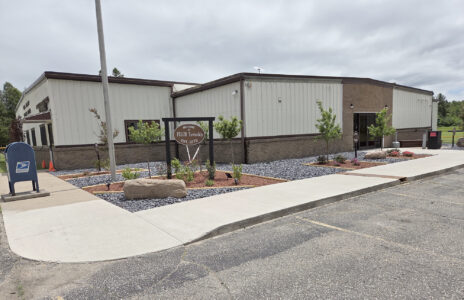
A business that’s evergreen
Trees by Wallace keeps producing for the holiday season
-
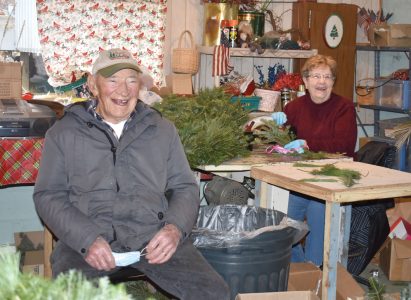
- KEN AND ROSE WALLACE in the shop of their Trees by Wallace business on U.S. 141 in the Town of Amberg, Wis. The couple have operated the Christmas tree farm, which Ken’s father started, together for more than 60 years. (Betsy Bloom/Daily News photo)
-
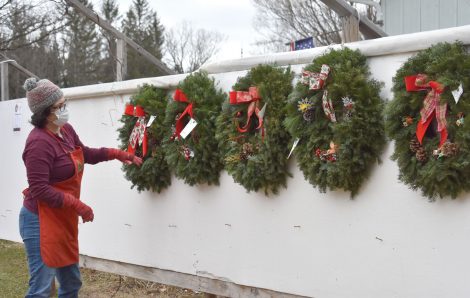
- HOLLY WALLACE HANGS some of the wreaths she made in the Trees by Wallace shop on U.S. 141 in the Town of Amberg, Wis. Holly is the daughter-in-law of the business’s owners, Ken and Rose Wallace. (Betsy Bloom/Daily News photo)
-
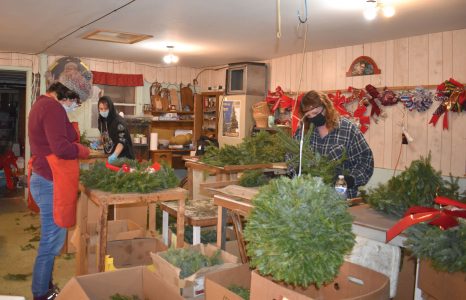
- Some of the crew that helps put together wreaths and other seasonal decorations at Trees by Wallace in the Town of Amberg, Wis. At left is Holly Wallace, in back is Miriam Johnson and at right is Tina Skenandore. (Betsy Bloom/Daily News photo)
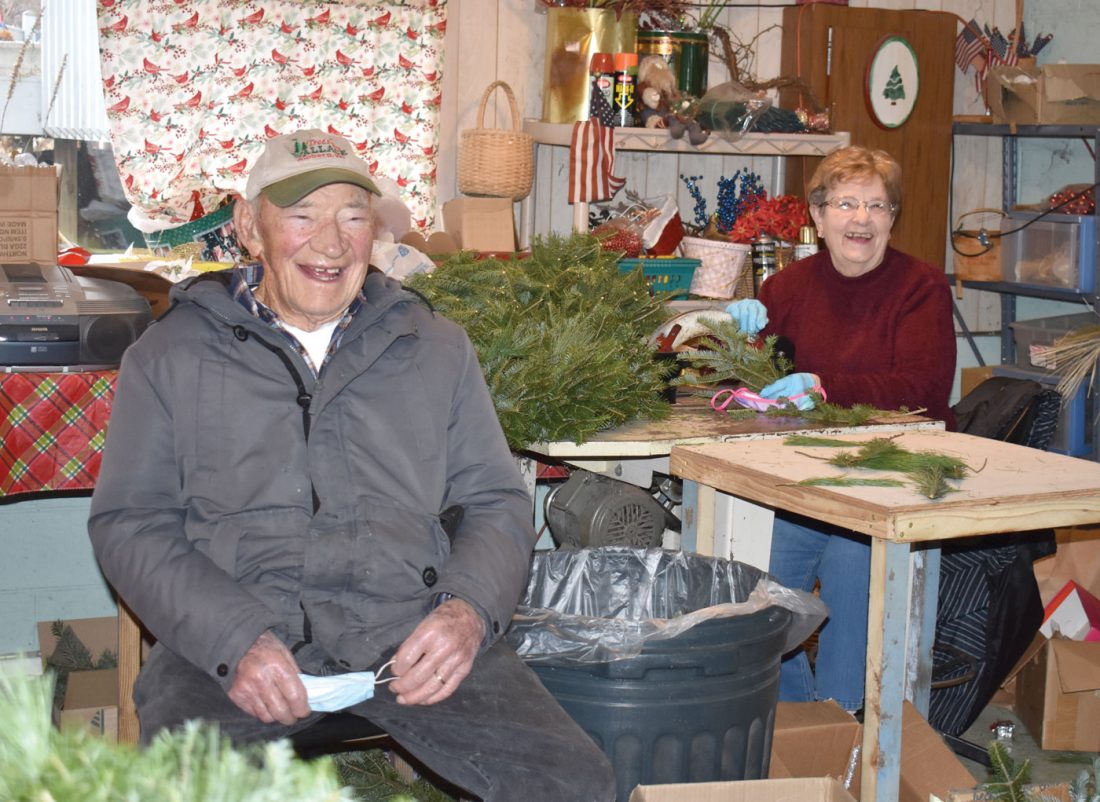
KEN AND ROSE WALLACE in the shop of their Trees by Wallace business on U.S. 141 in the Town of Amberg, Wis. The couple have operated the Christmas tree farm, which Ken’s father started, together for more than 60 years. (Betsy Bloom/Daily News photo)
TOWN OF AMBERG, Wis. — For Rose Wallace, the operative word in their business is “fluffy.”
A good Christmas tree is “fluffy” and full figured, a good wreath “fluffy” and dense, not flat. A “kissing ball” should be a fuzzy sphere, with hundreds of branches radiating from a styrofoam core.
“Nice and fluffy,” Rose declares.
For more than a half-century, she has turned out handmade Wreaths by Rose at Trees by Wallace, on U.S. 141 in the town of Amberg in Marinette County. For husband Ken, it’s been a lifetime commitment as the second generation in the family business.
The couple were introduced through their fathers, who knew each other from when Ken’s dad had a farm near Poynette, Wis.
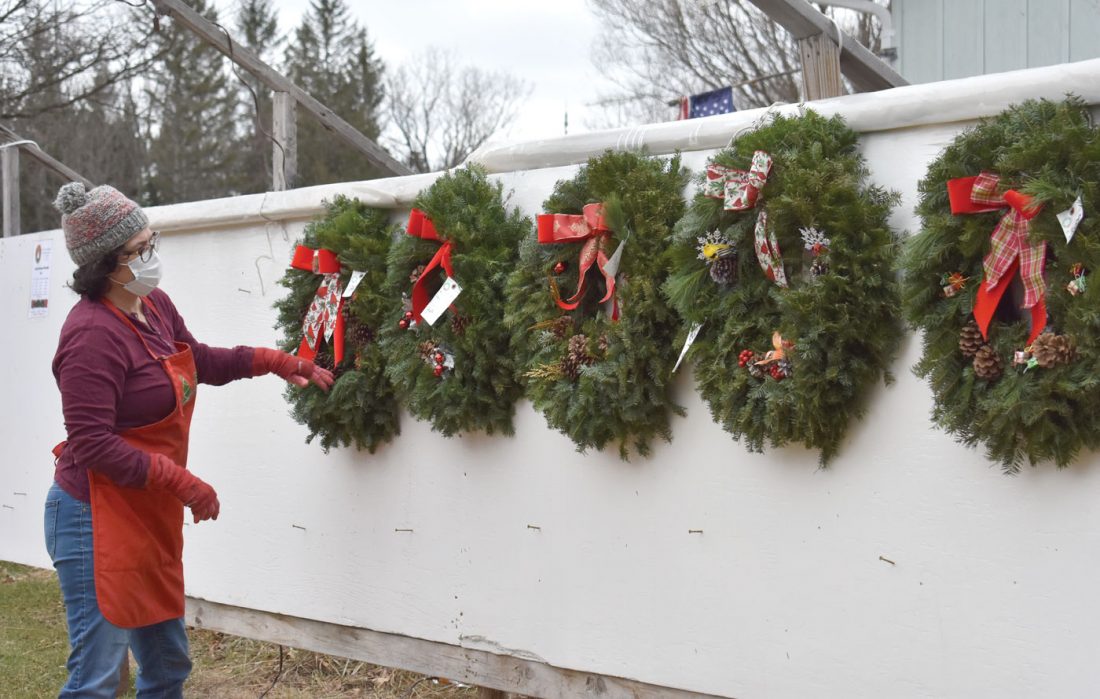
HOLLY WALLACE HANGS some of the wreaths she made in the Trees by Wallace shop on U.S. 141 in the Town of Amberg, Wis. Holly is the daughter-in-law of the business’s owners, Ken and Rose Wallace. (Betsy Bloom/Daily News photo)
“My father and his father went to barn dances as teenagers,” Rose said.
Ken’s family moved to Amberg after losing the farm in Poynette in 1929-30, the start of the Great Depression. But they kept coming back to Madison for the holidays, bringing trees cut in the north. Wisconsin state officials would buy from Ken’s dad to put at the corners of the Capitol property, Rose said.
Rose’s father eventually saw the trucks in Madison and made the connection, renewing their friendship and setting up the future union of their children.
Rose grew up on a farm in DeForest, Wis., about 15 miles north of Madison. Homemade ice cream from their dairy cows would be sold to motorists on their way back to Chicago. Dense and hard-frozen, it could hold up for the rest of the trip, Rose said.
Her mother also specialized in angel food cakes she’d sell at the Capitol building in Madison.
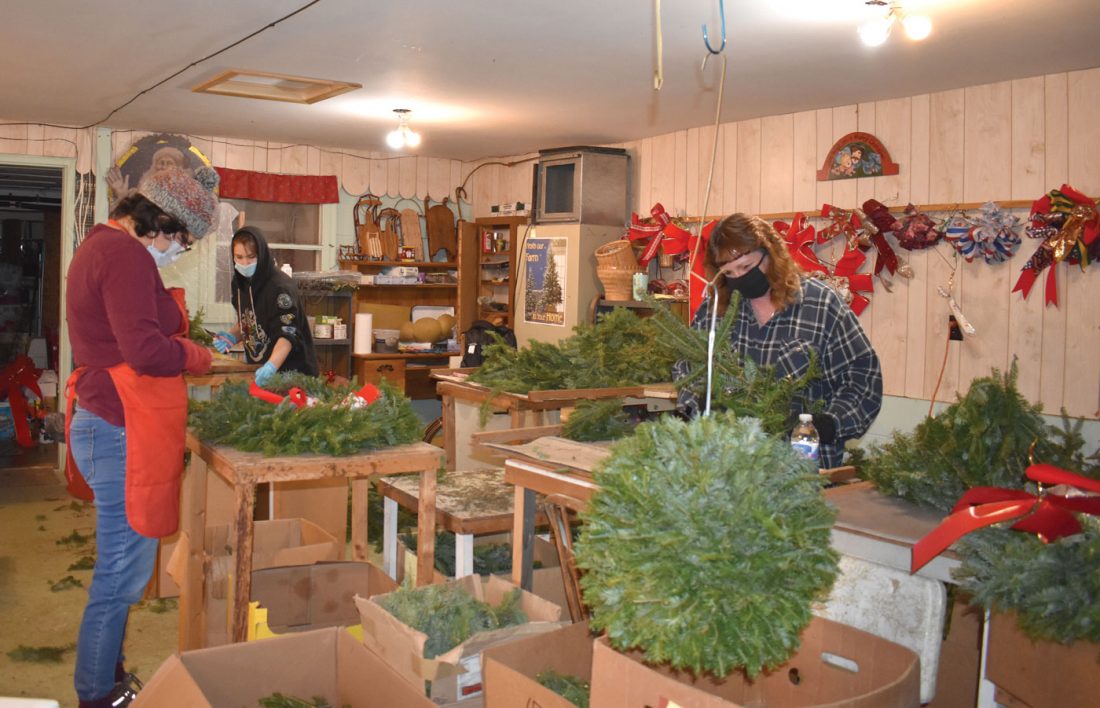
Some of the crew that helps put together wreaths and other seasonal decorations at Trees by Wallace in the Town of Amberg, Wis. At left is Holly Wallace, in back is Miriam Johnson and at right is Tina Skenandore. (Betsy Bloom/Daily News photo)
“During the Depression, folks did all kinds of things,” Rose said.
“To make a living,” Ken added.
They do this often in a conversation, finishing each other’s sentences, helping fill in the small details of their lives.
While Ken was serving in the Navy from 1953 to 1955 aboard the USS Oriskany in the Pacific — the ship now is a sunken artificial reef in the Gulf of Mexico, he adds — Rose’s mother encouraged her to strike up a correspondence, telling her daughter, “He’s lonely, write to him.”
They would wed in November 1956. They celebrated their 64th year of marriage last month with takeout food and a few family members, Rose said.
The couple kept going to Madison to sell Christmas trees, taking the kids along until they reached school age and “we couldn’t take them out of school.”
They then turned to selling wholesale to other lots, as far away as Wyoming — yes, rugged, mountainous Wyoming wanted Christmas trees from Wisconsin.
But after people kept seeing their sign on U.S. 141 and would stop, wanting to cut a tree to take home, they decided to open a retail operation as well.
“And it worked,” Ken said.
“We didn’t know what kind of business we’d have … but people came hunting,” Rose said.
Now, 75 percent of their business is traffic, “up and down the highway,” Rose said. During gun deer season, the same men will come in with the same message from their spouse, Ken says: “I don’t care if you kill a deer, bring my wreath.”
They now sell about 2,000 to 3,000 trees in a season, both wholesale and retail, along with about 200 to 300 wreaths. They once did yards of garland as well but the artificial variety that can be brought out annually has almost ended the market for the fresh variety, Rose said.
The room where they assemble the wreaths and other decorations is like you’d envision a little corner of Santa’s workshop, stacked with green boughs and boxes of ribbons and ornaments, the air saturated with the scent of pine, balsam and fir. The clock on the wall plays Christmas carols on the hour.
Rose sits at a bench with a wheel set in the surface like a table saw, weaving cut evergreen branches to build each wreath by hand. She’ll add ribbons and perhaps some other decorations, none quite the same. All tend to find a buyer, no matter what style.
“Beauty is in the eye of the beholder,” Rose said, “and that’s really true in the Christmas business.”
While Christmas might be the busy season, Ken and Rose say a tree farm is a year-round commitment. Cones are shaken for seeds they’d plant in the garden, then transplant as seedlings after three to five years to stands that will take perhaps another decade to reach the ideal height of 7 to 10 feet.
The growing trees need to be sheared and shaped each year, kept watered if drought threatens, monitored for attacks by grubs and other insects, even grasshoppers.
It takes cultivating 10,000 trees to ensure having 1,000 ready each year for harvest, Ken said. That’s a significant commitment of both time and acreage.
The operation also needs tractors, equipment that both cuts the tree and bale it in twine for transport, the machinery to assemble the wreaths.
Rose starts tying bows in September. Harvesting begins in the final week of October, with Brad Tabbert running the baler, so they’re ready to be loaded on a semi-truck in early November.
For decades, Ken also kept up a side occupation as a sign painter, working freehand before computers could be used to create templates for walls, windows and doors — though he learned how to use that technology when it emerged as well.
But at age 88, macular degeneration has eroded Ken’s vision to the point he no longer can paint. Yet he remains involved in what he can still do on the farm.
“It’s hard to believe we’ve been doing this 50, 60 years,” Rose said.
“Hard to believe, isn’t it?” Ken said with a grin.
What’s kept them in? “Starvation,” Ken quips, then rubs thumb and index finger together in the universal gesture for payment.
But that’s never been the real motivation. They talk fondly of those they’ve had as customers over the years, the general jovial atmosphere that surrounds being in Christmas trees.
“People come in smiling and happy,” Rose said.
“Kids bouncing around,” Ken said. “It’s a good, honest business; good, honest work … We meet a lot of good people, a lot of good people.”
“That’s it for me, the niceness of the business,” Rose said. “I’ve always liked Christmas and this is part of it.”
That includes other tree farmers, who remained friends rather than competitors over the years.
“People who grow trees are not cutthroat,” Rose said.
They raised four sons on the farm: Mike Wallace, a music director and teacher in Bloomington, Ill.; Casey Wallace, formerly in the Air Force, now involved in the family business; Andy Wallace, an x-ray and ultrasound technician who also had a choose-and-cut tree business near Francis Creek, Wis., until he was lost to gastric cancer; and Wesley Wallace, who works for Wisconsin Public Service and had been in Green Bay but moved back to Amberg so their kids could “start and finish in one school.”
Ken and Rose had their grandkids running in and out of the shop while their parents built a new house 5 miles away. Wesley Wallace’s wife — with the apt name of Holly — now is a key wreath maker for the business.
Ken and Rose have nine grandchildren and six great-grandchildren as well. But for now, none have leaned toward taking over the business completely — Casey says he might sell some trees but doesn’t want to do it on the scale his parents did — and Ken and Rose don’t pressure. They encouraged their sons to find their own path, Rose said.
Like other farming businesses, small growers are being squeezed out by larger operations. Their numbers have been thinned over the decades as artificial trees began to replace fresh-cut. The five or six farms that used to be within 20 miles of the Wallaces now have shrunk to one or two.
Even the Wallaces have cut back. They sold some of their land, retaining leases to harvest trees on some acreages, letting other plots go to camps and residential. They also gifted their children with land.
This year, Rose decided not to add to her stock of ribbons and decorations, thinking she needed to use up what she had. Ken said they stopped planting new trees, thinking he’d likely not be able to tend them for the 10 years they’d take to be ready for market.
So it was nice to see reports in the media about renewed interest in real trees, fresh-cut greenery for the holidays. In these COVID-altered times, choosing a Christmas tree has become a family event that can be done outdoors, with proper social distancing.
It was the same at Trees by Wallace. The Friday after Thanksgiving was twice as busy as normal, Rose said.
They’ll keep the business going as long as they can. For now, they haven’t made plans for retirement.
“We’re not planner people,” Rose said. “Our plans seem to just happen …”
Adds Ken, “Evolve.”
Local News
Stonehouse legacy endures as fire rebuild advances
Board meetings, hearings scheduled
The Iron Mountain Board of Education will have a public hearing and the end of year meeting at 5 p.m. today in the ...
Dunbar man killed in motorcycle crash
BEECHER, Wis. — A 74-year-old Dunbar, Wis., man died Saturday when the motorcycle he was operating on Highway Z ...

UP music festival series back in IM this week

Proposed cuts to NOAA threaten Great Lakes research