
Struggling to connect
School shutdowns during pandemic point up educational need for rural broadband access
-
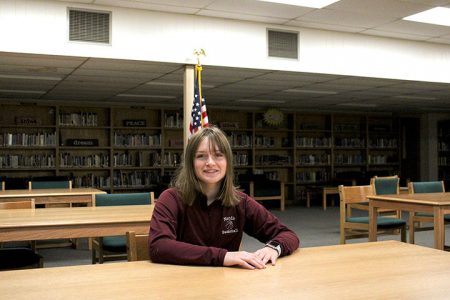
- DELANEY KRAMER, A soon-to-be sophomore at North Dickinson County School, lacked a decent wi-fi connection at her Hardwood home to participate in remote learning when the school was forced to close in spring 2020 due to COVID-19. “I couldn’t get any of my assignments open, so they were all half done,” Kramer said about trying to work online by using her mom’s phone hotspot. (Ta’Leah Van Sistine photo)
-
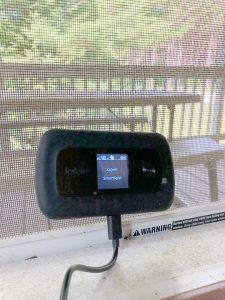
- The Beecher-Dunbar-Pembine School District distributed 56 Kajeet mobile hotspots to students who did not have reliable broadband access. Shown is the home hotspot Laura Strietzel’s family received in spring 2020. (Laura Strietzel photo)
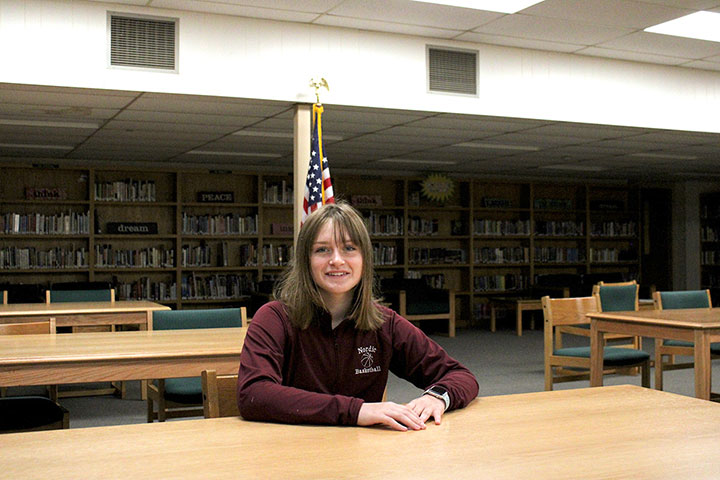
DELANEY KRAMER, A soon-to-be sophomore at North Dickinson County School, lacked a decent wi-fi connection at her Hardwood home to participate in remote learning when the school was forced to close in spring 2020 due to COVID-19. “I couldn’t get any of my assignments open, so they were all half done,” Kramer said about trying to work online by using her mom’s phone hotspot. (Ta’Leah Van Sistine photo)
Virtual learning never quite worked for Delaney Kramer when North Dickinson County School shut down in spring 2020 due to the COVID-19 pandemic.
The soon-to-be sophomore lives in Hardwood, roughly 15 miles from the Felch Township school — and in a home that didn’t have a wi-fi connection.
Kramer tried using the wi-fi hotspot on her mom’s phone but neither she nor her two brothers — who also needed the hotspot for school at the same time — could participate in internet Zoom classes or do online assignments.
“I was a little upset because I was getting my work in later than everybody else,” Kramer said. “My grades were always worse than everybody else’s.”
In the fall, whenever North Dickinson closed due to COVID-19 — and when Kramer got COVID-19 herself in October — she had to rely on paper packets provided by the district to do her schoolwork. Her grades did improve through that method compared with when she couldn’t get online the previous spring.
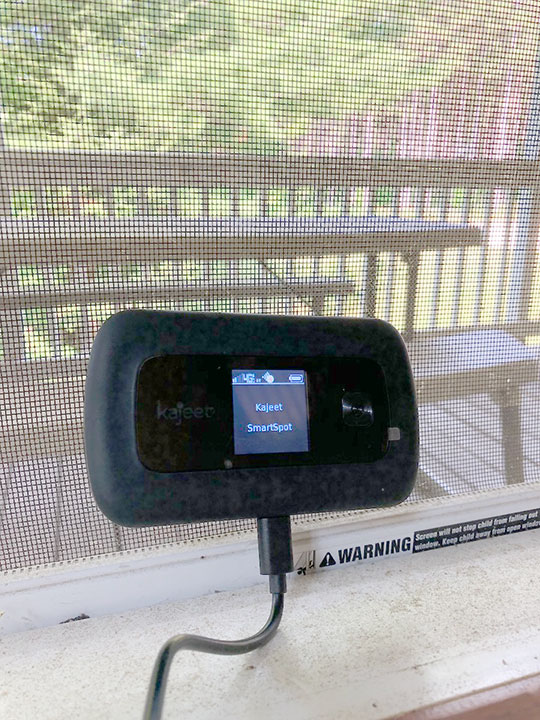
The Beecher-Dunbar-Pembine School District distributed 56 Kajeet mobile hotspots to students who did not have reliable broadband access. Shown is the home hotspot Laura Strietzel’s family received in spring 2020. (Laura Strietzel photo)
But it demonstrates that assuming classes could meet remotely didn’t work for all.
And Kramer’s story wasn’t rare for students in rural areas, as the pandemic shutdowns put a spotlight on how these areas struggle with limited internet access.
School districts in the Upper Peninsula and northeastern Wisconsin did try to help most families who lacked adequate internet connections by providing mobile hotspots or paper packets.
However, school administrators and staff say the pandemic revealed rural broadband access no longer can be considered a want or luxury but has become an essential teaching tool all students need to succeed.
Broadband defined
According to the Federal Communications Commission, broadband “allows users to access the internet and internet-related services at significantly higher speeds than those available through ‘dial-up’ services,” or those that allow connectivity through a standard telephone line.
One main broadband option in rural areas is Digital Subscriber Line internet, or DSL. It still uses telephone lines to establish a connection, but DSL is different from dial-up because users can be on the internet while also using their landline phone.
Another option is satellite broadband, which uses a dish to receive signals from space.
While satellite can be more readily available in remote areas, websites that evaluate computer access options advise this form of broadband usually is slower than DSL.
Broadband became a part of local and national discussions during the COVID-19 pandemic, as it exposed how many families in rural areas lacked reliable and high-speed internet access.
Even in these highly divided political times, Republicans and Democrats alike have agreed it’s worth investing in broadband access in rural areas.
The $1.2 trillion infrastructure bill that passed the Senate on Tuesday includes $65 billion to bring broadband internet access to rural areas and help those who have a connection to better afford internet service.
Additionally, Michigan state Rep. Christine Morse, D-Texas Township, introduced House Bill 5039 in June that would support broadband mapping, or the process of identifying “underserved areas in need of high-speed internet,” she said.
But getting high-speed broadband in rural areas won’t come cheap, said Eric Smith, director of broadcast and audio-visual services at Northern Michigan University.
“The cost per mile to construct (a wireline-type service) is very high,” Smith said, “and if you have, on a rural road, just a couple of homes and there’s a long distance between them, it’s very expensive to build out a wired connection to that location.”
Broadband challenges
The struggle to get broadband internet service in the outlying areas of the Upper Peninsula is one reason why NMU established the Educational Access Network, a service that helps students and families connect to the internet to access educational services.
Smith, an EAN team member, said EAN at first was a tool for NMU students to complete coursework on and off campus. But in 2016, the team began getting calls from other communities in the U.P.
Smith said the EAN team was told, “We really are challenged with our own schools to help them with broadband access. Is there a way you could help us construct something for our community?”
The EAN team was able to secure additional broadband spectrum, with FCC approval, and built the EAN across the U.P. Smith said EAN now is running a 4G LTE network, with plans to upgrade to 5G in the future, and has 72 transmitter sites in the Upper Peninsula, including Iron Mountain, Kingsford, Norway and Felch Township.
According to previous reporting by The Daily News, students enrolled in an EAN-qualified school can get full access to NMU’s LTE network for $19.95 a month, with an optional speed upgrade for an additional $5 per month.
Smith said the team is “thrilled” that students enrolled in EAN were able to stay connected to teachers and classes during the pandemic.
EAN, though, is just one of several efforts to help rural areas in the region get broadband access. From March 2020 and into the fall, a number of school districts worked to improve home connections for rural students and their families.
Some of the adjustments made at school districts in the region included:
North Dickinson County School
In December, North Dickinson — with roughly 242 students in kindergarten through 12th grade — received 120 HP Chromebooks, or one for each student in sixth through 12th grades. These were gained through federal and state COVID relief funds.
Even with these devices, some students on the outskirts of the approximately 500-square-mile district still have trouble with internet access, said Angel Inglese, superintendent/principal at North Dickinson.
Connectivity for students was more of an issue when the school shut down in March 2020, Inglese said, and “a lot” of paper packets were sent to families.
Households that lacked a reliable internet connection had to rely on phone communication with teachers, Inglese said.
Vicki Lindholm, an English and digital imaging teacher for ninth through 12th grades, said under remote learning, she had weekly check-ins with students who needed to have paper packets, making sure they were able to complete the materials.
Some of Lindholm’s students would start with a stable connection during virtual meetings but then their screen would freeze, so Lindholm said she’d repeat herself to ensure every student had the information they needed.
Beecher-Dunbar-Pembine School District
Laura Strietzel, a secretary at BDP who has three kids in the school district, said when they transitioned to remote learning, only one of her children could access Google Classroom at a time.
“It was frustrating and stressful,” Strietzel’s daughter, who will be in 10th grade this fall, said about the challenges she and her siblings faced with connectivity. Strietzel said her daughter especially worried about whether her assignments were being received or if she was going to be marked absent.
Once the family realized in spring 2020 that their connection wouldn’t hold up, Strietzel said they received a Kajeet mobile hotspot — one of 20 the BDP distributed soon after the district in Pembine, Wis. shut down in March 2020.
While Strietzel said the hotspot helped, only two children could be online at the same time, not all three.
When they continued to have trouble in the fall, Strietzel said she called their internet provider, CenturyLink.
“I was willing to pay for whatever we needed,” Strietzel said.
However, for the same price they were paying, the provider improved the family’s internet service from 1.5 megabytes per second to 15 megabytes per second. Strietzel said CenturyLink did not say whether this was due to the COVID-19 pandemic.
BDP — a school district that covers three towns in Marinette County and has about 195 students — conducted a survey in April 2020 that showed 25% of the district’s families, or about 25, lacked reliable internet service, said Vince Czahor, the district technology coordinator and district library media specialist.
Czahor said these families either had bad cell phone reception or no broadband internet access due to their remote location or the cost, or a combination of both.
To counter this, Czahor said the district purchased 36 more Kajeet mobile hotspots throughout 2020 with funding from a variety of grants.
Czahor said a small group of students who received a hotspot still needed to do their coursework through paper packets when the district had to go to remote learning.
“Broadband is such a huge problem in rural parts of our area because if there’s no cellphone signal, of course, the mobile hotspot won’t work,” Czahor said.
In summer 2020, Czahor said BDP also installed two access points that would propel BDP’s wi-fi signal about 200 feet into the school’s parking lot.
Czahor said he didn’t hear about parents driving to BDP to use the school wi-fi but noticed students who lived close to the school sometimes utilized that service.
Forest Park School District
The district based in Crystal Falls was able to acquire 15 hotspots at the end of November for families struggling with connectivity, said Jackie Giuliani, the Forest Park School District principal for pre-kindergarten through 12th grade.
“I think because every school was trying to get what they needed, it was just a backup of ordering,” Giuliani said. “Because this was (the COVID-19 pandemic), you couldn’t prepare for it.”
In the end, Giuliani said the district only needed to distribute 10 hotspots, some to families that had limited internet access but needed a boost to allow multiple students in the household to connect at one time.
Before the hotspots were available, Giuliani said students who had internet problems received paper packets, and staff made sure to have “good, open communication” with those families.
While NMU does provide EAN service in Crystal Falls, Forest Park Superintendent Christy Larson said she doesn’t know if any students utilized that connection during the pandemic.
Florence County School District
In April 2019, almost a year before the COVID-19 pandemic, Florence County finished installing broadband equipment on three local towers.
These towers were paid through a state grant that Florence County, in partnership with internet service provider Northwoods Connect, received in August 2017, according to a press release from Florence County Economic Development.
“Those three towers being installed played a huge role in our success (with) connectivity (during the pandemic),” said Monica Chartier, the district’s technology director.
Having this established relationship with Northwoods Connect helped when the pandemic forced classes to meet outside the school, as the vendor worked with the district to provide discounted internet services to families who were financially struggling, Chartier said.
The district, which has 381 students and is the only school district in Florence County, was able to get internet connections established by April 2020 to all but one of the 15 to 20 Florence County families that previously didn’t have some sort of service, Chartier said.
Chartier said that one student’s teachers would record their virtual sessions, download those videos onto an iPad and a bus driver would meet with the student’s parents twice a week to give them the iPad.
Some challenges remained even after most families got an internet connection, Chartier said. Some families had slow connections and others had to drop their internet service in the fall because they couldn’t afford it.
The district was able to purchase three mobile hotspots “at a very discounted price” through T-Mobile’s Project 10Million for families who were struggling financially, Chartier said. These hotspots were distributed at the start of the 2020-21 school year.
Ultimately, communicating with families and internet providers helped significantly in resolving most connectivity issues, Chartier said.
North Central Area Schools
About 20 of North Central’s 442 students had internet problems during remote learning sessions, said Jennifer Eichmeier, the North Central Elementary building principal and superintendent for North Central Area Schools in Powers.
Eichmeier said families that didn’t have viable internet in the roughly 600-square-miles district in Menominee County received hotspots by the start of the 2020-21 school year, after working with paper packets earlier.
‘A necessity for education’
Even though these school districts were able to find some solutions for students who didn’t have reliable — or any — broadband access during the pandemic shutdowns, several staff members said high-speed internet connections needs to be readily available to all, not just as an emergency service.
“Nobody should be disadvantaged based on geography,” said Ben Niehaus, former district administrator for School District of Florence County. “Broadband should really not be looked upon any differently than essential utilities.”
Czahor from Beecher-Dunbar-Pembine agreed, saying the COVID-19 pandemic brought this already existing problem to light.
“I seriously think, just like we brought electricity to rural America, we have to do the same thing with broadband internet access,” Czahor said. “It has become a necessity for education.”
_____
Ta’Leah Van Sistine is a creative writing and journalism major at the University of Wisconsin-Eau Claire who wrote several articles for The Daily News while spending this summer in Iron Mountain.
Local News

The cheesehead hat turns an insult on its head

Wisconsin Supreme Court agrees to hear congressional maps lawsuit
Niagara man dies after motorcycle-SUV collision

Forest Park student earns national publishing award

Lack of rehabbers leaves few choices for fawns in need of care
Motorcyclist killed in Breitung Township crash
A 21-year-old Niagara, Wis., man was killed Thursday when the motorcycle he was operating collided with an SUV ...