
The birds are back in town
Northwoods Notebook
Trending
If migration tracking is correct, the time may have come in the region to get grape jelly, oranges and nectar back out on the backyard bird buffet.
While cold weather in late April and May's snowy start seemed to put the brakes on most new avian arrivals to the region, temperatures now appear headed consistently for the 60s and even 70s.
Even more, the winds are shifting to a more favorable flow northward.
A migration map online at Cornell Lab of Ornithology's BirdCast site, https://birdcast.info/migration-tools/live-migration-maps/, showed a major movement starting overnight Thursday into early Friday, with at one point an estimated 781 million birds on the wing.
That map showed Iowa, Illinois, Minnesota having areas of high traffic, with Wisconsin and the Upper Peninsula considered in upper medium to lower high activity.
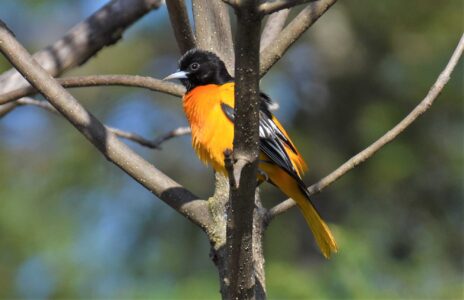
So, not surprisingly, the Birding Wisconsin's Facebook page got lit up with first-of-the-year photos and reports of Baltimore and orchard orioles, along with rose-breasted grosbeaks, as far north as Oshkosh and Waupaca.
In a bit of a surprise, Ken Diehn of Vulcan posted on the Upper Peninsula Birding Facebook page a photo of a ruby-throated hummingbird at his feeder Friday. The Wisconsin Birding Facebook site had hummingbird sightings mostly in the southern counties.
It can safely be assumed a host of warblers, tanagers and the indigo buntings -- already seen in Kenosha County in the southeast corner of Wisconsin -- either came along or are not far behind.
All are neotropical migratory species, which means they spend the winter months in Mexico, Central America, South America or the Caribbean islands, then come to the United States and Canada in spring to nest and raise young.
On its website at https://nationalzoo.si.edu/migratory-birds/neotropical-migratory-bird-faqs, the Migratory Bird Center at Smithsonian's National Zoo and Conservation Biology Institute states that about 200 species can be considered neotropical migratory birds. "The majority are songbirds (such as warblers, thrushes, tanagers, and vireos), but there are also many shorebirds (such as sandpipers, plovers, and terns), some raptors (such as hawks, kites and vultures), and a few types of waterfowl (such as teal)."
With migration picking up, this is a good time for a reminder to clean feeders and rake up old seed and other debris around backyard feeder sites, lest they potentially spread disease such as salmonellosis, caused by salmonella bacteria.
The National Audubon Society recommends cleaning bird baths and feeders with a solution of nine parts water to one part bleach, then letting the feeder dry completely before hanging it back up. Those who prefer not to use bleach can find instructions on alternative cleaners, such as vinegar, online as well.
Cleaning ideally should be done about twice a month and more frequently if an illness is suspected in area birds, such as the eye disease conjunctivitis, the Cornell Lab of Ornithology advised.
Raking or shoveling underneath feeders can remove old seed, discarded hulls and droppings that may have gotten wet, spoiled or harbor mold or bacteria potentially harmful to the birds.
Though highly pathogenic avian influenza still appears to be present in the United States this spring, it has not been reported at the level seen in 2022, and no warnings have been issued so far on feeding birds as happened last year. But those with domestic flocks probably would be advised to guard their birds against exposure to migrating wild birds, the Michigan Department of Agriculture and Rural Health stated in a news release after HPAI was found in March in an Eaton County backyard flock.
Meanwhile, feel free to send in reports and photos of what may turn up at your homes in the next week.
Betsy Bloom can be reached at 906-774-2772, ext. 240, or bbloom@ironmountaindailynews.com.