
Canada geese have ‘cousins’ who may pass through
Northwoods Notebook

A gaggle of snow geese pick their way through a field on Kramer Road near Sagola in this photo from spring migration in 2017. These are the most likely “other” goose species — beyond the well-known, numerous Canada goose — that can turn up in the Upper Peninsula, but only during spring and fall migration. (Theresa Proudfit/Daily News photo)
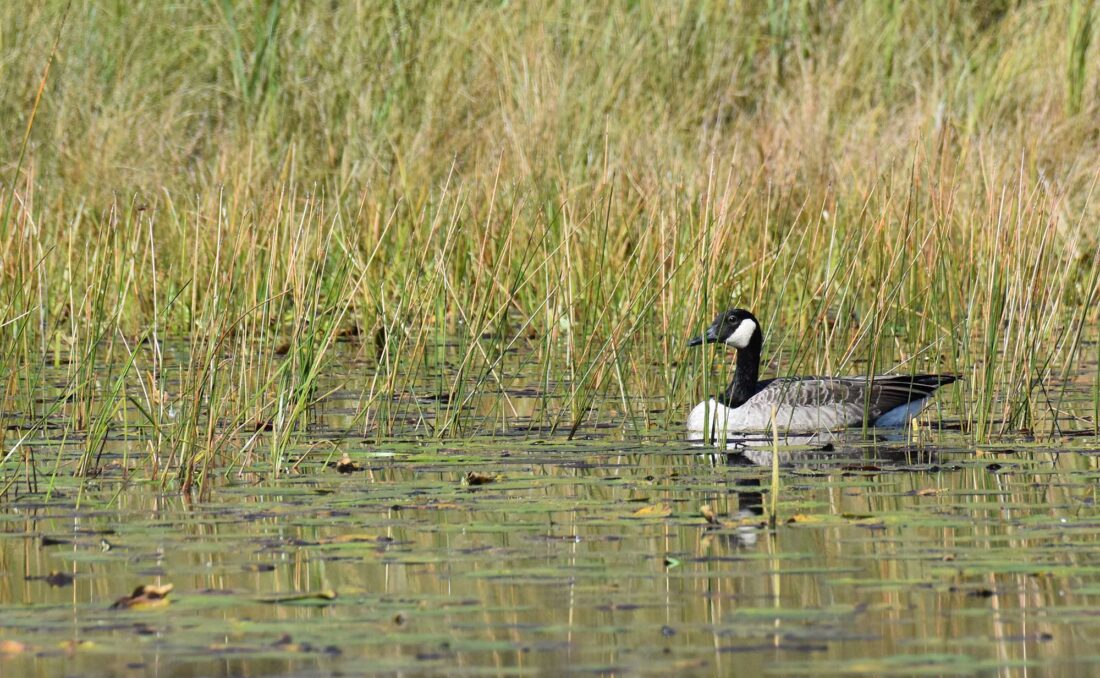
A lone Canada goose loafs Thursday on Six Mile Lake in northern Dickinson County as temperatures reached into the 80s. While Canada geese are by far the most common goose species seen in the Upper Peninsula, the fall migration can potentially bring several other varieties into the region. (Betsy Bloom/Daily News photo)
A gaggle of snow geese pick their way through a field on Kramer Road near Sagola in this photo from spring migration in 2017. These are the most likely “other” goose species — beyond the well-known, numerous Canada goose — that can turn up in the Upper Peninsula, but only during spring and fall migration. (Theresa Proudfit/Daily News photo)
A lone Canada goose loafs Thursday on Six Mile Lake in northern Dickinson County as temperatures reached into the 80s. While Canada geese are by far the most common goose species seen in the Upper Peninsula, the fall migration can potentially bring several other varieties into the region. (Betsy Bloom/Daily News photo)
Trending
A flock of geese passed overhead earlier in the week, the first one I've seen this fall migration.
It's still early for most waterfowl -- ducks, geese and swans -- to begin making the exodus out of the north in earnest.
But it was a good reminder that this is the time of year when we might catch a glimpse of the "other" geese that can temporarily appear in the Upper Peninsula and northern Wisconsin.
The rural Midwest sometimes is referred to as "flyover country," because airlines often pass far overhead as they travel between destinations. Most native geese species do much the same.
We're most familiar with Canada geese, the only variety that actually nest here. These "giant" Canada geese, Branta canadensis maxima, originally bred from central Manitoba to Kentucky but were nearly driven extinct in the early 1900s, according to the Cornell Lab of Ornithology's All About Birds website, https://www.allaboutbirds.org. "Now, they've rebounded so successfully they're considered a nuisance in many urban and suburban areas," the site noted.
But most other geese species in North America have their breeding grounds far to the north, in the arctic coastal tundras of Canada, Alaska, even Greenland.
They include snow geese and its "blue" morph that has a white head and gray plumage. These are the most likely to stray into the area, as they have central and eastern populations that may end up funneling into the Mississippi flyway during migration. The Ross's goose, which looks like a dwarf version of the white snow, tends to follow the same travel routes as the snow, so has turned up here as well. Harvested fields offer the best chance to see snow geese foraging in the fall.
More rare for the region is the greater white-fronted, the "specklebellies," which tend to prefer staying west of the Mississippi River. These large gray birds with pink bills and black markings across their chest and bellies are the most alike in appearance to domestic geese, most of which descend from the similar graylag goose of Europe and Asia.
Like the Ross's, cackling geese look like mini-me's of another goose -- in this case the Canada -- and formerly were considered Canada geese until the smallest four of the 11 recognized Canada subspecies were split out in 2004, according to the Cornell Lab of Ornithology's All About Birds website.
Again, as with the Ross's, cackling geese differ not just in size from their larger lookalikes but also in having a shorter bill and neck.
The other native geese species -- the brant and emperor -- are almost strictly coastal, so highly uncommon this far inland. The brant, subspecies Atlantic on the east coast and black on the West Coast, can appear on the two most-eastern Great Lakes, Erie and Ontario, as it migrates from Hudson Bay, but has only sporadic sightings further west. The emperor would be a miracle to see here, as this beautiful small species -- with blue-gray feathers scalloped in black, white heads, black throats, pink bills and orange feet -- lives its whole life along the fringe of western Alaska and eastern Russia.
So, as always during migration season, scan the fields, lakes and marsh areas to see if something unusual has decided to make a visit.
Betsy Bloom can be reached at 906-774-2772, ext. 240, or bbloom@iromountaindailynews.com.