
Evers pushes for more school funding, end to gerrymandering
Trending
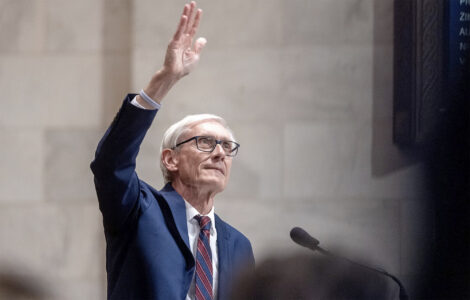
In his eighth and final State of the State address Tuesday night, Gov. Tony Evers said Republicans have chronically underfunded Wisconsin schools and blamed them for increased property taxes after negotiations for a tax cut stalled this week.
In comments to reporters after the speech, Republican Assembly Speaker Robin Vos said negotiations would continue and he remains "optimistic" about the prospects for a tax and spending deal.
In his hourlong speech, Evers described a tenure in office that includes 800 bill signings, paying off billions in state debt and enacting $2 billion worth of annual tax cuts -- but said there is work left to do before he retires early next year.
That work likely won't include approval of a $2.3 billion package that Republicans sent him this week, which included a tax rebate plan.
"Local property taxes go up when the state fails to do its part to meet its obligation," said Evers, calling for a plan to get "meaningful resources to K-12 schools and provide property tax relief."
"And it must balance these important obligations a heck of a lot better than the plan Republican leaders sent me this week," he added.
With the state Assembly due to wrap up business this week, Evers called on lawmakers to stay in Madison and said he'd call a special session of the Legislature in the coming weeks with the goal of banning partisan gerrymandering.
That comes two years after the Legislature passed and Evers signed a law creating new voting maps that gave Democrats more representation in the Legislature.
"Politics should stay out of redistricting from start to finish," Evers said.
Evers said he is responding to efforts by Republican legislatures elsewhere to gerrymander in their favor, triggering similar efforts in Democratic-run states.
"While we have fair maps today, we still don't have a nonpartisan redistricting process in place. That means there's no guarantee Wisconsinites will still have fair maps after the next U.S. Census," said Evers.
The governor has the power to call a special session but no power over how legislators conduct it. Evers' previous attempts to convene special sessions have largely ended in a matter of seconds, with Republicans gaveling in and out without taking action. And he acknowledged that lawmakers are gearing up to campaign for November's legislative and midterm elections.
"We can't afford for lawmakers to lose focus on the future we've been working hard to build together just because it's an election year," said Evers, who is not seeking re-election. "I know the Legislature would rather hit the road and take the rest of the year off, but I'm going to ask lawmakers to stick around until our work here is finished."
The mood at Tuesday's event was unusually ebullient. Evers was greeted at the podium with loud cheers from fellow Democrats, and throughout the speech attendees whooped and shouted jokes, call-and-response style.
And while Republicans often respond coolly to Evers' speeches, there was a bit of an edge in the air on Tuesday, too. As cabinet members were introduced at the evening's start, some lawmakers booed State Superintendent Jill Underly -- an atypical breach of decorum.
Evers' address came after weeks of back-and-forth with Republicans over a solution for steep property taxes. Republicans have blamed Evers' 400-year veto -- a budget maneuver that extended school districts' abilities to raise revenue for four centuries -- for the high rates, while Evers has pointed out that communities were voting to raise their own taxes to fund schools for years.
On Tuesday, Evers doubled down on his position, saying that high taxes are a consequence of a "decade of Republicans consistently failing to meaningfully invest in our kids and K-12 schools."
Evers pointed to requests for school funding that Republicans have nixed over previous budget cycles.
"If lawmakers want to have an honest conversation about property taxes, start there," he said.
Last week, Evers and Assembly Republicans were negotiating a possible deal that would include trading some tax relief for increased school aids and special education funds. Then on Sunday, Republicans drafted a plan to offer universal tax rebates and a property tax credit. That package also included an increase in special education funding.
Speaking to reporters after the speech, Vos said he'd received a response from Evers' team, and that the two camps were to continue discussions Wednesday.
"Sounds like he is willing to sit down and talk, but he is trying to draw bright lines in the sand. That is not something I've ever found to be productive," Vos said. "I'm optimistic we can sit down tomorrow and talk about the things that are important for the governor to invest in ... but also making sure that we give meaningful tax relief to the citizens who have obviously overpaid and are struggling to deal with the rising costs all across the economy."
Evers did not name President Donald Trump directly but spoke about "reckless decisions being made in Washington," which he said will have "disastrous consequences" for the state. And he said he was angry about the federal government's crackdown on immigration.
"I'm also angry when I think about our neighbors -- young kids and families across our state -- who aren't going to school or work or anywhere else, because they're scared leaving their home may mean their family will be torn apart," he said. "And I worry about what all of this means for America's Dairyland, which has depended on the hard work of immigrants for generations."
He also alluded to major changes at the U.S. Department of Health and Human Services, as he called for investments in health care. He announced that Wisconsin will join a growing coalition of Democratic-led states joining the World Health Organization's Global Response Network.
Earlier this year, Trump pulled the U.S. out of the global alliance, which monitors and develops plans responding to disease outbreaks. Since then, several U.S. states have independently joined the network, including California, New York and Illinois.
"We must do what we can to keep our kids, our families, and our communities healthy and safe," he said.
After the speech ended, Republican leaders said Evers was claiming credit for victories secured by their party in the Legislature.
In a televised speech, Senate Majority Leader Devin LeMahieu said Wisconsin is strong "despite the governor, not because of him."
"If the Democrats were in charge in Madison, Wisconsin would be a very different place. Jobs would flee to other states. ... Our increasingly mobile workforce would leave for states with lower income tax rates," he said. "Thankfully, that's not reality. And thanks to the state Legislature, the state of our state is strong."
Vos called the governor's speech partisan.
"He spent quite a bit of time taking credit for the bipartisan work that we were able to successfully accomplish," Vos said.
And Vos said he is "skeptical" about Evers' gerrymandering proposal. He pointed out that Republicans had called for a nonpartisan redistricting commission -- a request during the redrawing of state maps that Democrats called a ploy.
"I guess I'd be open to listening to what his proposal is," Vos said. "Frankly, all the Democrats across the country are rushing to gerrymander -- I hope he's sincere in saying he doesn't want that."