
Michigan budget deal may be near
Trending
While firm details are scarce, Michigan's respective legislative leaders and the state's budget office signaled Tuesday that they have a framework for a deal on the 2026-27 fiscal year budget.
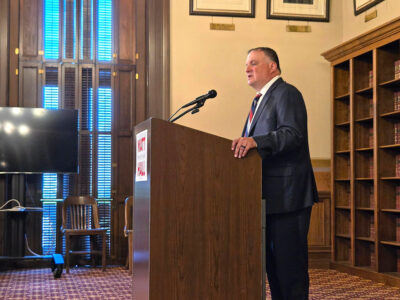
An agreement was not far off, House Speaker Matt Hall, R-Richland Township, said during a news conference, indicating that if the deal was agreed to Tuesday, it would allow the House and Senate appropriations committees to set departmental spending targets.
The state's budget office also confirmed Tuesday that a framework was in place.
Hall said the respective parties worked through the Juneteenth holiday on Friday and through Father's Day on Sunday to get that framework in place. Hall claimed that his maneuvering last week moved things along.
The speaker had said previously that he had worked to talk about budget items with State Budget Director Jen Flood while Gov. Gretchen Whitmer was on an overseas economic mission, but because Flood wasn't initially authorized to talk about the budget, there was no way to move forward with Whitmer's team until the governor returned to Michigan.
Hall said he had posited that he would work to strike a budget deal with Senate Majority Leader Winnie Brinks, D-Grand Rapids, instead if Whitmer's team wasn't authorized to deal with the budget in her absence.
That all changed quickly when Hall, on the evening of June 18, posted to social media that the parties were back at the negotiating table.
"I think it's back on track where we can do it with the governor," Hall said. "That's my preference, to do the deal with the governor, and with Leader Brinks. That's easier, but everyone needs to be authorized to talk about the budget."
Hall shared few details about the framework other than saying that a deal exists, as to not break the confidence of the negotiations.
Brinks spokesperson Rosie Jones also confirmed with Michigan Advance that a framework was in place.
There was no mention, however, whether that meant a framework for the entire budget or just pieces of it, including the education budgets that fund K-12 schools and higher education.
The state's schools are particularly on edge awaiting movement on the budget from state appropriators, as they set their base budgets in the summer months before the school year begins in the fall.
Michigan has a statutory July 1 budget deadline -- the target for the governor to have a final budget signed -- which was passed in 2019 and took effect in 2020 to move the budget process earlier and ensure schools knew how much state funding they would receive each year.
Lawmakers and legislative majorities of both Democrats and Republicans have routinely blown through that deadline when hard budget fights have come to pass, often aiming for the constitutional Oct. 1 deadline for a budget to be in place for the next fiscal year.
Hall's team and Brinks' team have relayed to the Advance that they were still hopeful to meet that deadline.
Although Hall could not share details on spending targets, he has said that there was room for negotiations on both the budget and on policy as separate tracks, but said that the Legislature could do both at the same time.
Hall has proposed a multi-billion dollar elimination of the state's property tax as one of his key policy areas that he wants to get across the finish line along with a budget deal. He has vowed to make that math work with proposed cuts and a set of luxury service taxes. Hall has similarly been opposed to a budget flushed with what he has deemed to be "pork spending" and continues to focus on cutting what he has called "waste, fraud and abuse" from the state budget -- focusing on so-called "ghost employees" and a plan to bring state workers back to Lansing after Michigan allowed government employees to work from home during and after the pandemic.
Meanwhile, the Democratic-led Senate remains focused on ensuring that free school meals for all kids are included in the new budget, reforms to the state's Freedom of Information Act that would open the Legislature and the governor's office to the act's auspices and a Michigan Voting Rights Act to address protections in the federal Voting Rights Act which have been substantially weakened by recent U.S. Supreme Court decisions.
Hall said Tuesday that he was willing to let his Democratic colleagues in both the Senate and the House net some of their policy wins if they agree to accept his policy priorities, too.
But when the Advance asked Hall if that could include FOIA, Hall said it would not. The speaker has been adamantly opposed to the Senate's push to open the Legislature and the governor's office to FOIA, and said he wouldn't consider it as part of a two-part policy and budget deal.
While some were optimistic about the budget's progress, Progress Michigan remained skeptical.
"We won't hold our breath," Progress Michigan Executive Director Justin Mendoza said in a statement after Hall's news conference.
———
Michigan Advance is part of States Newsroom, a national 501(c)(3) nonprofit. For more, go to https://michiganadvance.com.