
National Guard plays major role in Wisconsin’s pandemic response
Trending
LA CROSSE, Wis. -- After more than three months, the Wisconsin National Guard's mission to assist as nursing assistants at state health care facilities is winding down.
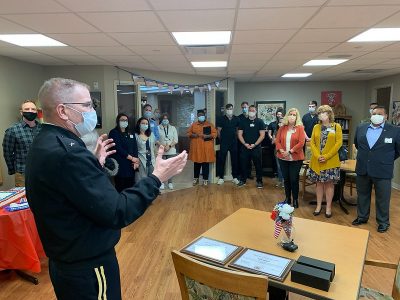
Senior Wisconsin National Guard leaders and officials from the Wisconsin Department of Health Services travelled to several health care facilities around the state to express their appreciation for the partnership that formed between them and the hospitality they provided to the Guard members who have been serving at those facilities.
As the state grappled with the omicron COVID-19 variant surge in late 2021 and an ongoing staffing shortage in the health care field, bedspace availability at health care facilities was at a premium. That mission is now ending as the need for the Guard's assistance has dissipated.
The state turned to the National Guard to help fill the void and open up additional beds at key facilities. More than 160 citizen soldiers and airmen completed two-week training programs at Madison College or Bellin College in Green Bay as well as on-the job training to gain nursing assistant certification before getting assigned to health care facilities and long-term care facilities around the state. More than 130 additional troops provided assistance at other state-operated facilities.
Despite these troops coming mostly from non-medical backgrounds, the reviews have been phenomenal, as the troops displayed their adaptability and professionalism at every turn.
Charlene Everett, the CEO at Odd Fellows Home in Green Bay, where approximately 10 troops assisted beginning in mid-January, praised the Guard members for their service at her facility.
"It's been wonderful," she said at an April 26 recognition event at Odd Fellows Home. "They've been obedient, attentive, and so kind to our residents."
Everett relayed a story about an Odd Fellows resident who historically did not want anyone assisting her, but struck up a fantastic relationship with one of the Guard members helping at the facility. Another resident struggling financially told one of the Guard members that he needed a few items, and the Guard member wanted to assist and used his own money to purchase the items for the man.
"I honestly don't have one negative thing to say," Everett said. "I'd do it again in a heartbeat. The scary part is their absence, but we knew it was coming, so we prepared for it, and I think we're going to be good."
Brig. Gen. Tim Covington, the Wisconsin National Guard's deputy adjutant general for civil support, travelled to Green Bay to personally thank the soldiers and airmen involved in the nursing assistant support mission who served at Bellin Health Systems facilities and Odd Fellows before travelling to La Crosse, where troops had been assisting at both Mayo Clinic and Hillview Health Center.
The Wisconsin Department of Health Services' Dr. Jon Meiman, state epidemiologist and chief medical officer, and Miki Gould, the facility liaison for the Wisconsin Healthcare Capacity Task Force, joined Covington and Col. Randall Myszka, the Wisconsin Army National Guard's Medical Detachment commander, on the visits.
Meiman noted the critical role long-term care facilities play in the state's overall health care system and how profound the impact of COVID coupled with health care staffing shortages impacted that system.
"We can't thank the Guard enough for the work that you've done, being willing to step up and volunteer into a completely new role," Meiman said while visiting troops finishing their tours at Odd Fellow Home in Green Bay. "It has helped more patients than I think we'll ever know across this state."
Covington also expressed his gratitude for the service of National Guard members while pointing out that the success of the mission over the past several months has been largely due to the strong partnerships developed between the National Guard, the Department of Health Services, and health care facilities like Bellin, Odd Fellow, Mayo, Hillview, and dozens of others that troops directly supported.
"Success comes in partnerships," Covington said. "It doesn't come from being a 185-year-old organization. It comes from partnerships. First and foremost our partnership is that relationship we have with the soldiers and airmen that are members of the organization that trust the leadership to find a way to make things happen, but then it's the partnership with the civil authority that is actually asking us for support."
Since beginning its nursing assistant staffing surge mission in mid-January, Guard troops helped increase the state's post-acute care bedspace capacity by nearly 270, which enabled health care partners to decompress hospitals.
The Wisconsin National Guard played a major role in the state's response to the pandemic from the day the public health emergency was first declared in March 2020. Since then, the Guard has helped administer more than 1.2 million COVID tests, more than 230,000 vaccines, placed more than 565,000 calls to notify residents of test results, assisted county medical examiners, staffed self-isolation facilities, and more.
The COVID response represents the largest sustained domestic mobilization in the Wisconsin National Guard's 185-year history.