
Wisconsin judge hears request to halt work on Line 5 reroute
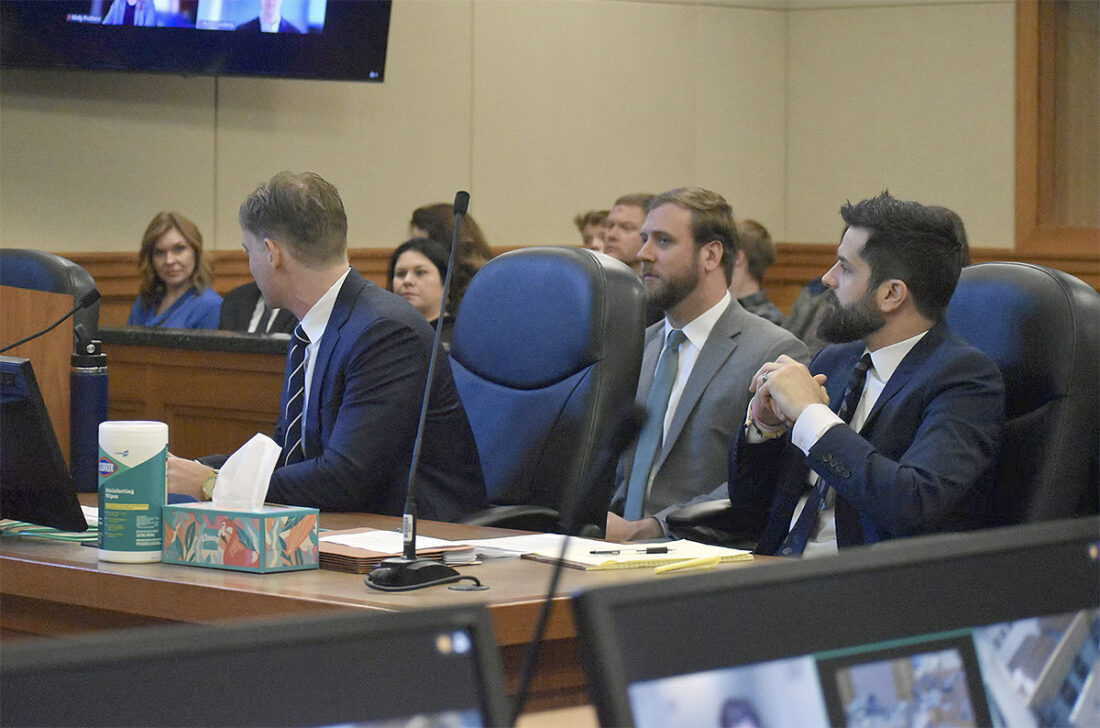
Clean Wisconsin attorney Evan Feinauer, left, and Midwest Environmental Advocates attorney Rob Lee, right, urged a Bayfield County judge Thursday to pause construction of the Line 5 reroute while their legal challenge plays out. (Danielle Kaeding/Wisconsin Public Radio)
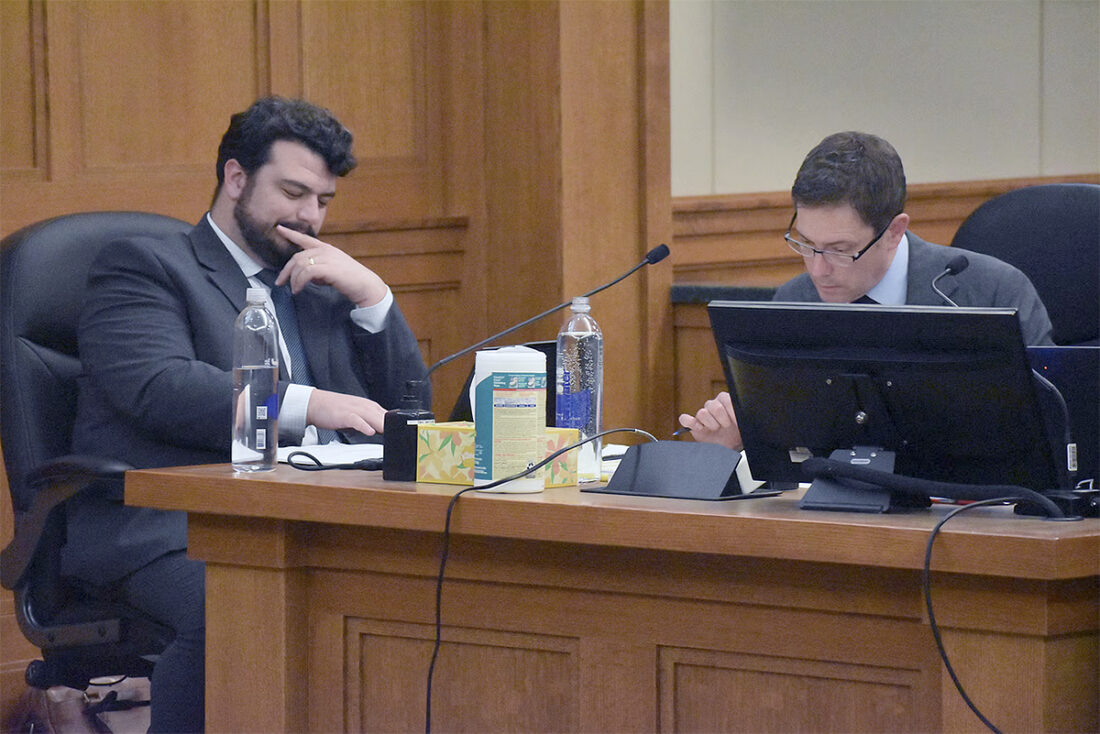
Enbridge attorney Eric Maassen argued Thursday that permits issued by the Wisconsin Department of Natural Resources for the project were lawful. He argued the reroute needs to move forward to avoid impacts to energy security and the potential for billions of dollars in losses to refineries and the Midwest if Line 5 were shut down. (Danielle Kaeding/Wisconsin Public Radio)
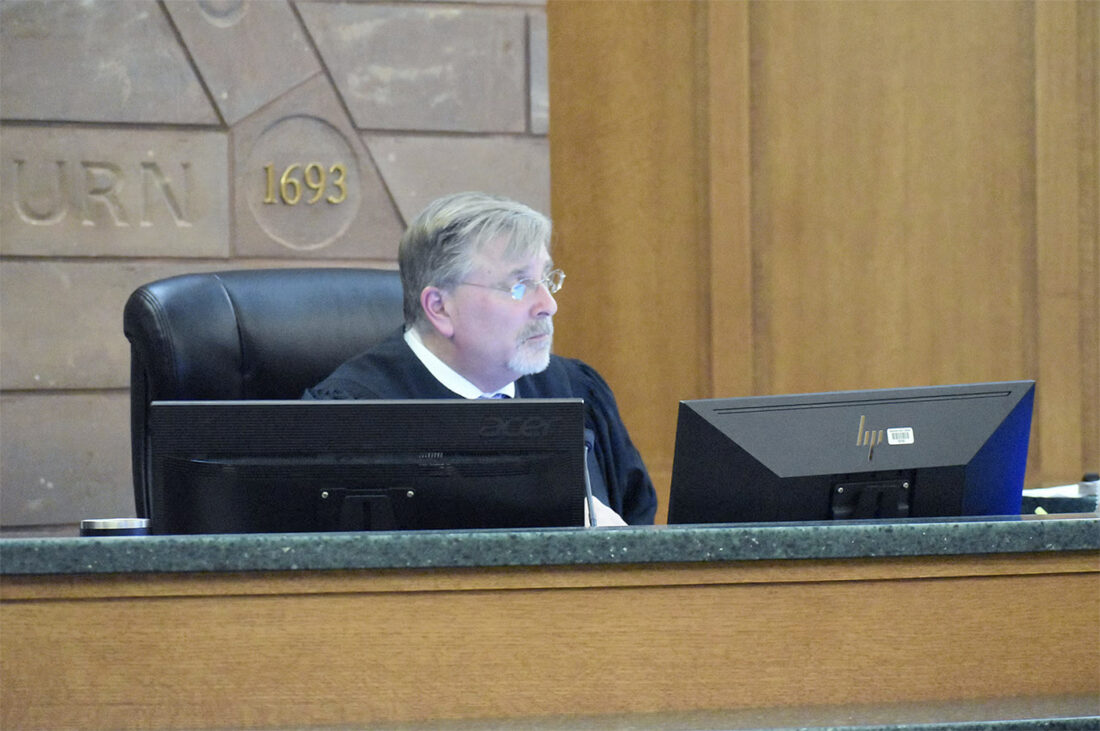
Bayfield County Judge John P. Anderson hears arguments Thursday on whether the construction of the Enbridge Line 5 reroute in Wisconsin should be halted while legal challenges filed by the tribe and environmental groups play out. (Danielle Kaeding/Wisconsin Public Radio)
Clean Wisconsin attorney Evan Feinauer, left, and Midwest Environmental Advocates attorney Rob Lee, right, urged a Bayfield County judge Thursday to pause construction of the Line 5 reroute while their legal challenge plays out. (Danielle Kaeding/Wisconsin Public Radio)
Enbridge attorney Eric Maassen argued Thursday that permits issued by the Wisconsin Department of Natural Resources for the project were lawful. He argued the reroute needs to move forward to avoid impacts to energy security and the potential for billions of dollars in losses to refineries and the Midwest if Line 5 were shut down. (Danielle Kaeding/Wisconsin Public Radio)
Bayfield County Judge John P. Anderson hears arguments Thursday on whether the construction of the Enbridge Line 5 reroute in Wisconsin should be halted while legal challenges filed by the tribe and environmental groups play out. (Danielle Kaeding/Wisconsin Public Radio)
Trending
A Bayfield County judge is weighing whether the Bad River tribe and environmental groups face irreversible harm if Enbridge continues building a new stretch of its Line 5 oil and gas pipeline around the tribe's reservation.
The tribe and environmental groups are seeking review of the state's decision to issue permits for the project after an administrative law judge upheld state approvals in February. On Thursday, Bayfield County Circuit Court Judge John Anderson heard arguments on their request to halt construction while legal challenges play out.
Enbridge's Line 5 carries up to 23 million gallons of oil daily from Superior across northern Wisconsin and Michigan to Ontario, including through Dickinson and Iron counties. The Canadian energy firm proposed a 41-mile reroute of Line 5 after the Bad River tribe sued in 2019 to shut down the pipeline on its lands. The project would cross close to 200 waterways and affect around 100 acres of wetlands in Ashland and Iron counties.
The judge said the permitting record on the Line 5 reroute now comprises more than 113,000 pages, and he's expected to issue an order on whether to pause construction after parties submit briefs by April 27.
Here are some of the key disputed issues in the case.
Did the DNR have enough data on wetlands and blasting?
Attorneys for the tribe and environmental groups argued the Department of Natural Resources lacked data on overall wetlands affected, as well as where blasting would be used to install the pipeline.
Evan Feinauer, attorney for Clean Wisconsin, noted wetlands provide important functions that reduce flooding, improve water quality and provide habitat for rare species. He said the agency didn't consider impacts on all wetlands when it granted a wetland and waterway permit.
Earthjustice attorney John Petoskey, who represented the tribe, also claimed the DNR incorrectly determined that clearing of forested wetlands would have temporary impacts, saying they would never return to their original state.
"If a stay is not issued, the pipeline will be built. The harm will be wrought, and the tribe will suffer as a result," Petoskey said.
Eric Maassen, an attorney with Foley & Lardner who represents Enbridge, said the company provided extensive evidence of wetland impacts, adding that "trees grow back."
As for blasting, Midwest Environmental Advocates, or MEA, attorney Rob Lee said the agency can't determine impacts to waterways without knowing where blasting will take place, saying the effects would be irreversible.
"You cannot put that rock back together again," Lee said.
Maassen said adopting that viewpoint would practically eliminate the use of blasting for large projects statewide, saying there's no way to know exactly where blasting will be needed.
"You don't know until you get out there," Maassen said.
Assistant Attorney General Gabe Johnson-Karp argued the Legislature didn't say protect the environment at all costs when it enacted permitting laws, saying lawmakers have allowed similar impacts to occur.
Did DNR comply with state protections of waterways?
The tribe and environmental groups also questioned whether the DNR complied with state waterway permitting standards and protection of the public's rights to navigable waterways, which are deemed "common highways and forever free" under the state constitution. The pipeline would directly cross around 70 such waterways.
"We feel quite strongly that Enbridge and the DNR have not complied with the state constitution as it relates to the protection of public waters," MEA Executive Director Tony Wilkin Gibart told WPR.
The group argued a 2019 law that made it a felony to trespass on an energy provider's property would irreparably harm the public's rights to access those waters during construction.
Bad River Tribal Chairwoman Elizabeth Arbuckle said they're also worried about their treaty rights to hunt, fish and gather.
"There's concerns that if they put their pipeline in, that's going to limit our ability to exercise our treaty rights, which is extremely important for tribal sovereignty," Arbuckle told reporters.
Bad River's attorney said tribal members fear they risk prosecution for exercising those rights along the route.
Maassen said the only restrictions on access will be during construction. He said Enbridge has connected tribal members with an escort on the project's right-of-way, saying no one is being prosecuted for exercising their treaty rights.
Is Enbridge eligible for a permit at waterway crossings?
The tribe and environmental groups also argue the DNR violated the law when it issued a waterway permit because Enbridge isn't a riparian owner, meaning it doesn't own land bordering the project's waterway crossings.
Under the law, MEA attorney Lee argued Enbridge must own the land next to waterways if it wants to place temporary or permanent structures on the bed of rivers and streams during construction.
"In our view, that is unlawful if Enbridge is not the riparian owner," Lee said.
In February, an administrative law judge modified the waterway permit and required Enbridge to apply for a separate permit with landowners near waterways where permanent structures would be placed.
Assistant Attorney General Gabe Johnson-Karp, who represented the DNR, said that approach has been the agency's past practice with similar projects. The DNR has yet to grant an additional permit, drawing concern from the judge.
Maassen argued the court wouldn't have to halt construction of the entire project just because another permit is needed. He said the presence of waterways and wetlands doesn't mean roads, power lines or pipelines aren't built.
"There is a way to do it. In the meantime, we need to be making progress on the rest of the project," Maassen said. "This is critical energy infrastructure."
He urged the judge to consider the potential harm to 700 union workers who may need to look for work elsewhere if the project is delayed, as well as billions of dollars in potential losses to Midwest refineries if Line 5 were shut down.
An Enbridge spokesperson said permits for the project were issued after an exhaustive review that spanned years, and it looks forward to the court's decision.