
County approves DCHS sale to Bellin
Trending
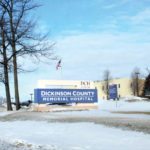
IRON MOUNTAIN -- The sale of Dickinson County Healthcare System to Bellin Health will go forward with what appears to be strong public support.
About 200 people attended a hearing Monday -- essentially the first and last airing of grievances on the estimated $60 million transaction -- and objections were few. Some attendees raised questions, but even those who were critical had no sour words for Bellin.
"I welcome Bellin," said Kevin Pirlot of Iron Mountain, who nonetheless claimed Dickinson County and DCHS officials both have been secretive after allowing the hospital to grow beyond its means.
Bellin, a Wisconsin non-profit corporation based in Green Bay, announced plans in December to acquire financially troubled DCHS by summer. Both parties accepted an asset purchase agreement earlier this month, subject to approval by the Dickinson County Board.
After Monday's 90-minute hearing, the board gave that approval in a unanimous vote.
"To delay this purchase agreement would be certain bankruptcy," Commissioner Barbara Kramer said. "We need a strong, sustainable health care system."
The purchase price will be used to pay all liabilities, including the hospital's long-term debt and pension obligations. That total figure has been reported by the hospital's legal counsel at an estimated $61.3 million, though officials say the agreement is a fluid process with "moving targets." The anticipated closing date is July 1.
Fornetti Hall at Bay West College was packed for the hearing, which was well represented by hospital employees as well as Bellin staff and local physicians.
"This is a good move," said Dr. Stephen Leonard, an internal medicine physician at Bellin's family clinic in Iron Mountain and a former DCHS board member.
George Kerwin, Bellin Health president and CEO, praised DCHS employees and said there are a number of strategies to improve the hospital's finances.
One of the first steps is to bring DCHS into the fold of Bellin's Epic medical records software system. Epic centralizes information for providers and patients and will improve billing and collections, Kerwin said.
Bellin will organize coverage in various specialties, such as orthopedics, so patients can be confident in having access to care, he said.
The main complaint during the hearing came from DCHS nurses, who said they were rushed and pressured into decisions on their pensions.
Bill Edberg, DCHS board chairman, said about $40 million of the purchase price is to make pensions whole. There also will be a successor retirement plan under Bellin, he said.
An ever-changing hospital reimbursement system has made it difficult to sustain a business model, Edberg lamented. "You could have your busiest month and lose money," he said. "The deck is really stacked against a hospital our size."
After profitable years in 2014 and 2015, DCHS's finances have gone haywire, culminating in an estimated loss of $14 million for 2017. Still, the hospital has achieved patient safety ratings that rank among the best in the nation.
DCHS Administrator-CEO John Schon said Medicare, Medicaid and Michigan Blue Cross/Blue Shield have engaged in a "continual effort not to reimburse us for health care."
Blue Cross, which might have helped overcome losses elsewhere, represented 24 percent of the hospital's patients last year but added another $1 million in red ink. "They have admitted that we're underpaid," Schon said.
Dr. John Loewen, a family practice physician from Niagara, Wis., thanked Kerwin for assuring him he can practice at the new Bellin-DCHS, even if he doesn't join Bellin's physician team. DCHS actually deserves credit for its achievements in the face of poor reimbursements, Loewen told the crowd.
"And I am not in Schon's pocket; you know that," he said in one of the hearing's lighter moments.
DCHS has more than 90 active physicians and operates as a Michigan municipal health facility corporation under Public Act 230. As such, it receives no direct county appropriations or taxpayer support and has been self-sustaining since moving to its U.S. 2 facility in 1996. It has more than doubled its staff and patient utilization over the past 20 years.
Commissioner Joe Stevens said the hospital, with 850 staff members, is the largest employer in the Dickinson County area with an annual economic impact of nearly $200 million. He thanked DCHS employees and said he expects Bellin to lead the hospital to a bright future.
Under the purchase agreement, Bellin will hire all of the existing DCHS employees, including physician staff and management, at the existing terms and conditions of employment. Bellin also will recognize each collective bargaining agent and take over existing collective bargaining agreements.
Bellin has committed to operating the facility as a licensed hospital, either as a general acute care hospital or as a critical access hospital, for at least five years. It will remain a non-profit, tax-exempt hospital and provide charity care as required, accepting Medicare and Medicaid patients and all other patients regardless of their ability to pay.
An 11-member board of directors will be appointed by Bellin, of which five will be Dickinson County residents and two will be hospital medical staff. The initial local directors will be nominated by the current DCHS Board.
The Michigan attorney general's office has signed off on the purchase agreement, raising no concerns, hospital attorney Michael Celello said.
Bellin-DCHS will fall under the umbrella of Bellin Health System, which includes Bellin Hospital, an acute care, 167-bed, multi-specialty hospital in Green Bay. Bellin-DCHS will be a sub-entity of the Bellin system, with its board of directors answering to the Bellin board.
Jim Anderson can be reached at 906-774-3500, ext. 26, or janderson@ironmountaindailynews.com.