
China’s Xi issues Taiwan warning
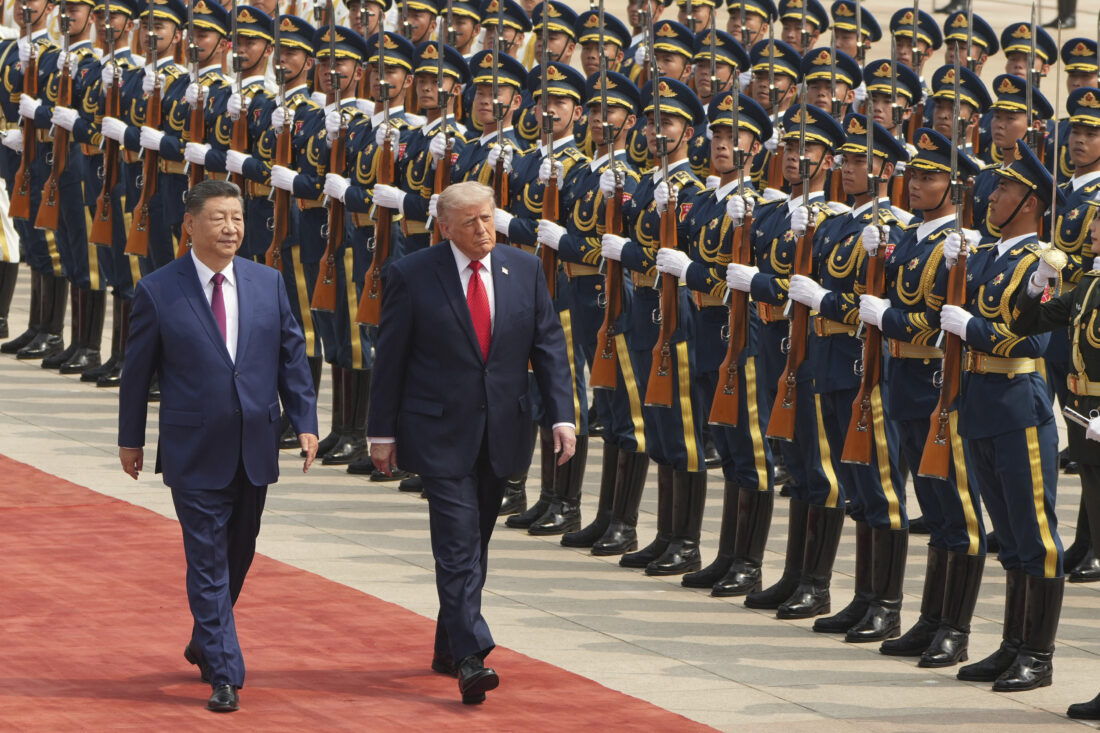
President Donald Trump participates in a welcome ceremony with China's President Xi Jinping at the Great Hall of the People, Thursday, in Beijing. (AP Photo/Mark Schiefelbein)
BEIJING (AP) — China’s Xi Jinping warned President Donald Trump on Thursday that their two countries could clash over Taiwan if the issue is not handled properly, an unusually harsh admonition that stood in contrast to the American leader’s praise for his counterpart.
The exchange at a highly anticipated summit in Beijing underscored just how far apart Trump and Xi still are on thorny issues, including the war in Iran, trade disputes and Washington’s relations with Taiwan, which is self-ruled but which China claims as part of its territory.
It also suggested that Trump’s three-day visit to China is likely to be longer on pageantry and symbolism than substantive political or economic breakthroughs.
The pair met for about two hours behind closed doors at the Great Hall of the People after an elaborate welcome ceremony featuring booming cannons, a band playing “The Star-Spangled Banner” and China’s national anthem, and hundreds of schoolchildren jumping and waving flowers and American and Chinese flags.
According to a post on X by Chinese Foreign Ministry spokesperson Mao Ning, Xi told Trump that “the Taiwan question is the most important issue in China-U.S. relations.”
“If it is handled properly, the bilateral relationship will enjoy overall stability. Otherwise, the two countries will have clashes and even conflicts, putting the entire relationship in great jeopardy,” she wrote.
That comment followed a brief public exchange before the meeting began in which Trump told Xi: “You’re a great leader. Sometimes people don’t like me saying it, but I say it anyway, because it’s true.”
“It’s an honor to be your friend,” Trump said before promising that the U.S.-China relationship “is going to be better than ever before.”
Trump later told Fox News’ Sean Hannity in an interview that Xi said during their conversations that he “would like to be of help” in negotiating an end to the Iran war and reopening the Strait of Hormuz to oil shipments.
Xi was far more stark in his opening public remarks, expressing hope that the U.S. and China could avoid conflict and asking “whether the two countries can transcend the ‘Thucydides Trap’ and forge a new model for relations between major powers.”
That’s a term, popular in foreign policy studies, referring to the idea that when a rising power threatens to displace an established one, the result is often war. Xi has used the term for years, but using it as Trump offered optimism was noteworthy and foreshadowed his closed-door comments on Taiwan.
Secretary of State Marco Rubio later said U.S. policy toward Taiwan was “unchanged” but warned that it would be “a terrible mistake” for China to take Taiwan by force.
“They always raise it on their side. We always make clear our position, and we move on to the other topics,” Rubio, who is traveling with the president, said in an interview with NBC News.
After their meeting, Xi took Trump on a tour of the Temple of Heaven, then hosted a state banquet for him. The Chinese leader used his evening toast to note that he and Trump had kept U.S.-China relations “generally stable” in a turbulent world.
“Achieving the great rejuvenation of the Chinese nation and making America great again can go hand in hand,” Xi said, referring to Trump’s political movement. “We can help each other succeed and advance the well-being of the whole world.”
In his toast, Trump said his visit had been “a great honor” punctuated by a “fantastic” day. He said matters “all good for the United States and China” were discussed.
Trump also said Xi would make a reciprocal visit to the White House on Sept. 24 — a date not previously announced.
The positive tone was reflected in the White House assessment of the earlier meetings, which said both leaders had touched on ways to enhance economic cooperation, including expanding market access for American businesses in China and increasing Chinese investment into U.S. industries.
The White House readout did not mention Taiwan directly, but, in relation to Iran, said both sides had agreed that the strait must remain open. The strait’s closure has stranded tankers and caused energy prices to spike, threatening global economic growth.
National News
An age of innovation in the US
News briefs
Court allows abuse verdict WASHINGTON (AP) — The Supreme Court is rejecting a push by President Donald Trump ...
Justices protect Fed, but uphold other Trump firings
Firefighters killed were trying to shield themselves from flames
US and Iran pause strikes, disagree over next steps
News briefs
Three die fighting fires BEAVER, Utah (AP) — Three firefighters have died and two were injured while battling ...