Formidable herons dot UP landscape
Northwoods Notebook
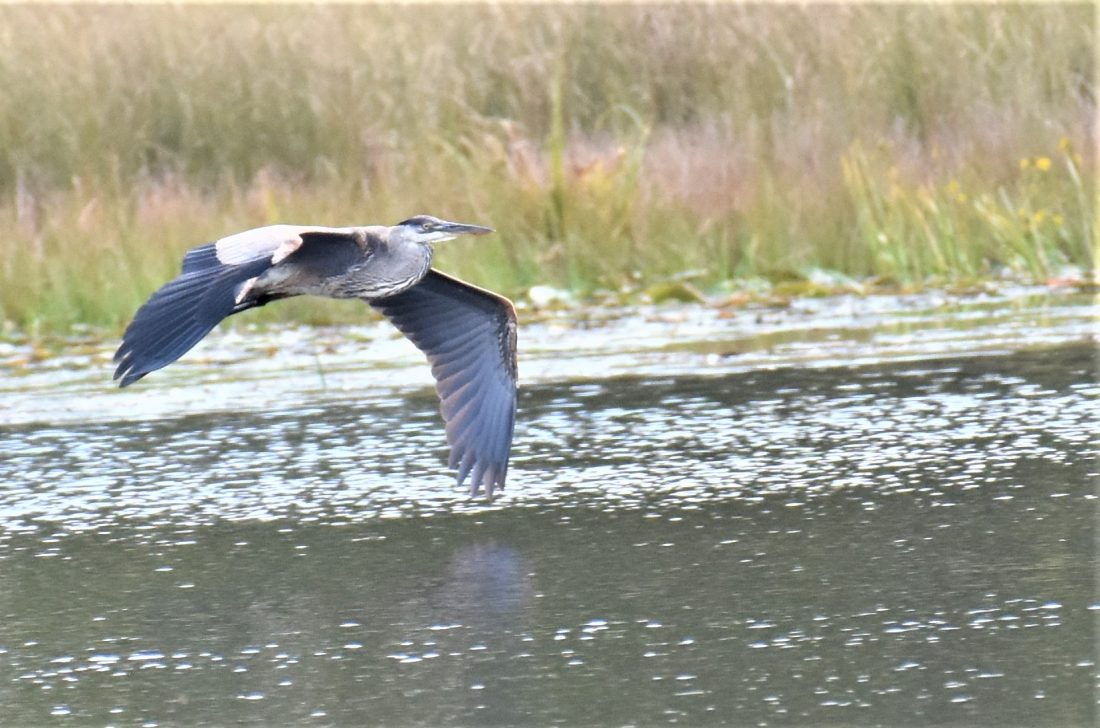
A great blue heron patrols Six Mile Lake in northern Dickinson County. By the end of this month, most herons in the area will have headed south. (Betsy Bloom/Daily News photo)
Early this summer, in the hours as the sun came up, I heard a new voice in the natural morning chorus outdoors.
This call was difficult to describe — like turning a full bottle of liquid upside down, to have it gush and pause as air replaced fluid inside. It was a guttural “glunk-glunk, glunk-glunk” sound that seemed to travel as much through the ground as air.
It was an American bittern. I’d have liked to have seen it, but this bird of wetland shores is smaller, secretive and striped to blend in with the reeds. Yet the call is unmistakable.
It marked another representative of the heron family that turned up at Six Mile Lake.
The Upper Peninsula doesn’t normally host a ton of heron species compared with what can turn up farther south in the United States. Herons, which number roughly 70 species worldwide, naturally tend to prefer more temperate climates with shallow open water that allows for reliable fishing opportunities.
Still, we in the U.P. do get at least a handful of the more common herons known to venture into the northern United States — American and least bitterns, black-crowned night herons, green herons and, of course, the very familiar great blue heron. While the occasional pure-white great egret — yes, also in the heron family — will wander into the U.P., it is considered a stray, not breeding bird, like white pelicans.
Locally, great blue herons may be more conspicuous due to height, but they might be outnumbered by the chicken-sized but less visible green herons. They, too, have plumage that mimics marsh grasses, green and brown with streaked throats.
Members of the heron family have a definite reptilian vibe, an echo of their dinosaur relatives. With a kinked sinuous snake neck, seemingly spring-loaded to strike, and a dagger of a bill, herons look formidable and lethal, especially the great blue heron.
It is surpassed in size only by the goliath heron of Africa. And while it superficially resembles sandhill cranes in being long in leg and neck, they are not closely related — herons are grouped with ibis and spoonbills, while cranes are considered more aligned with coots.
Cranes, too, are willing to eat their vegetables as well as meat — farmers complain they will walk planted fields to pick out seed corn and potatoes — while the herons are hard-core carnivores.
Most herons favor a fish diet, yet they can definitely be opportunistic predators, snapping up small mammals such as voles and chipmunks, ducklings and smaller waterbirds, amphibians, snakes and young turtles — basically anything they can manage to gulp down or skewer into submission. Like owls, they later may regurgitate a pellet of bones and other indigestible parts of their meal, according to the Cornell Lab of Ornithology’s All About Birds website.
Great blue herons in flight can be easily distinguished from cranes by first the neck — herons fold back their heads onto their shoulders, while cranes fly with neck extended — and the slow flap of herons versus the more gliding and soaring cranes.
The ones that spend time on our local lakes and rivers probably are non-breeding, as great blue herons prefer nesting in groups called rookeries, constructing stick nests in hardwood trees alongside water. Chicks hatch after about 27 to 29 days and fledge in about seven to eight weeks, so by mid-summer usually are out of the nest. These young birds will disperse widely — a study of more than 3,000 juveniles showed an average of 471 miles in the first winter — and don’t usually start breeding until their third spring, according to the Cornell Lab of Ornithology.
But the green herons do nest locally, in solitary pairs; I’ve seen adults with fledglings on Six Mile Lake. They, too, favor trees for nesting but build in a large fork and may even use a sturdy bush if suitable.
By the end of this month, most great blue and green herons, along with the bitterns, will have headed south, bound for the Gulf Coast states and even Caribbean for the winter. But they might linger longer if conditions allow.
Betsy Bloom can be reached at 906-774-2772, ext. 240, or bbloom@ironmountaindailynews.com.
Local News
Bacco selected for EK water service line project
IRON MOUNTAIN — Bacco Construction Co. of Iron Mountain will be the contractor on a $3.6 million project to ...

Michigan budget deal may be near

Bates Township receives aid to move Township Hall
Remember when?

Justices reject requiring higher prices in tax foreclosure sales