Verso to pay $250K for Escanaba River fish kill
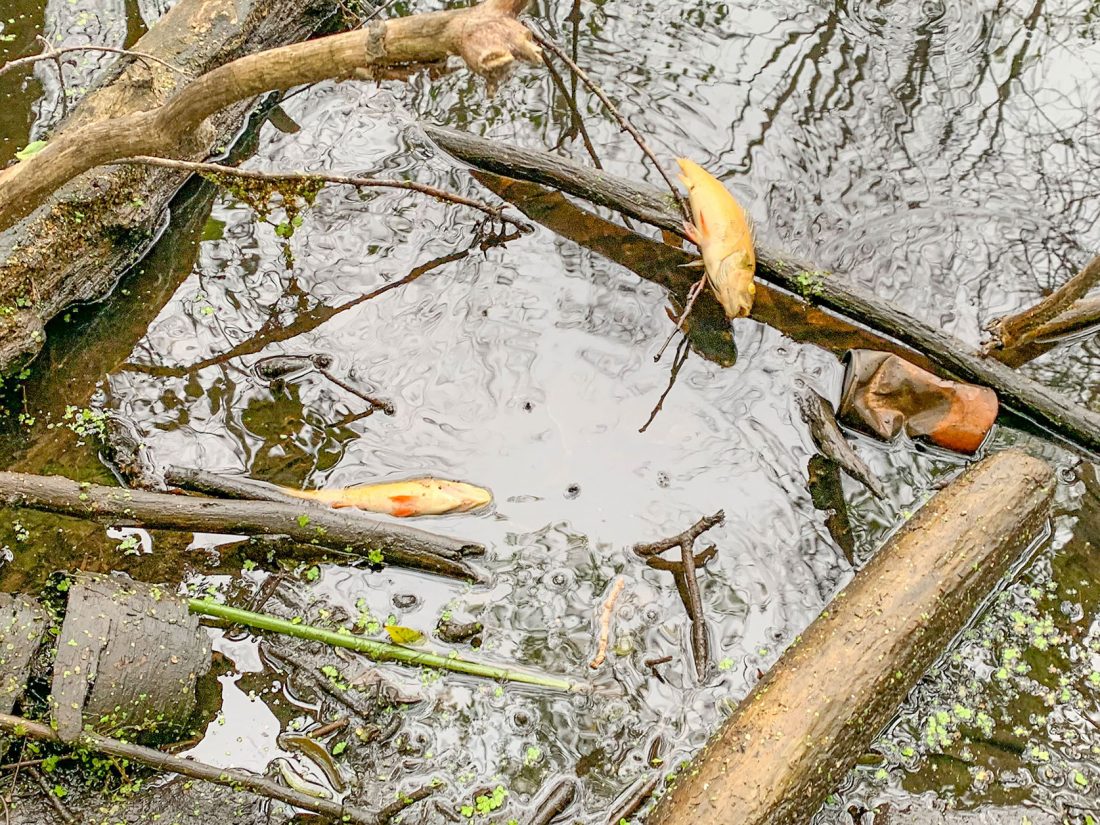
A COUPLE OF dead fish are shown along the Escanaba River in Delta County in August 2020. In all, more than a dozen species of fish were killed in the release of an organic pollutant from Verso Corp.’s Escanaba paper mill. (Michigan Department of Environment, Great Lakes, and Energy photo)
ESCANABA (AP) — Verso Corp. has agreed to pay nearly $250,000 to settle an investigation of a 2002 fish kill in the Escanaba River, state regulators said.
The Michigan Department of Environment, Great Lakes, and Energy announced the settlement over National Pollutant Discharge Elimination System violations at Verso’s Escanaba mill.
The permit violations concern a “black liquor” release to the wastewater treatment facility at Verso’s paper mill on Aug. 6, 2020, that resulted in fish being killed in the Escanaba River downstream of the mill.
The mill generates black liquor — a high-strength organic pollutant — as a byproduct of turning pulpwood into paper pulp for the mill’s craft paper-making process. Typically, black liquor is concentrated and burned as an energy source.
Under the settlement, the Ohio-based Verso will pay more the $244,451 in civil penalties and natural resource damages and will make spill prevention and containment improvements at its facilities to ensure protection of the Escanaba River and Lake Michigan, as the river empties into the lake south of the mill.
“It is important that facilities properly handle, contain and control these high-strength pollutants to prevent surface water degradation that can result in fish kills,” said Tom Asmus, an EGLE environmental quality analyst with the agency’s district office in Marquette. “These efforts are needed to safeguard our rivers, lakes and streams and the resources and recreational opportunities they provide.”
Failure to comply with National Pollutant Discharge Elimination System permits can result in significant fines. Under the Clean Water Act, the NPDES program controls point-source discharges of pollutants to waters of the United States. Verso operates under the tenets of a permit to discharge treated wastewater to the river.
After anglers reported dead fish in the river, staffers from EGLE’s Water Resources Division and the Michigan Department of Natural Resources Fisheries Division investigated the fish kill, which stretched about 3 mile down the Escanaba River from Dam No. 2 to the river mouth.
“The investigation included a fish kill assessment, river evaluation and dissolved oxygen monitoring,” Asmus said. “After the investigation and discussions with Verso staff, EGLE determined that a catastrophic pipe failure at the mill resulted in a large quantity of the black liquor entering and overwhelming the facility’s wastewater treatment plant, which caused the fish kill and pollutant discharge permit limit violations.”
When the partially treated wastewater from the plant reached the river, oxygen was drawn from the water, starving the ecosystem of dissolved oxygen. This consequently killed numerous fish representing at least a dozen species, including northern pike, bass, walleye and other sportfish, according to EGLE.
The Escanaba River runs for 52 miles through portions of Marquette and Delta counties.
Local News
Residents urged to take statewide housing survey
ESCANABA — The Central U.P. Regional Housing Partnership invites residents, business owners, leaders and others ...
Remember when?
Skandia fatal crash victim ID’d
The Marquette County Sheriff's Office is seeking information from a possible additional witness to a fatal crash ...

Kind of Blues Band plays Thursday in IM, Norway

Democrat-led states criticized for Guard deployments to DC