
Cougar kittens caught on camera in Minnesota
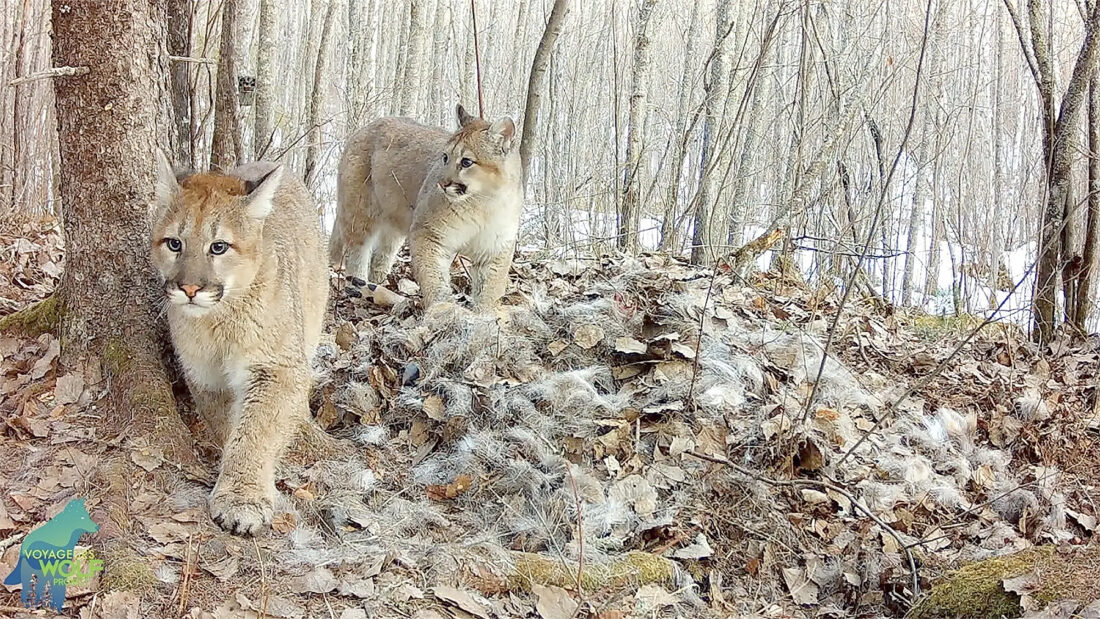
Cougar kittens captured on a trail camera near Voyageurs National Park in northern Minnesota on March 25. The Minnesota Department of Natural Resources said it’s the first documentation of cougars reproducing in Minnesota in more than 100 years. (Voyageurs Wolf Project via Minnesota Department of Natural Resources)
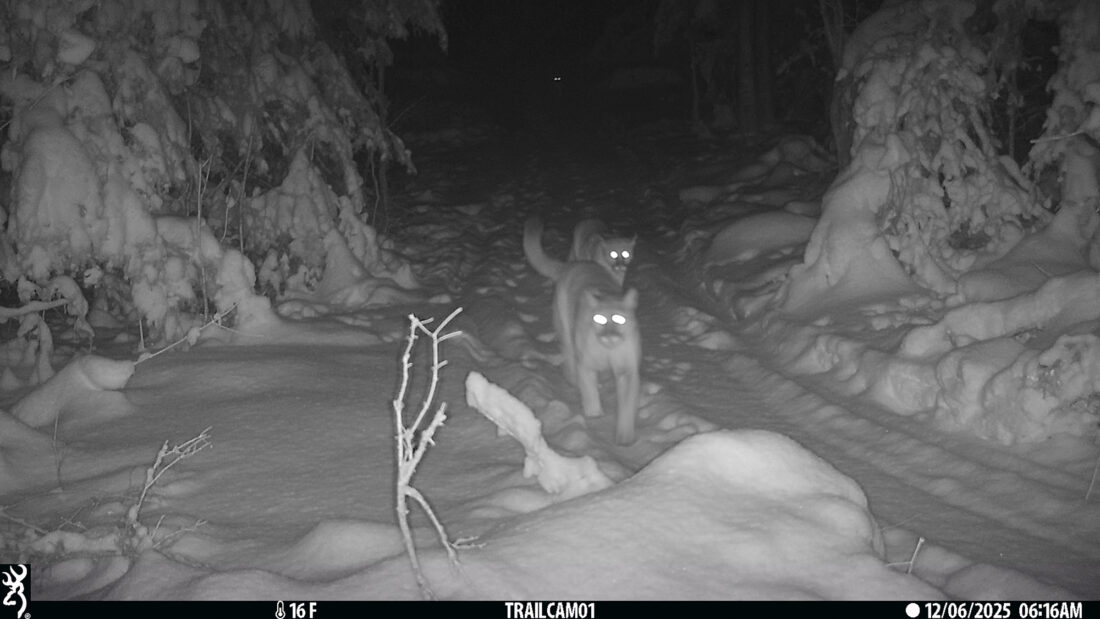
An adult cougar photographed Dec. 6 walking down a trail in Ontonagon County, followed by two cougar cubs. The Michigan Department of Natural Resources verified this photo from a private trail camera by enhancing the image to determine it had the three cougars, including one cub bringing up the rear. (Photo courtesy of private landowner, via Michigan Department of Natural Resources)
Cougar kittens captured on a trail camera near Voyageurs National Park in northern Minnesota on March 25. The Minnesota Department of Natural Resources said it’s the first documentation of cougars reproducing in Minnesota in more than 100 years. (Voyageurs Wolf Project via Minnesota Department of Natural Resources)
An adult cougar photographed Dec. 6 walking down a trail in Ontonagon County, followed by two cougar cubs. The Michigan Department of Natural Resources verified this photo from a private trail camera by enhancing the image to determine it had the three cougars, including one cub bringing up the rear. (Photo courtesy of private landowner, via Michigan Department of Natural Resources)
Trending
Minnesota has become the second state in the Great Lakes Region to document that cougars have reproduced there for the first time in more than a century.
The University of Minnesota's Voyageurs Wolf Project video in March showed a female cougar with three well-grown kittens south of Voyageurs National Park near the Canadian border, according to the Minnesota Department of Natural Resources.
The Voyageurs Wolf Project has hundreds of trail cameras in northeast Minnesota to help with wolf research. "Those cameras have recorded footage of lone cougars eight times since 2023, but none of those cameras had recorded footage of kittens. The videos of the cougar with kittens were captured by two cameras that researchers placed over a GPS-collared deer they suspected a cougar might have killed," the Minnesota DNR stated in a news release Thursday.
"Looking at the footage was and still is surreal. We never anticipated seeing four cougars together in northern Minnesota," Thomas Gable, project lead of the Voyageurs Wolf Project, said in the news release. "In total, we captured around four hours of footage of this cougar family at the kill, and it was fascinating to see and hear their interactions -- the mother grooming her kittens, the kittens growling and hissing at each other. We feel incredibly fortunate we were able to capture such a wild moment in such detail."
The discovery comes roughly a year after the Upper Peninsula had Michigan's first cougar kittens in the wild since the early 1900s photographed on a rural road in Ontonagon County in March 2025. It was the first known modern reproduction of the big cats in the western Great Lakes states, which include Michigan, Wisconsin and Minnesota.
The two U.P. cubs were judged to be about 7 to 9 weeks old at the time. The three in Minnesota are thought to now be 7 to 9 months old, born sometime in late fall.
In notes with its video posted on YouTube online, the Voyageurs Wolf Project said, "In late March, we received a mortality signal from a GPS-collared deer and found the carcass buried under a pile of leaves on a hillside -- a telltale sign of feline predation. We suspected it was likely a bobcat but thought, just possibly, it could be a cougar. So we put up two trail cameras on the cached deer carcass and four hours later, two cougar kittens returned to the kill. The entire family showed up that evening and spent hours in front of our cameras."
It termed the footage, "Without a doubt, our best trail camera capture yet."
The Voyageurs Wolf Project video can be viewed at https://www.youtube.com/watch?v=7EL1FRB11DU.
Although the three states have had regular reports of cougars for more than a decade, most until now appeared to be transient young males, dispersing from western South Dakota, North Dakota or Nebraska.
What DNA testing could be done on some of the U.P. cats confirmed only males, said Brian Roell, large carnivore specialist for the Michigan Department of Natural Resources.
Yet the kittens in Ontonagon County and now in Minnesota do show at least a couple of females have wandered into the region as well.
"Although this is an important starting point for potential population establishment in Minnesota, predicting the future is extremely difficult," said John Erb, research biologist with the Minnesota DNR. "These kittens might not survive, potentially getting killed by wolves, a male cougar or vehicles. They may also become part of the founding catalyst for a slow but steady increase in numbers. Time will tell, but we are clearly nearing a point where the probability of a self-sustaining population has increased."
In the U.P., a private landowner Dec. 6 caught the two kittens, this time following their mother, by remote camera on an Ontonagon County trail, confirming they were still alive.
While they have not been seen since, the Michigan DNR expects to pull cards on its 1,200 cameras set up throughout the Upper Peninsula later this summer, so it's possible they'll turn up again, Roell said. Juvenile cougars normally remain with their mother for about two years.
It will be interesting to see if that same female can be documented with new kittens next spring, which would prove the region has an actual local breeding population rather than perhaps a pregnant female reaching here after being bred elsewhere, Roell said.
Michigan is coming off a record year for cougar reports in the state, the DNR stated in January. Cougars were detected 31 times in 2025, all in the Upper Peninsula.
Roell stressed some of these sightings may be the same cats roaming throughout the U.P. He had a trail camera image submitted Friday of a single cougar in Marquette County that looks similar to one that was earlier photographed in Schoolcraft County.
But it holds the promise that "another large carnivore might be naturally recolonizing former territories," Roell said.
Betsy Bloom can be reached at 906-774-2772, ext. 85240, or bbloom@ironmountaindailynews.com.