
Outdoors report: Turkey surveys underway in Michigan, Wisconsin
Trending
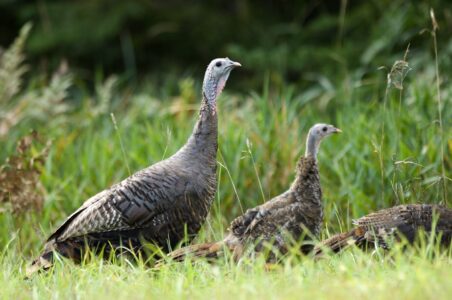
The Michigan Department of Natural Resources is asking residents to report sightings of wild turkeys and turkey broods -- family units consisting of at least one adult hen and her young -- from now through Aug. 31.
“Summer is one of the best times of year to see wild turkey families,” said Adam Bump, the DNR’s upland game bird specialist. “Every brood observation helps us better understand how many young turkeys are surviving and where reproduction is occurring across Michigan.”
Now entering its fourth year, the turkey brood survey is part of a larger multistate effort supported by the National Wild Turkey Federation to monitor turkey populations using a standardized survey protocol.
Since the survey launched in 2023, Michigan residents have submitted more than 17,000 observations, documenting over 36,200 hens, 95,300 poults and 15,500 male turkeys.
“Turkey populations are influenced by many factors, including weather, habitat conditions and poult survival,” Bump said. “By collecting observations year after year, we’re building a long-term dataset that helps us understand trends before they become problems.”
When participants report the number of hens and poults they observe, biologists can estimate average brood size and other indicators that help measure how successfully young turkeys are surviving through the summer months.
Anyone can contribute to the turkey brood survey. Through Aug. 31, simply report any wild turkey sightings using the online survey form available on the turkey brood survey webpage at https://www.michigan.gov/dnr/things-to-do/hunting/turkey/turkey-brood-survey.
Participants will be asked a few short questions about:
-- The date of the observation.
-- The location.
-- The number of hens observed.
-- The number of poults observed.
-- The number of gobblers (adult males) or jakes (juvenile males, about a year old) observed.
Most reports take only a minute or two to complete.
For more, go to Michigan.gov/Turkey.
***
The Wisconsin DNR is conducting a Game Bird Survey through Aug. 31.
Data will be used to track population productivity of game birds, including wild turkeys, ruffed grouse and pheasants.
“Wherever you are out in Wisconsin, you can help the DNR manage wildlife by collecting data in your area,” said Paul Frater, DNR surveys coordinator. “Sightings can easily be submitted through our app, and every submission increases our dataset and helps build a more complete picture of how game birds are doing throughout the state.”
No registration is required, and observations can be recorded using a mobile device. If in a vehicle, participants should only record sightings when they are not driving.
The deadline to submit bird observations for the Game Bird Survey is Aug. 31.
More information and a link to download the survey is available on the DNR's Game Bird Survey webpage at https://dnr.wisconsin.gov/topic/WildlifeHabitat/GameBirdBroodObservations.
***
As summer heats up, the DNR in Michigan points out you’re never more than 6 miles from a body of water where you can find some relief and maybe some great fishing. Anyone who needs help planning a Michigan fishing trip can find more information at https://www.uptravel.com/outdoors-recreation/.
The DNR reported this Upper Peninsula activity:
Little Bay de Noc: Anglers targeting yellow perch reported limited success and overall slower fishing. Positive reports came from the head of the bay near the Whitefish River, although some anglers reported marking schools of perch near the reefs in the upper bay. Worms were the primary bait used, but anglers also used minnows. Walleye anglers in the upper bay reported catching many smaller walleye. Some anglers continued to find success near the mouth of the Escanaba River and near the narrows. Larger fish were reported in the outer portions of the bay, typically in 18 feet of water or deeper. Walleye anglers found success drifting or trolling crawler harnesses. Those casting used larger, snap-style lures with fins, triggering reaction bites. Some anglers also had success using jigs tipped with worms or leeches.
Manistique: Anglers fishing the Manistique River caught walleye, northern pike and smallmouth bass. Some walleye anglers trolled the river using shallow-diving crankbaits. Anglers reported good lake trout fishing and fair salmon fishing. Lake trout were marked near the bottom, but anglers also reported catching some higher in the water column. Multiple age classes of Chinook salmon were caught. Some anglers reported seeing sparse schools of baitfish and very limited numbers; however, most anglers had successful trips and caught fish using flies and spoons.
Marquette: Lake trout anglers found success while trolling in deeper water at near-surface depths. Most anglers trolled around White Rocks and traveled toward Granite Rock in 120 to 200 feet of water. However, fish were caught in depths ranging from 10 to 60 feet of water. While targeting lake trout, anglers continued to catch a few coho salmon, brown trout and steelhead. Some good-size lake trout were also reported this past week.
Munising: Boat anglers did well targeting lake trout when trolling and jigging around Grand Island and Wood Island. The salmon bite in the bay slowed this week. Anglers reported catching a few splake near the mouth of the Anna River, but overall fishing was slow.
Lake Independence, Big Bay: Most anglers targeted walleye and yellow perch using natural baits paired with jigs for both species.
Keweenaw Bay/Huron Bay: Anglers reported catching good numbers of coho salmon while trolling spoons and flasher-fly combinations in the top 60 feet of the water column. Anglers also caught Chinook salmon, although in smaller numbers and sizes compared to the previous few weeks. Those targeting lake trout found success while trolling and jigging natural and artificial presentations in waters deeper than 140 feet.
Traverse Bay/Portage Entry: Anglers trolling near structure reported catching good numbers of lake trout, along with a few coho salmon and Chinook salmon, while using spoons and flasher-fly combinations. Anglers jigging for lake trout reported a fair bite using both natural and artificial baits, with most fish caught between 140 and 180 feet of water.
Ontonagon River: Walleye were caught in low to fair numbers. Boat anglers found success while both trolling and jigging, with some reporting better results when jigging. Shore anglers reported catching low numbers of walleye and rock bass.
Ontonagon/Silver City/Union Bay: Anglers reported catching fair numbers of lake trout, along with the occasional coho salmon. Trolling continued to produce the best results for boat anglers.
Black River Harbor: Boat anglers reported catching low numbers of lake trout and coho salmon. Trolling continued to be the most effective method.
Grand Marais: Boat anglers reported some good catches of lake trout while trolling and jigging, along with a few coho and Chinook salmon. There was little fishing pressure from anglers fishing off the breakwall.
St. Ignace: Large perch were caught near the M-134 overpass bridge. Shore anglers drifted jigs tipped with leeches or nightcrawlers and cast nightcrawler harnesses. Boat anglers trolled nightcrawler harnesses and body baits.
Les Cheneaux Islands/DeTour: Anglers in Hessel caught a few perch off the marina docks but had to sort through many smaller fish. In Detour, anglers trolling through the channel and around the lighthouse caught a few salmon along with good numbers of lake trout. A few impressive Atlantic salmon were caught over the past week, and there were still no reports of herring.