Walla speaks to Golden K about FT form of dementia
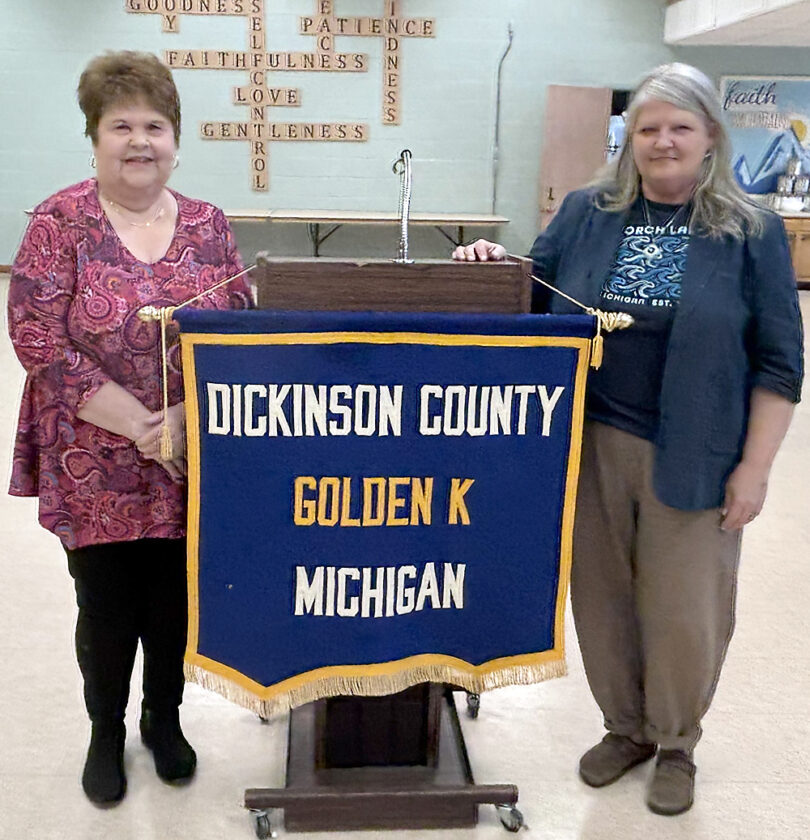
Golden K chair Judy Sielaff introduces guest Erin Walla, who spoke at Monday's meeting on her experiences dealing with a family member with frontotemporal dementia. (Joanne Lindholm photo)
KINGSFORD — Take a few minutes out of your busy day to look around and enjoy the beauty unfolding. Daffodils, crocus and tulips are spreading their colors in full array. Trees are beginning to leaf out and the grass is green. Birds are announcing their joy every morning as sunshine warms the earth. Absorb the excitement of new life as it unfolds in our short but sweet spring and summer days.
The Golden K seniors gather each Monday morning with enthusiasm and wonder. Ready to begin each week with anticipation for concerts, vacations, family gatherings and many other outdoor activities. Judy Sielaff, chairmanship, opened the meeting. Lois Outcelt on the piano, with her sidekick song leader Richard Ochoa, had the group singing a few oldies.
Kirk Olson collected winnings from the 50-50 drawing and the “Welcome Song” greeted guest speaker Erin Walla. Happy Dollars shared feelings for good weather, flowers blooming, and prayers for friends who are ill. Kathy Jo Anderson shared joy for her daughter’s graduation with a 4.0 grade-point average, gaining her master’s degree in nursing to become a family nurse practitioner.
Erin Walla shared her first-hand experiences in dealing with early-onset frontotemporal dementia, or FTD. It affected her father and left her mother as the main caregiver.
Changes noted by family and friends inspired Walla to move back to the area to help her parents. Hands-on experience became the best teacher.
She has become an advocate and support facilitator, spreading the word about this type of dementia.
Most people are familiar with Alzheimer’s dementia, as it primarily affects memory. Common symptoms of frontal lobe dementia include changes in social behavior, emotional blunting and difficulties with language. It’s the type of dementia that actor Bruce Willis is currently battling.
The medical world has been on a learning curve seeking diagnostic answers. Many cases go undiagnosed and affect people in jails and prisons.
Dementia comes in as many forms. What begins as mild forgetfulness may slowly turn into other neuro-degenerative disease.
Families may notice changes in their loved one and not know how to deal with it. The person affected may not fully understand what is happening or why they cannot control their thoughts, actions or feelings.
Caregivers deal with daily events as they happen. Sometimes things can be handled easily. Help is needed if things become violent or extreme.
Walla and her family shared the journey with her father and his FTD. Frontotemporal disorder involves changes in behavior, judgment and personality. Some of the telltale symptoms included becoming impulsive, saying or doing inappropriate things, and losing interest in activities. As awareness spreads, doctors and patients can work together to diagnose the type of treatment suitable for each individual. Individuals are encouraged to talk to their doctor about changes that seem to be out of the usual.
The journey for the family and patient can be long and arduous. Gathering information helps make the road bearable. The National Institute on Aging, or NIA, and the National Institutes of Health, or NIH, provide a lot of information.
Health care professionals are discovering there is much more to be learned about dementia and its variations. “Those with any form of dementia may forget us, we as society must remember them.” — NIH National Institute of Health.
The Golden K will meet at 10 a.m. Monday at the First Presbyterian Church in Kingsford, with Jana Underwood from Camp Molinare as the guest speaker.
Life
Class Get-togethers
Friday — Forest Park High School Class of 1971, reunion, starting at 4:30 p.m., Paint River Landing. Attendees ...
Wausaukee Public Library offers summer programs
WAUSAUKEE, Wis. — The Wausaukee Public Library invites children, teens and adults to join this year’s free ...
PEO Chapter AN to meet July 13
IRON MOUNTAIN — PEO Chapter AN will meet at 6 p.m. Monday, July 13, at the home of Sally Bloom. Co-host will be ...

Today’s Birthdays
Bay College honors 2026 Outstanding Graduates