
The charcoal briquets Ford built
Museum exhibit tells history of Kingsford charcoal
-
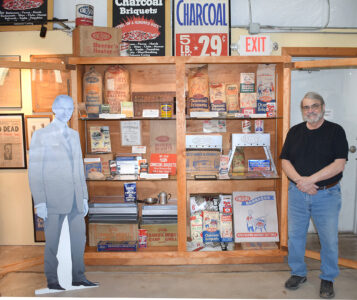
- Guy Forstrom of Quinnesec has donated his extensive collection of Ford and Kingsford charcoal artifacts to the Menominee Range Historical Museum in Iron Mountain. The MRHF treasurer recently built a cabinet to house the artifacts in the World War II Glider and Military Museum. (Terri Castelaz/Daily News photo)
-
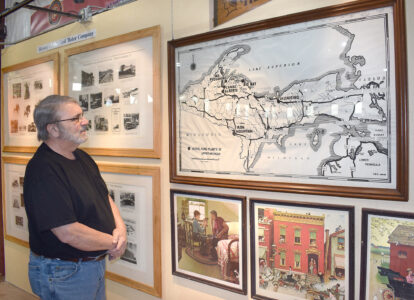
- Guy Forstrom of Quinnesec points out an original 1945 Ford Plant map that shows all of the company’s active operations in the Upper Peninsula. The map hung at the Kingsford plant. (Terri Castelaz/Daily News photo)
-
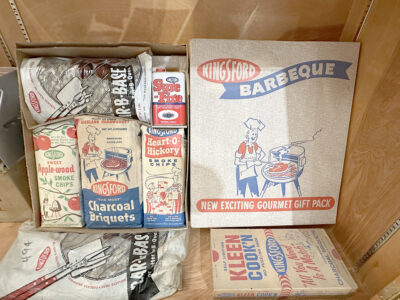
- A rare, new, old-stock Kingsford Barbeque gourmet gift set marked Iron Mountain, containing charcoal briquets, hickory and applewood chips for smoking, lighter fluid, and a grill base that is part of a new exhibit at the Menominee Range Historical Museum in Iron Mountain. (Terri Castelaz/Daily News photo)
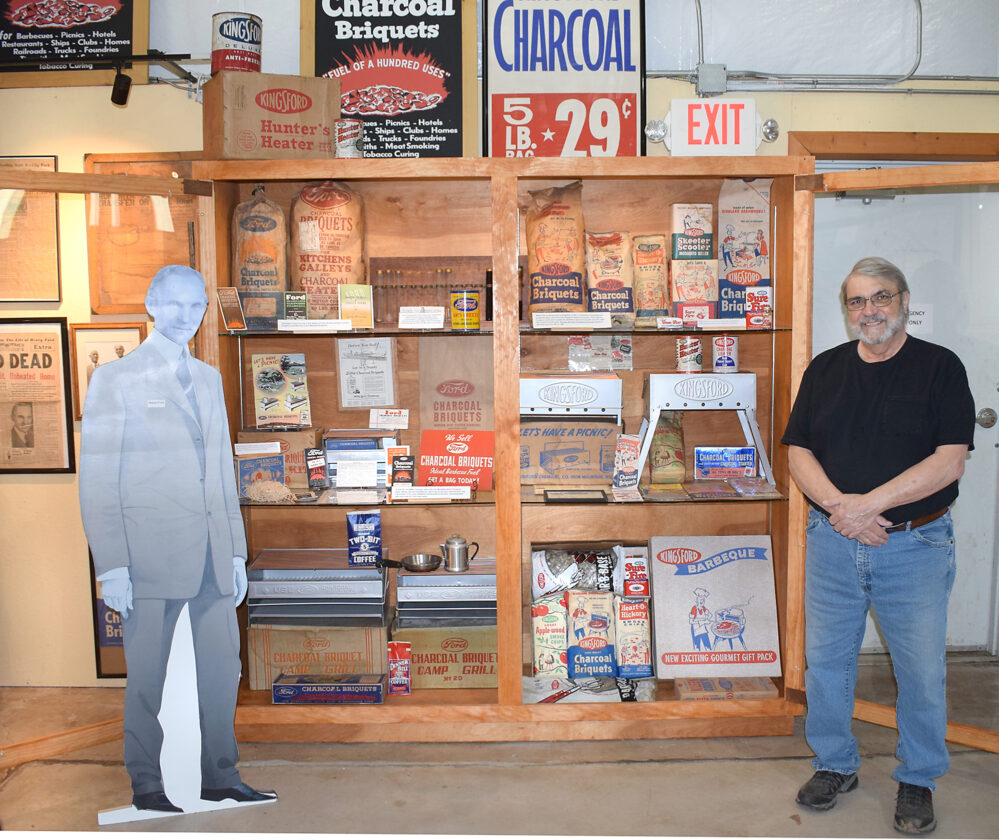
Guy Forstrom of Quinnesec has donated his extensive collection of Ford and Kingsford charcoal artifacts to the Menominee Range Historical Museum in Iron Mountain. The MRHF treasurer recently built a cabinet to house the artifacts in the World War II Glider and Military Museum. (Terri Castelaz/Daily News photo)
IRON MOUNTAIN — For decades, Guy Forstrom of Quinnesec has been preserving part of local history — one bag of charcoal, one grill and one advertisement at a time.
Now, that extensive collection of Ford and Kingsford charcoal artifacts have a permanent home with the Menominee Range Historical Museum in Iron Mountain.
The newly installed display in the World War II Glider and Military Museum tells the story of the Iron Mountain-produced charcoal briquets and the nationally recognized Kingsford brand.
“I’ve been collecting pieces from the local plant for 40 years,” the MRHF treasurer said, adding he felt strongly these items belonged in the museum.
The exhibit includes original Ford and Kingsford charcoal bags, picnic grills, lighter fluid containers, original advertising materials and brochures, chemical displays, photographs, one-of-a-kind storyboards and an original 1945 map depicting all the Ford Plants in Upper Michigan.
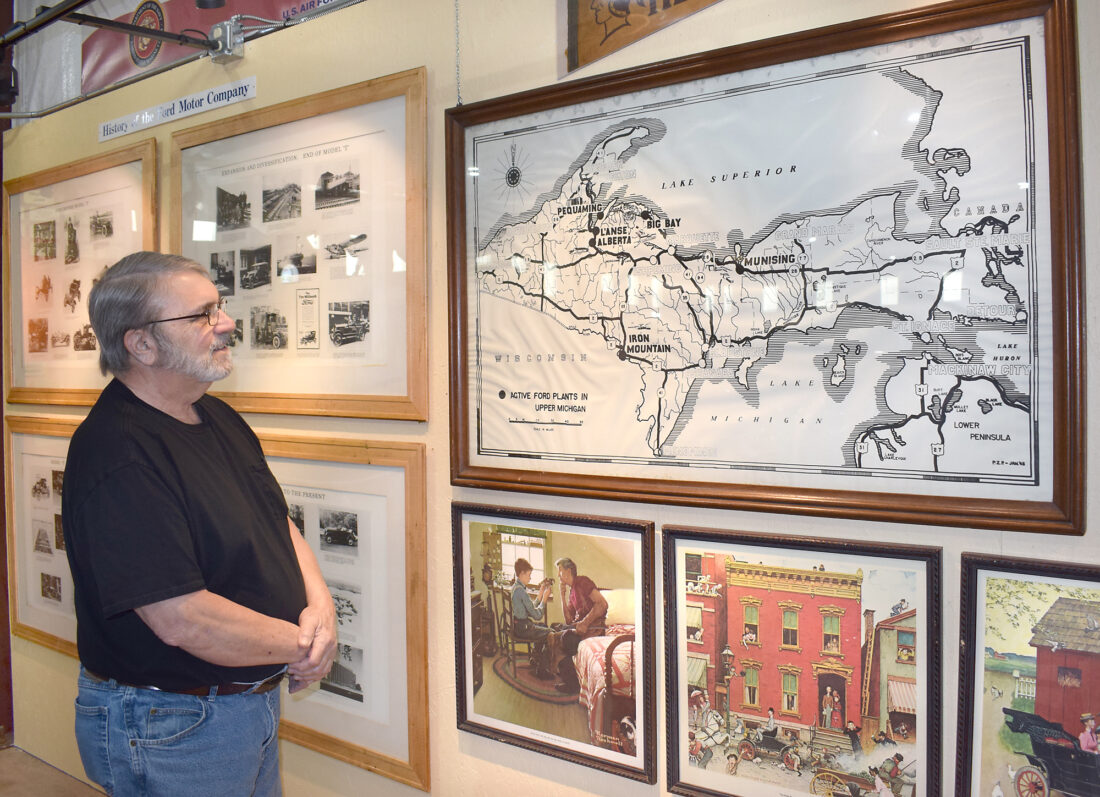
Guy Forstrom of Quinnesec points out an original 1945 Ford Plant map that shows all of the company's active operations in the Upper Peninsula. The map hung at the Kingsford plant. (Terri Castelaz/Daily News photo)
“It’s a little bit of everything from that era,” he said.
One of the most unique items is a rare, new, old-stock Kingsford Barbeque gourmet gift set marked Iron Mountain, containing charcoal briquettes, hickory and applewood chips for smoking, lighter fluid, and a grill base.
“I was really tickled to get that barbecue set — it’s really cool that it’s still all complete,” Forstrom said.
Another intriguing artifact is a railroad boxcar charcoal heater. “Back in the day, they’d put that in a boxcar shipping perishable vegetables from warmer climates to northern markets,” he explained. “They’d add 20 pounds of charcoal, light it, and it would keep the contents from freezing.”
Original Ford charcoal bags are harder to find. “I’ve got one original bag, and a new-old-stock bag, which are extremely rare,” he added.
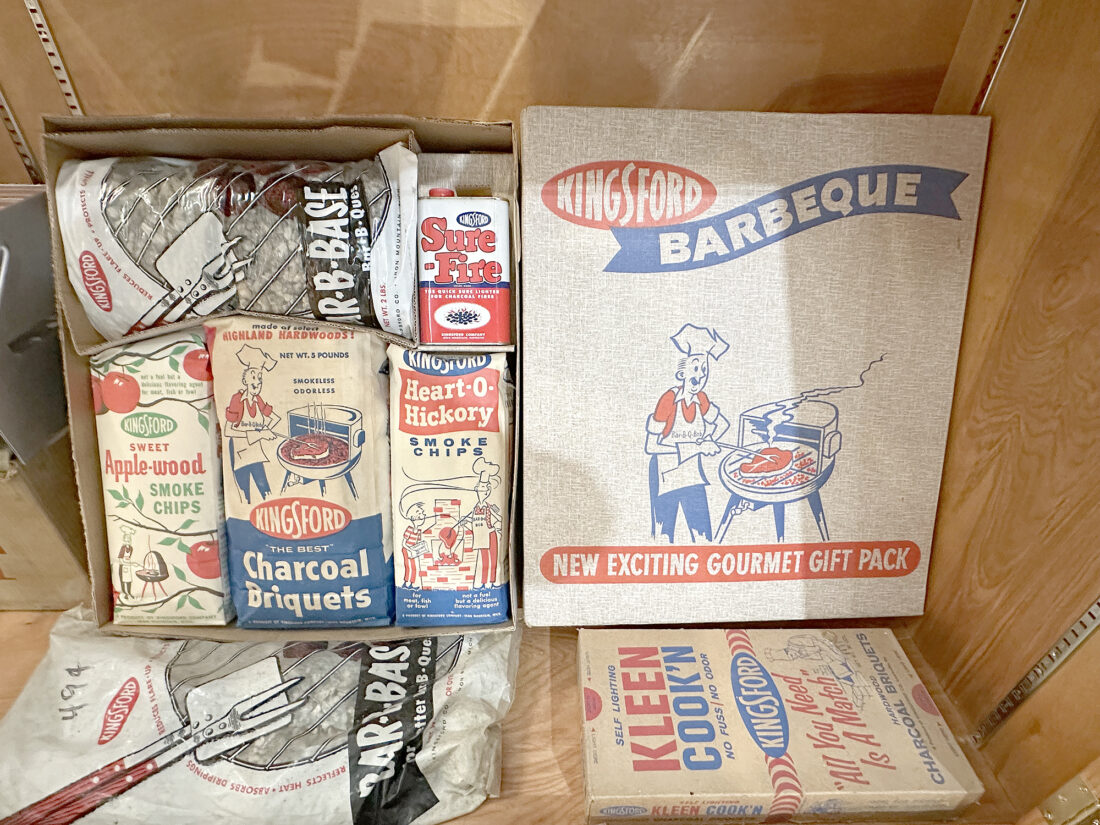
A rare, new, old-stock Kingsford Barbeque gourmet gift set marked Iron Mountain, containing charcoal briquets, hickory and applewood chips for smoking, lighter fluid, and a grill base that is part of a new exhibit at the Menominee Range Historical Museum in Iron Mountain. (Terri Castelaz/Daily News photo)
Advertising also plays a key role in the display. An original 1939 brochure illustrates the grills available at Ford dealerships. “It was a built-in mechanism for sales,” he said.
Forstrom restored unique storyboards from the 1950s and 1960s that hung in Ford dealerships. “I built frames for them using hardwood flooring stamped ‘Ford Motor Company’ on the back,” he said.
He also acquired an original 1945 map of all Upper Peninsula Ford plants from the wife of a local collector, the late Dick Brown. “That’s a rare piece,” he said. “A few of the photographs also came from his collection.”
Among his favorite pieces are grills sold with boxes of briquets for just $1–a reflection of Henry Ford’s philosophy of affordability and accessibility.
“Ford invented the 40-hour week and offered families time for weekend picnics,” Forstrom said.
Early picnic kits didn’t include lighter fluid, so shredded wood was used to start the charcoal. When Kingford came, they developed charcoal starters.
Forstrom acquired an original bottle of starter, along with a tube of Sure-Fire, which is on display along with several of the larger cans that Kingsford eventually produced.
He pointed out a new, filled Ford bag of charcoal briquets now runs about $500 a bag on eBay.
Advertising materials — including signs and brochures from different years — are also among his top interests. One embossed tin Ford sign in his collection cost $2,000 because of its rarity. “There are only four or five known in the country,” Forstrom said.
Two Ford tin signs on display are reproductions made by Baker Sign Co.
A homemade display in the exhibit highlights Ford’s chemical operations. “People don’t realize the chemical end was as important as the sawmill,” Forstrom explained.
He also obtained a rare Kingsford mosquito killer called Skeeter Scooter, made with a chemical that was banned years ago.
Some items were discovered locally and in the Upper Peninsula, while much of the collection was acquired over the years on eBay.
“There are pickers who knew I liked Ford or Kingsford stuff that always watch for items for me,” Forstrom said.
There are a few pieces he would like to get his hands on. “I’ve got a friend out east who’s a huge Ford collector who has several tin signs that I never have come across,” he said. “Sometimes the collecting is more about the chase.”
The history dates back to 1924, when Ford began producing briquets charcoal at its Iron Mountain chemical plant. The operations were massive, as Ford purchased 2,000 acres — spanning from Woodward Avenue south to Breitung Avenue and extending to the Menominee River.
At its peak in the 1920s, the plant employed 7,500 people, but during the “Woody and Glider Days,” it dropped to about 3,000, Forstrom said.
“It was a big operation,” he said. “They had distillation and carbonization buildings — each five stories and 300 feet long.”
The plant produced materials for the Woody, Forstrom said. “The end product was a lump of charcoal after all the chemicals were removed from the wood during the distillation process,” he explained. “Ford, not wanting to waste anything, installed briquetting equipment.”
Originally, the charcoal was advertised as a replacement fuel of “100 uses.”
In the 1920s and 1930s most people had wood stoves in their houses. They advertised the charcoal briquets as a fuel that didn’t flare with even heat.
“You could buy a 50-pound bag of it back then,” he added.
Eventually, charcoal grilling caught on. During its peak, the Iron Mountain Ford Motor Company Plant produced 100 tons of lump charcoal, though resale markets were limited.
Because of his love of the U.P., Henry Ford kept the plant running until 1947. When his son, Henry Ford II, took over, he investigated the value of the plant.
The Ford Company closed the local facility in 1951. In its final days, they employed less than 1,000.
In ’51, a group of investors bought it, and they just kept making charcoal briquets from the distillation building, changing the bags, he said — “That’s how Kingsford Charcoal got started.”
Forstrom points out that many of the charcoal bags are marked “Kingsford Chemical Company, Iron Mountain, Michigan.” When they started out, Kingsford Chemical Company marked its label as formerly Ford.
The company operated locally from 1951 to 1961 before moving south.
“The son of one of the owners said the reason they moved was shipping costs — the costs from here to the rest of the country were too high,” he said.
After receiving approval from the MRHF Board, Forstrom built a custom display cabinet to match existing museum displays and spent weeks arranging the artifacts.
“It took me about three weeks to build it,” he said. “Once I got the cabinet built, then I could start putting the stuff in and arranging things.”
Forstrom hopes it will inspire visitors to appreciate the region’s contribution to the charcoal and chemical industries. “We live in the present and don’t always think about the past,” he said. “This is a little bit of everything from that era, preserved for the next generation.”
The museum will open for the season June 9.
———
Terri Castelaz can be reached at 906-774-2772, ext. 85241, or tcastelaz@ironmountaindailynews.com.
Local News

Visit with Heimo and Edna Korth at UP convention
Beginner pickleball classes offered in Florence
FLORENCE, Wis. — Pickleball is a great way to be physically active, using skills similar to those of tennis, ...
Health care-focused simulation workshop at Bay College
ESCANABA — Bay College is co-hosting a mini Simulation User Network event on the Bay College Escanaba campus from ...
Norway-Vulcan introduces first Hall of Distinction class
UP’s jobless rate dips below 6%
IRON MOUNTAIN — The Upper Peninsula’s not seasonally adjusted unemployment rate fell to 5.9% in May, down from ...
Heat wave in forecast ahead of July 4
Highs in the low 80s are predicted this weekend, but the forecast will take a much hotter turn through next week, ...