Remember when?
-
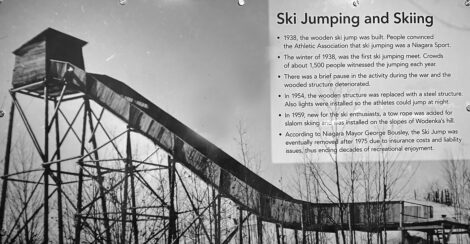
- Niagara’s first wooden ski jump was built on Tyler Road in the summer of 1938. (Photo taken from exhibit at the Niagara Area Historical Museum)
-
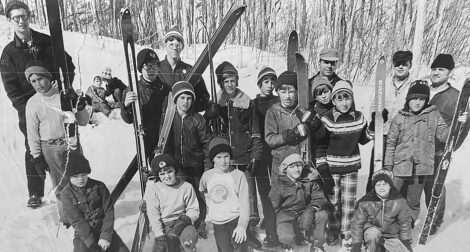
- The Niagara Ski Club 1975 team members — from left, in front are Chris Connis, Mike Goudreau, Tom Brault, Raymond Brault, Roger Maes; middle, Peter Ponzio, Mike McCormick, Danny Recla, Doug DePas, Pat Recla, Tim Sexton, Ken Maes, Rich Steeno and Boyd Morstad; in back, Doug Maes, Julie Brault, Kelly DePas, Ed O’Connell, Eugene Steeno, instructor Mertin Brault and Frank Lake. (Photo provided by the Niagara Area Historical Museum)
-
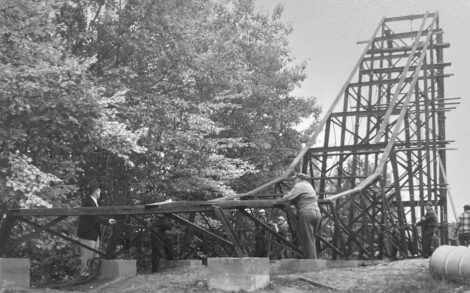
- A group of volunteers constructed a new 45-foot scaffold of steel in 1954. The jump was 10 feet higher than the former wooden slide. (Photo provided by the Niagara Area Historical Museum)
-
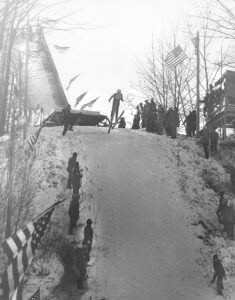
- Guy Gordon is shown jumping in 1976. Sam Chartier served as a judge during that time. “You can almost hear the spectators cheering along the sides,” said Karen Klenke, Niagara Area Historical Society president. (Photo provided by the Niagara Area Historical Museum)
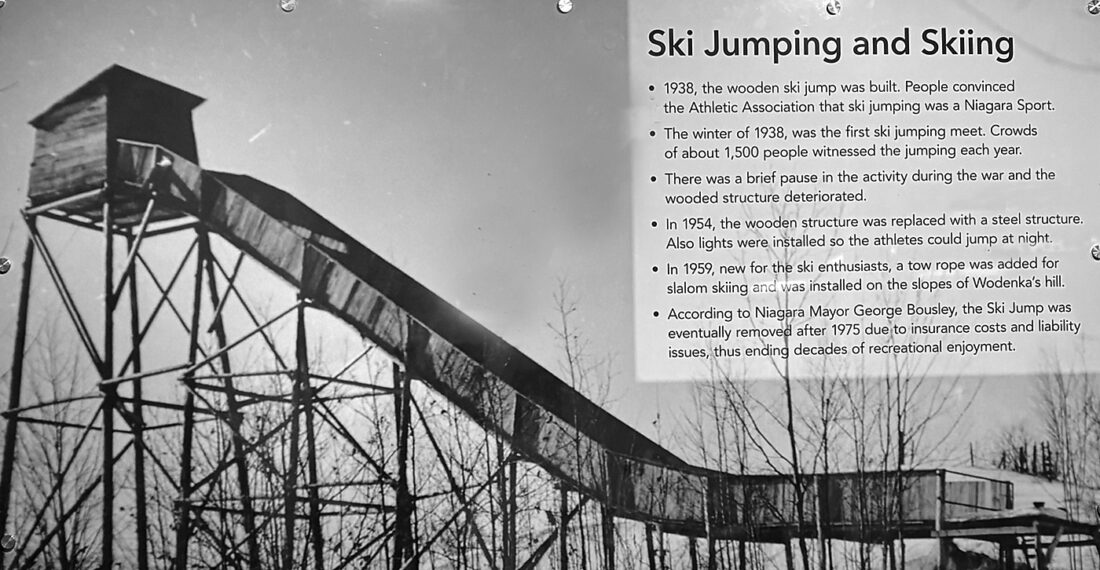
Niagara’s first wooden ski jump was built on Tyler Road in the summer of 1938. (Photo taken from exhibit at the Niagara Area Historical Museum)
This week’s “Remember when?” — provided by the Niagara Area Historical Museum — looks back at the Niagara Ski Jump, a popular winter sports venue with the locals for more than 30 years.
Avid skier Herb Peterson of Niagara, Wis., convinced the Athletic Association ski jumping was a Niagara sport and gained their support, Niagara Area Historical Society President Karen Klenke said.
A group of volunteers built the village’s first wooden ski jump on Tyler Road in the summer of 1938. It was noted that jumps of 90 feet were possible from a scaffold of this size.
“The first competition took place that winter, drawing a crowd of about 1,500,” Klenke said.
Before his passing in 2022, Dennis “Sam” Chartier of Niagara shared his experiences during his ski jumping time with the Niagara Area Historical Society. At the age of 12 he started jumping with skis shaped from wood and strapped to his feet with inner tubes from old cars. He received his first real pair of jumping skis from his brother after he returned home from serving in World War II.
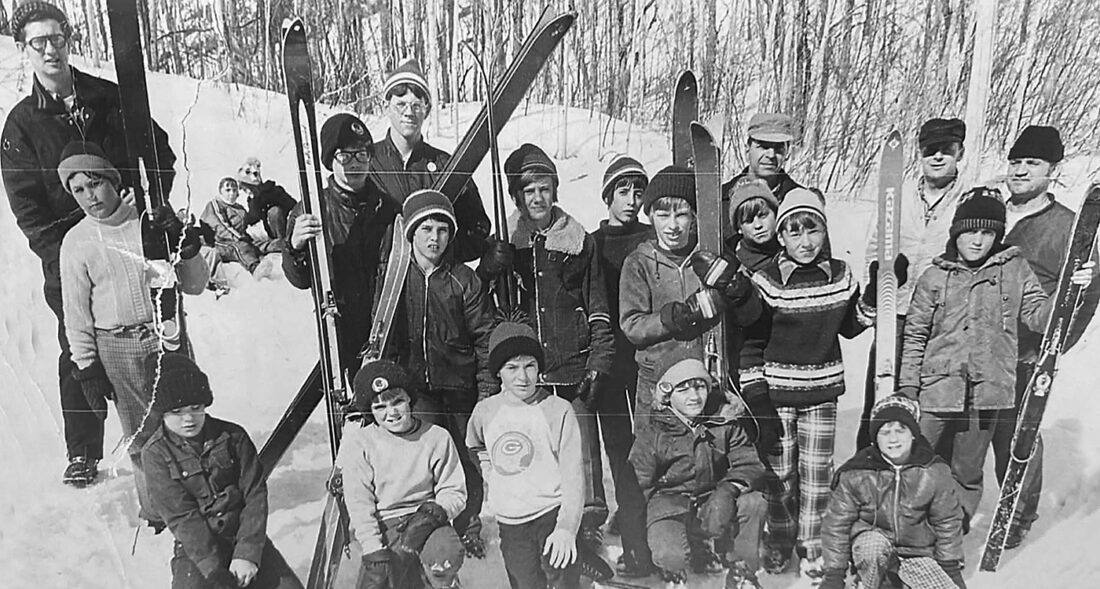
The Niagara Ski Club 1975 team members — from left, in front are Chris Connis, Mike Goudreau, Tom Brault, Raymond Brault, Roger Maes; middle, Peter Ponzio, Mike McCormick, Danny Recla, Doug DePas, Pat Recla, Tim Sexton, Ken Maes, Rich Steeno and Boyd Morstad; in back, Doug Maes, Julie Brault, Kelly DePas, Ed O’Connell, Eugene Steeno, instructor Mertin Brault and Frank Lake. (Photo provided by the Niagara Area Historical Museum)
Chartier said he spent much of his time on the hill with fellow jumpers, including Peterson, Gene Steeno, Mertin Brault, Ronald Brault, Billy Lantagne, Billy Harwath and Dicky Peterson. He also considered himself a decent jumper, taking an occasional second or third place in tournaments.
He recalled the time famous ski jumpers Torger Tokle and Art Devlin practiced on the Niagara ski jump because preparations to the Pine Mountain Ski Jump were being made for the 1942 competition.
Chartier said teachers and students took the day off to watch them. The two experienced jumpers were said to have to pull back or they would surpass the entire landing area.
There was a brief cessation of activities during the war, and the wooden structure started to deteriorate.
Klenke said volunteers replaced the wooden jump with a new steel structure in 1954. The new ski slide was 45 feet, 10 feet higher than the old wooden slide.
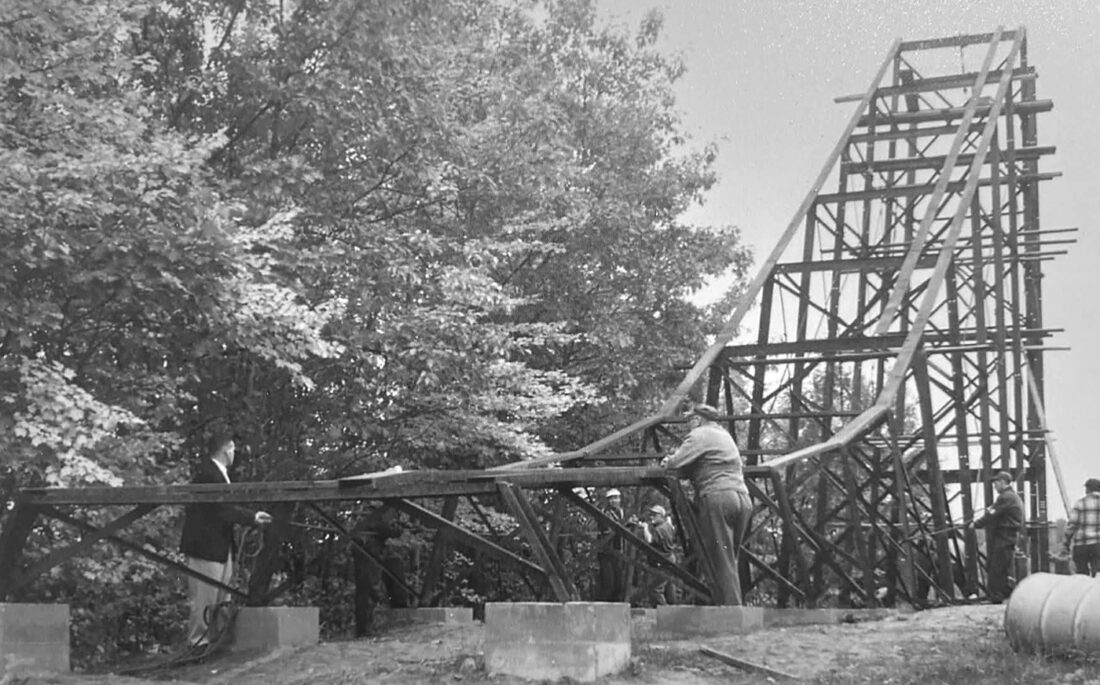
A group of volunteers constructed a new 45-foot scaffold of steel in 1954. The jump was 10 feet higher than the former wooden slide. (Photo provided by the Niagara Area Historical Museum)
The scaffold was constructed from salvaged electrical towers purchased from the Michigan Powers Company, Klenke said.
The towers were transported to the site, disassembled and used to build the slide. As each section was welded together, additional workers came to help raise each section into place.
The total cost for the ski jump was $2,200.
“They also installed lights so they could jump at night,” she added.
Steps and a new judges’ stand were also erected on the hill.
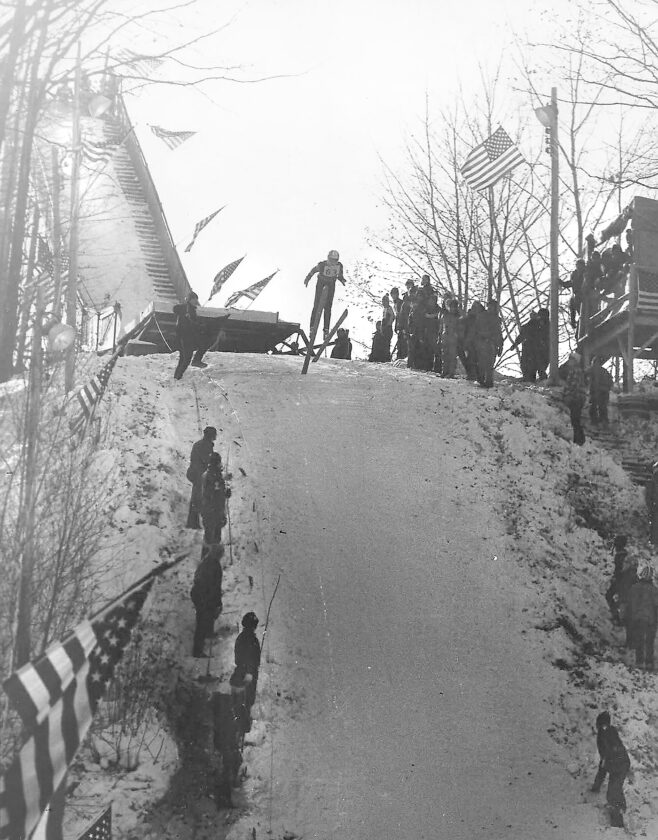
Guy Gordon is shown jumping in 1976. Sam Chartier served as a judge during that time. “You can almost hear the spectators cheering along the sides,” said Karen Klenke, Niagara Area Historical Society president. (Photo provided by the Niagara Area Historical Museum)
That winter, jumpers showed up to try out the new hill. The Junior District Championship Jump took place in February, the first in Niagara since 1950.
The Niagara Ski Club, consisting of 16 members, enjoyed a successful 1955-56 season, competing in six meets.
“The new jump was huge for those kids that were into the ski jump program,” Klenke said. “That was the life in Niagara in the ’50s, ’60s, and ’70s.”
Klenke shared a story former Niagara Ski Club member Roger Maes told during a recent visit about his first time taking flight off the hill.
“Mertin (Brault) yells down from the top to my dad (Doug Maes) at the bottom of the jump, ‘Hey Doug, what do you want me to do with Roger?’ and Doug says, ‘Send him down,'” Maes said. “I did the ‘Wide World of Sports’ wipeout.”
“I went the next day and landed it,” he added, noting he still has his jump skis hanging in his cottage.
“The ski jump tournaments continued to be part of the community into the ’70s,” Klenke said.
Due to insurance costs and liability issues, the ski jump was removed after 1976, according to Niagara Mayor George Bousley.
———
“Remember when?” appears every Wednesday in The Daily News. Those with suggestions or historical photographs they would like to submit can email Terri Castelaz at tcastelaz@ironmountaindailynews.com.
Local News

Sand sculptors bring Bigfoot back to Gladstone Beach
UP sees ‘The Ford Boom’ in the 1920s
An age of innovation in the US
Democratic-led states sue over new Medicaid work requirements
Twenty-five Democratic-led states plus the District of Columbia have sued the Trump administration over its new ...

State appeals court upholds ex-school officer’s sentence for sexual abuse