IM plans rate increase as infrastructure work picks up
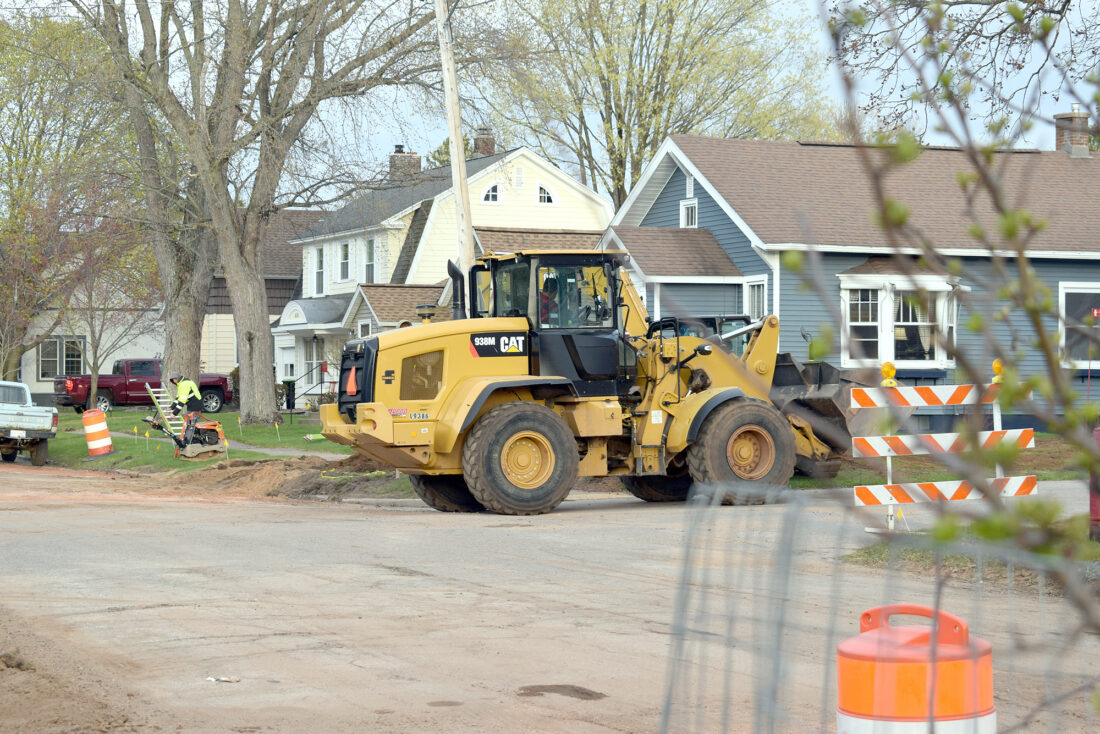
A Bacco Construction crew works on water service line replacements Wednesday on West B Street in Iron Mountain. A total of 426 replacements are part of a sewer and water infrastructure project that began last fall. (Jim Anderson/Daily News photo)
IRON MOUNTAIN — A monthly fixed increase of $8.77 is planned for Iron Mountain water customers, along with a consumption rate increase of $3.99 per 1,000 cubic feet, or 7,480 gallons.
Average at-home water usage in the U.S. is about 2,000 to 3,000 gallons per month per person, according to U.S. Geological Survey. At 6,000 gallons of usage per month, the total utility rate increase for an Iron Mountain household would be about $144 per year.
The city council has scheduled a public hearing for 6 p.m. Monday, May 18, on a proposed 2026-27 fiscal year budget that includes the increased charges. The new fiscal year begins July 1.
The proposed millage rate in the budget remains unchanged.
The increase in the fixed utility rate is needed to cover loan payments to the U.S. Department of Agriculture for replacement of sanitary and storm sewers as part of an ongoing project, City Manager Jordan Stanchina said.
Of the $3.99 consumption rate increase, 98 cents is due to a proposed rise in costs from the Iron Mountain-Kingsford Wastewater Treatment Plant, he added.
The budget also includes $1.35 million for local road paving. This will be in addition to 2.5 miles of paving that will occur as part of water and sewer projects, mainly on West A, West Hughitt and East C streets, Stanchina said.
“Some of it will be to extend off the projects in areas where it makes sense,” he told the council Monday.
The current year’s budget for street and alley paving totaled $914,000, which provided for more than 1.5 miles of work.
A utility project begun by Bacco Construction Co. last fall includes replacement of 11,900 feet of gravity sanitary sewer and 13,900 feet of water main, along with 426 water service replacements.
The water portion is funded by a 40-year Michigan Drinking Water State Revolving Fund loan of $10.64 million at 2% interest, plus a $2.666 million grant. The city expects to fund the sewer portion through a $7.63 million loan from USDA Rural Development.
Bacco was awarded a $15.4 million construction contract last year, but only the water portion could be funded through the DWSRF program. With streets being torn up for water main replacements, the council elected to pursue USDA funding so that the sewer work could be done at the same time.
A USDA budget analysis for the sewer improvements calls for an increase in the city’s fixed rate charge of at least $7 per month to cover the federal borrowing. Meanwhile, an overall analysis conducted by the Michigan Rural Water Association suggests a fixed rate increase of $8.77 per month, which is the amount the city has included in its budget.
In seeking a rate study last fall, Stanchina said it was “essential to ensure the financial health of our utility funds.”
With the federal Bipartisan Infrastructure Law of 2021 providing a boost in available funding, the city has tried to make use of DWSRF grants and loans administered by the Michigan Department of Environment, Great Lakes and Energy. Facing the need to replace all water service lines containing lead, the city hopes to have nearly all such lines replaced by 2028 — 13 years ahead of a state mandate set in 2018 following the Flint water crisis.
In most cases, the service lines replaced are galvanized pipes connected to water mains through a “gooseneck” that contains lead.
Along with the Bacco project, Ultra Construction Services of Marquette is proceeding with a service line replacement project funded by a $2.24 million grant and a $2.33 million loan at 2% interest through the DWSRF. That work, which began in the fall of 2024, should wrap up this year and replace about 375 service lines in all.
Another DWSRF project to replace about 400 service lines is expected to be bid this year and continue through 2028. For that work, the city has been awarded a $2.5 million loan at 2% interest, plus $1.72 million in principal forgiveness and a lead and infrastructure grant of $780,000.
Stanchina reported Monday the city has about $450,000 in its sewer fund to cover costs incurred in the Bacco project before the USDA loan is secured.
———
Jim Anderson can be reached at 906-774-2772, ext. 85226, or janderson@ironmountaindailynews.com.
Local News
IM’s downtown Summer Roll Out ‘great for all ages’
Breitung board pleased with superintendent pick
DIDHD offers free vision, hearing screenings for kids
KINGSFORD — The Dickinson-Iron District Health Department will provide free hearing and vision screenings for ...
Enbridge says 500 at work on Line 5 reroute in Wisconsin

IM looks to fill two police vacancies